


- Introduction
- Quick Answer
- 1. Decide Why You Are Starting a Founder-Led Podcast
- 2. Define a Precise Audience and Message for the Bay Area Context
- 3. Design a Show Concept That Aligns With Your Strategy
- 4. Align Branding and Positioning With Your Startup Narrative
- 5. Set Up a Lightweight but Reliable Production Workflow
- 6. Launch With a Pilot Season, Not an Infinite Commitment
- 7. Build a Distribution and Repurposing Engine
- 8. Use the Podcast Actively for Fundraising, Sales, and Recruiting
- 9. Choose What to Keep In House and When to Partner
- 10. Measure What Matters and Iterate Intentionally
- Common Mistakes Bay Area Startups Make With Founder-Led Podcasts
- Key Takeaways for Bay Area Founders
Introduction
A founder-led podcast can be one of the most efficient ways for a Bay Area startup to show how you think, how you operate, and why you are worth betting on. When it is designed correctly, your show becomes a permanent, compounding asset that warms up investors, educates customers, and attracts the kind of people who want to work with you. When it is done reactively or without a clear strategy, it becomes an expensive hobby that eats time and budget without moving any core metric. This guide walks through how to design, launch, and grow a founder-led podcast in a way that supports fundraising, pipeline, and hiring, instead of just producing “content.”
Quick Answer
A Bay Area founder-led podcast should be treated as a strategic communication channel, not a side project. Start by defining one primary outcome, such as warming up investor relationships, educating a very specific customer segment, or building an employer brand that attracts top operators. Design the show concept, format, and guest strategy directly around that outcome. Launch with a tight, testable pilot season of 6 to 10 episodes, set up a simple but reliable production workflow, and build a distribution engine that repurposes each episode into LinkedIn posts, short video clips, website content, and email touches. Use the podcast to have the conversations you want to be known for in the Bay Area ecosystem, then measure its impact on introductions, meetings, pipeline velocity, and candidate quality. Over time, refine the show based on what drives real outcomes, not vanity download numbers.
1. Decide Why You Are Starting a Founder-Led Podcast
Before you think about microphones or cover art, you need a clear strategic “why.”
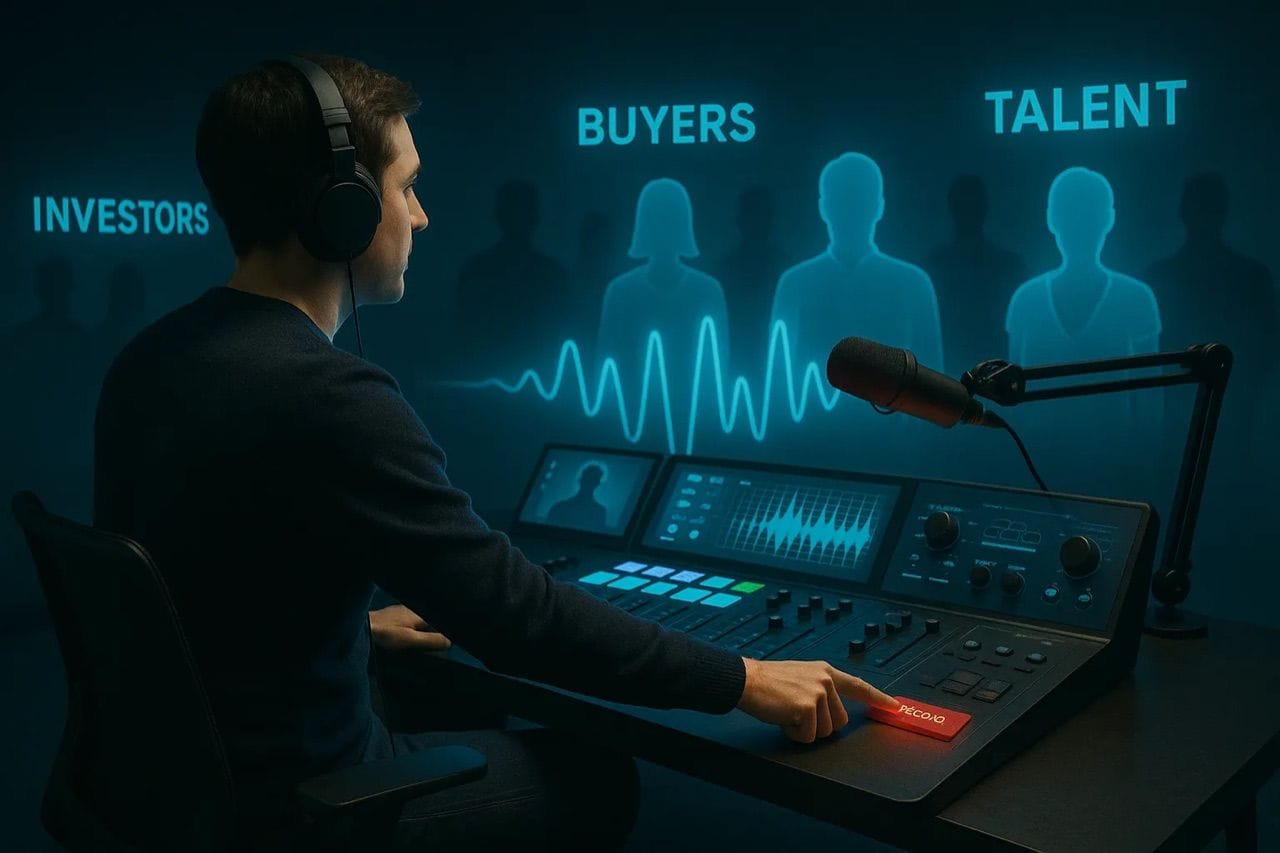
For Bay Area startups, a founder-led podcast usually has one dominant purpose:
- Investor attraction and credibility
Give investors a deeper look at how you think about your market, moat, and product.Turn episodes into a warm context before or after investor meetings. - Customer acquisition and education
Answer the nuanced questions your ideal buyers are asking.Show that you understand their world better than generic industry shows. - Employer brand and talent attraction
Let potential hires hear how the founding team thinks.Share how you make decisions, learn from failure, and build culture.
You can benefit in all three areas, but you should prioritize one outcome for the first season. That primary outcome should shape:
- Your title and positioning
- Your guest criteria
- The questions you consistently ask
- How you measure success
Without a clear primary outcome, the show will feel unfocused and will be hard to justify when time pressure increases.
2. Define a Precise Audience and Message for the Bay Area Context
“Tech people” is not a podcast audience. In a competitive market like the Bay Area, you need to be very specific.
Clarify three things.
- Who exactly should feel “this show is for me”
Early stage SaaS founders selling into mid marketDeep tech founders working on climate, robotics, or AI infrastructureProduct leaders at Series B to Series D companiesSenior engineers or operators you want to hire in the next 12 to 24 months - What high stakes decisions they are facing
Raising a first institutional roundRepositioning a product after early customer feedbackMoving from founder led sales to a repeatable GTM modelDeciding whether to join a young startup or a later stage company - What you want to be known for in their mind
Clear thinking about a niche market or technologyPractical operator stories rather than theoryA specific way of building companies or culture
When you know who you are speaking to and what you want to be known for, it becomes much easier to filter topics and guests. It also helps you avoid the generic “startup stories” trap that blends into everything else in San Francisco and Silicon Valley.
3. Design a Show Concept That Aligns With Your Strategy
Once the audience and outcome are clear, you can shape the actual concept of the show.
Choose a Repeatable Show Format
For a founder-led podcast, formats that usually work well include:
- Deep dive founder or operator interviews
One founder host interviewing other founders, investors, or domain experts.Works well for relationship building and warm introductions. - Segmented “working session” episodes
Episodes structured like live strategy sessions, teardown sessions, or audits.Strong for customer education and authority. - Short solo monologues
10 to 20 minute deep dives on problems you solve every week.Efficient, easier to schedule, and great for thought leadership. - Hybrid format
Mix of interviews and solo episodes, but with one consistent spine.For example: weekly interviews plus monthly solo “memo” episodes.
The important point is consistency. Your format should make it easy to produce, not hard.
Lock in a Clear Episode Structure
Decide on a default structure that you can reuse across episodes, such as:
- Quick hook and why this conversation matters
- Context on who the guest is and why they are relevant
- Core problem or decision area
- Specific stories, mistakes, and playbooks
- How this ties back to your broader thesis or category
- Simple summary and suggested next step for the listener
This structure gives you the freedom to improvise while keeping every episode focused on real outcomes for your audience.
4. Align Branding and Positioning With Your Startup Narrative
Your podcast is another surface where investors, customers, and candidates encounter your brand. Treat it as part of your brand system, not a separate side project.
Name and Tagline
Choose a name and tagline that:
- Is clear in your niche, not just clever.
- Indicates who the show is for and what they will get.
- Connects to your broader positioning, without feeling like a product brochure.
For example, if you are building a platform for B2B AI founders, your show could sit clearly in that world by focusing on real-world AI deployment in enterprise settings, not generic startup advice.
Visual Identity and Audio Cues
- Use your existing brand colors and typography as a base.
- Create a simple, legible cover that works at small sizes in podcast apps.
- Consider a short, consistent intro and outro that reflect your brand tone, such as calm and analytical, or energetic and fast moving.
Many Bay Area teams work with specialized agencies or partners to align podcast visuals and brand identity so that the show feels like part of the same company rather than a separate side project. Content partners like Ankord Media are often brought in specifically to keep this alignment tight while freeing the founder to focus on thinking and hosting.
5. Set Up a Lightweight but Reliable Production Workflow
A founder-led show lives or dies on the founder’s ability to keep showing up. The production workflow must be realistic for your calendar.
Minimum Viable Production Stack
At a basic level, you need:
- Decent microphone and headphones, either in office or at home.
- Simple recording setup, such as Riverside, SquadCast, Zoom with local recording, or another remote recording platform.
- A shared project space or board for episodes in progress.
- A defined handoff process from recording to editing to publishing.
Define Clear Roles
Even early on, outline who owns each step.
- Founder host
Prepares topic and key questions.Hosts and drives the conversation. - Producer or operations owner
Manages the pipeline of guests or topics.Schedules, follows up, and tracks production status. - Editor or audio video specialist
Cleans up audio, applies basic sound treatment.Cuts clips for social or site usage. - Content repurposing owner
Pulls quotes and insights into posts, emails, and web content.
You do not need a large team. Many Bay Area startups start with one content lead plus a part time editor and build from there. The key is that each step is owned, documented, and repeatable.
6. Launch With a Pilot Season, Not an Infinite Commitment
Instead of promising a weekly show forever, launch a pilot season. This gives you a natural point to evaluate what is working.
Design a Pilot Season
- Commit to 6 to 10 episodes.
- Keep the format, length, and structure consistent.
- Choose guests and topics that directly tie to your primary outcome.
For example:
- If your goal is investor attraction, invite investors, experienced founders, and domain experts you want relationships with.
- If your goal is customer acquisition, focus episodes around real customer challenges and use guests who represent your ideal customer profile or adjacent roles.
Launch Plan for the Pilot
When you release the first season:
- Launch with 2 to 3 episodes on day one to give new listeners depth.
- Release the remaining episodes on a predictable schedule such as weekly.
- Share episodes through:
Founder LinkedIn, X, and any other personal channels.Company email list and product updates.Warm intros and one to one outreach for high value relationships.
Treat the first season as a structured experiment, not the final form of the show.
7. Build a Distribution and Repurposing Engine
In a Bay Area context, the biggest leverage from a founder-led podcast usually comes from the content that spins out of each episode, not just from the RSS feed itself.
For every episode, plan how you will:
Turn the Episode Into Multiple Assets
From a single recording, you can create:
- Short clips for LinkedIn, X, and other platforms.
- Quote cards or text posts built from the strongest insights.
- A written summary or article on your website.
- Internal enablement assets, such as a clip for sales or recruiting.
Make the Founder Easy to Discover
- Post consistently from the founder’s personal profiles, not just from company accounts.
- Add episodes to relevant landing pages, case study pages, or hiring pages.
- Use episodes as context for outbound, for example sharing a conversation that mirrors a prospect’s situation.
Integrate With SEO and Content Strategy
Over time, you can align episodes with the topics you are already targeting in your broader content and Answer Engine Optimization efforts. For example:
- Record episodes that answer questions your prospects search for.
- Use transcripts to support in depth articles and resource hubs.
- Link between podcast content and written guides to create a more complete experience.
This makes the podcast part of a connected system rather than an isolated format.
8. Use the Podcast Actively for Fundraising, Sales, and Recruiting
A founder-led podcast is not only a way to “build an audience.” It is also a structured excuse to build the relationships you need.
For Investors
- Invite investors you respect to have a real conversation, not a pitch.
- Share episodes selectively with investors when they are considering your space.
- Use episodes to show your thinking on your market, product, and category narrative.
For Customers
- Invite power users, design partners, and ideal customers onto the show.
- Use conversations to surface language, objections, and success stories.
- Turn those stories into content that helps other buyers move forward.
For Talent
- Record episodes about how you make decisions, how you ship, and how you handle complexity.
- Feature key team members to show the quality of people behind the product.
- Share specific episodes with candidates who are considering offers.
In all of these cases, the show is a relationship builder and a proof of how you think. That is especially powerful in the Bay Area ecosystem, where many founders and investors are evaluating hundreds of signals at once.
9. Choose What to Keep In House and When to Partner
Many founders start fully in house, then reach a point where the time cost becomes too high. Others prefer to partner from day one.
Keep In House When
- The founder enjoys the creative and editorial process.
- You have someone on the team who can own operations and scheduling.
- You want to experiment heavily before standardizing.
Consider Partnering When
- The founder calendar is the main constraint.
- You want a clear, repeatable process quickly.
- You want guidance on concept, positioning, and distribution, not just editing.
A partner’s role can range from basic editing to full strategy, production, and repurposing. The important part is clarity on who owns what and how the show ties back to investor, customer, and talent outcomes.
10. Measure What Matters and Iterate Intentionally
Download numbers and chart rankings are rarely the most important metrics for a founder-led podcast in a B2B or niche context.
Instead, track signals that reflect real business impact.
Relationship and Pipeline Signals
- Intros that come directly from guests or listeners.
- Meetings booked after someone mentions hearing the show.
- Investors who reference episodes in conversation.
- Candidates who mention specific episodes during interviews.
Engagement and Distribution Signals
- Completion rates for episodes.
- Engagement on clips and posts derived from episodes.
- Growth of your email list or community alongside the show.
Operational Signals
- Time from recording to publishing.
- Internal adoption of episodes, for example by sales or recruiting.
Every season, review these signals and adjust:
- Format and length.
- Topic selection.
- Guest profile.
- Distribution and repurposing workflow.
Aim to make each new season more focused, not just more frequent.
Common Mistakes Bay Area Startups Make With Founder-Led Podcasts
A few patterns show up repeatedly.
- Treating the podcast as a vanity project instead of a strategic channel.
This usually leads to unstructured conversations that are difficult to repurpose. - Overcomplicating production early.
Buying expensive studio gear and complex workflows before you have a repeatable format. - Being too broad in topic and audience.
Trying to speak to everyone in “tech” instead of a specific group of investors, customers, or operators. - Publishing without distribution.
Releasing episodes without a consistent plan to share and repurpose them across the channels that matter. - Stopping too early.
Ending the show after a few episodes, before you have enough data to learn what resonates.
Avoiding these mistakes is often less about budget and more about discipline, clarity, and realistic scope.
Key Takeaways for Bay Area Founders
A founder-led podcast should have one primary outcome, whether that is investor attraction, customer education, or talent acquisition, and the show concept, guests, and format should be designed around that outcome and a precise audience. A pilot season of 6 to 10 episodes is a practical way to test without overcommitting, and most of the leverage comes from how you distribute and repurpose each episode, not just from downloads in podcast apps, so measure relationship and pipeline impact instead of vanity metrics. When you approach the show with the same clarity you apply to product and fundraising, it becomes a durable asset that helps investors, customers, and top talent understand how you think before they ever talk to you live.