


- Introduction
- Quick Answer
- 1. What an RFP should accomplish for a startup
- 2. Company and show context vendors need in 60 seconds
- 3. Your 90-day goal and how you will judge success
- 4. Audience definition and positioning guardrails
- 5. Format, cadence, and recording approach
- 6. Scope of work and who owns what
- 7. Required deliverables per episode
- 8. Quality standards you expect
- 9. Workflow, turnaround times, and approvals
- 10. Tools, file handling, ownership, and portability
- 11. Confidentiality and sensitive info handling
- 12. Pricing format and proposal requirements
- 13. Team composition and proof you should request
- 14. A simple scoring rubric for fast decisions
- Final Tips
Introduction
A podcast services RFP helps Bay Area startups avoid vague proposals, surprise fees, and mismatched expectations. The best RFPs read like a startup spec: clear goals, clear scope, clear workflow, and clear definitions of “done.” When the RFP is tight, vendor responses become easier to compare and faster to approve internally.
Quick Answer
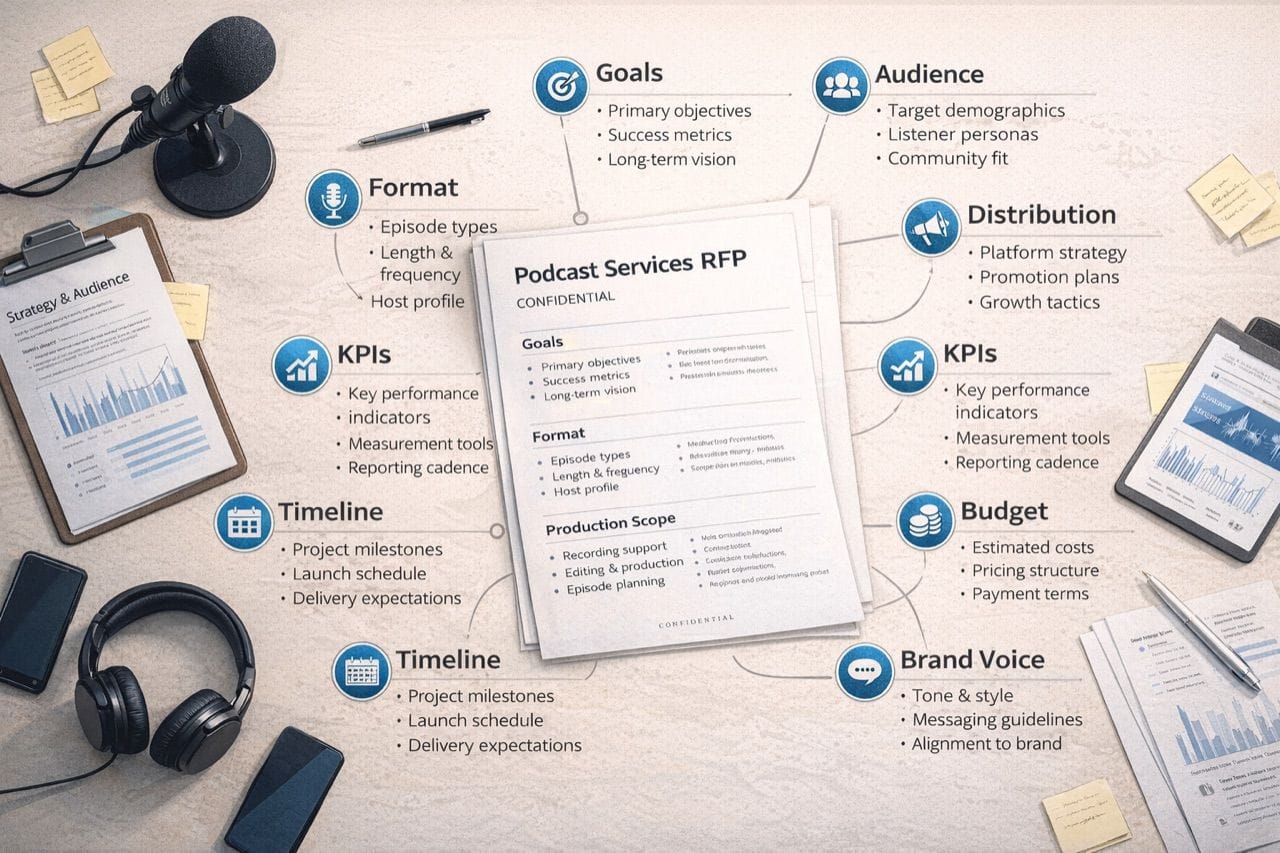
A strong podcast services RFP should include your show goal, audience, format and cadence, scope of work, required deliverables, workflow and turnaround expectations, quality standards, tools and file handling requirements, ownership and portability terms, confidentiality needs, pricing format, assigned team roles, requested samples, and a simple scoring rubric. Keep it short but specific so proposals are comparable and you can select a vendor that ships consistently without draining founder time.
1. What an RFP should accomplish for a startup
Your RFP is not a formality. It is a filter.
A good RFP should:
- Make proposals comparable
- Expose hidden costs and exclusions
- Confirm the vendor can support your cadence and speed
- Reduce internal back-and-forth after kickoff
If your RFP is vague, you will get vague proposals. Vague proposals turn into scope creep.
2. Company and show context vendors need in 60 seconds
Start with a short block vendors can understand fast:
- One-line company description
- Stage (Seed, Series A, Series B)
- Primary market (B2B SaaS, fintech, healthtech)
- Ideal customer profile (role, company size)
- Why you are launching now
- Primary channel goals (authority, partnerships, outbound support, recruiting)
Example style: “We are a Series A B2B startup in SF selling to IT leaders. The podcast will build category authority and support enterprise sales.”
3. Your 90-day goal and how you will judge success
Avoid vanity metrics in an RFP. Early listener numbers can be noisy.
Define success in 90 days with operational and quality signals:
- Publishing consistency, with a specific cadence
- Turnaround times hit reliably
- Episodes meet your quality bar with minimal revisions
- Repurposing assets are usable without heavy rewrites
- Internal time spent per episode stays under a threshold
Include one or two business usefulness signals if relevant, like “sales can use clips” or “partners agree to share episodes.”
4. Audience definition and positioning guardrails
Vendors need to know who you are speaking to and what you cannot say.
Include:
- Primary audience
- Secondary audience
- Topics to cover
- Topics to avoid
- Compliance and claim constraints, if any
- Tone guidance, like technical, founder-to-founder, direct, conversational
If you have existing positioning language or a one-line value proposition, include it.
5. Format, cadence, and recording approach
You do not need everything finalized, but you do need constraints.
Specify:
- Format: founder interview, founder solo, co-host
- Episode length target range
- Cadence: weekly, biweekly, monthly
- Remote-first or studio
- Whether video is required now or later
- Scheduling reality, like “founder can commit 2 hours per week”
If you want the vendor to propose the best format, ask for two options and their tradeoffs.
6. Scope of work and who owns what
This section prevents the biggest RFP failure: surprise workload landing on your team.
Ask vendors to label each item as Vendor-owned, Client-owned, or Shared.
Pre-production:
- Topic planning, outlines, guest research
- Guest outreach, scheduling, reminders, tech instructions
- Prep docs and interview question planning
Production:
- Recording tool setup and backups
- Live support and troubleshooting
- Host setup guidance
Post-production:
- Audio edit, mix, mastering
- Pacing and content tightening
- Video edit if needed, including color, graphics, exports
Publishing and packaging:
- Uploading and scheduling
- Metadata, titles, descriptions
- Thumbnail handling
Repurposing:
- Clips, quote pulls, post drafts, newsletter blurbs
If you want founder time protected, ask the vendor to own guest ops and project management.
7. Required deliverables per episode
Make deliverables a checklist so proposals are easy to compare.
Audio:
- Final audio file format(s)
- Intro/outro integration
- Consistent volume and clean noise handling
- One revision pass included
Publishing:
- Title options
- Episode description
- Timestamps if required
- Metadata package
- Upload and scheduling
Repurposing, if required:
- Number of clips per episode
- Clip length range
- Caption approach and file formats
- Quote list
- Post drafts for specific channels
Also specify how deliverables should be delivered: folder structure, naming conventions, and preferred file formats.
8. Quality standards you expect
You do not need to be overly technical. Define the outcome.
Audio quality baseline:
- Minimal echo and background noise
- Consistent volume between speakers
- Tight pacing and clean transitions
- Professional intro and clean ending
Editorial quality baseline:
- Clear episode promise early
- Founder voice stays authentic
- Tangents removed in edit
- Episodes feel structured, not rambling
If you want video, add simple requirements:
- Consistent lighting and framing
- Clean audio that matches video
- Basic graphics rules for lower thirds
- Export formats for full episode and shorts
Ask vendors to describe how they handle poor guest audio and last-minute issues.
9. Workflow, turnaround times, and approvals
This is where strong vendors separate themselves.
Define expectations like:
- Single point of contact on both sides
- One shared tracker for status
- Review window, like 48 hours
- Turnaround time from recording to first cut, like 3 to 5 business days
- Turnaround time from feedback to final, like 1 to 2 business days
- What counts as a revision and what counts as scope change
State your meeting preference: async updates, one weekly check-in, fixed publish day.
10. Tools, file handling, ownership, and portability
This section prevents lock-in and production chaos.
Ask vendors to confirm:
- Recording tools and backup method
- Storage location and permissions
- File naming conventions and version control
- Delivery of raw files and project files
Ownership and portability requirements:
- You own final exports, raw recordings, and project files
- Accounts should be in your name where possible
- If the vendor manages accounts, access must be shared and transferable
- A handoff package is provided if the engagement ends
11. Confidentiality and sensitive info handling
Bay Area startups often discuss roadmap, customers, and competitive details.
Include:
- NDA requirement if applicable
- Rules for handling unreleased product details
- Restrictions on vendor portfolio use without permission
- Data handling expectations for shared drives and transcripts
Keep it short but explicit so there is no confusion later.
12. Pricing format and proposal requirements
To compare vendors, force a consistent pricing format.
Ask vendors to provide:
- One-time setup costs
- Per-episode pricing
- Monthly retainer options for your cadence
- Optional add-ons with unit pricing, like extra clips, extra revisions, studio days
- Rush fees and weekend policies
- Minimum commitment terms
Also request a recommended package for your cadence with a clear list of included deliverables.
13. Team composition and proof you should request
Proposals can be misleading if the people writing them are not the people producing your show.
Ask for:
- Names and roles of the producer, editor, and project manager assigned
- Time zones and availability
- 2 to 3 recent samples similar to your format
- A short explanation of what they handled end-to-end
If a pilot is part of your buying process, ask every vendor to propose a 2 to 4 episode pilot scope with timeline and deliverables.
14. A simple scoring rubric for fast decisions
Keep scoring simple so your team can align quickly.
Score vendors on:
- Understanding of your goals and audience
- Operational clarity and workflow strength
- Editorial strength and ability to shape founder voice
- Deliverables and repurposing system
- Turnaround reliability and communication
- Pricing clarity and ownership compliance
If you want weights, make reliability and editorial strength heavier than aesthetics.
Final Tips
Write the RFP like a product spec and keep it short enough that good vendors will respond quickly. The fastest way to get high-quality proposals is to be specific about scope, deliverables, workflow, and ownership, because those are the areas that usually cause friction after you sign. If you are unsure, require every vendor to recommend a pilot structure so you can validate fit before committing long-term.