


- Introduction
- Quick Answer
- 1. Decide which pages are “key” before you talk deliverables
- 2. Define the goal of each page as a decision, not a paragraph count
- 3. Lock the inputs that prevent generic output
- 4. Include a messaging foundation deliverable, even for “just web copy”
- 5. Define page-level deliverables that make the work implementation-ready
- 6. Scope the interviews so the agency can extract real differentiators
- 7. Define proof expectations so claims are credible
- 8. Set success metrics and what “improvement” means
- 9. Define the workflow, approvals, and revision rounds to avoid churn
- 10. Clarify what is included and excluded to prevent scope creep
- 11. Use a scope template you can copy into an agency SOW
- 12. Recommended timelines for Bay Area startup speed
- Final Tips
Introduction
A website copy project goes sideways when scope is vague and the agency is forced to “fill in the blanks” without real positioning and product input. For Bay Area startups, the goal is not prettier words. It is a homepage and product pages that explain value fast, route buyers to the right next step, and reduce sales friction. This guide shows how to scope the work so you get clarity, speed, and measurable outcomes.
Quick Answer
Bay Area startups should scope a homepage and key product page copywriting project by defining the pages to be rewritten, the decisions the copy must drive, the inputs the agency needs (ICP, differentiation, objections, proof), and the deliverables that make the work usable (message hierarchy, page briefs, drafts, revision rounds, and launch support). The scope should include a clear interview plan with founders and SMEs, success metrics like demo rate or PQL rate, and an agreed workflow for approvals so the agency can ship conversion-ready pages without endless revision churn.
1. Decide which pages are “key” before you talk deliverables
Do not scope “website copy.” Scope the pages that carry intent and drive action.
For most Bay Area B2B SaaS startups, “homepage and key product pages” typically includes:
- Homepage
- One primary product overview page
- One to three feature or capability pages
- Two to four use case pages, if your buyers vary by workflow
- One integrations page, if integrations are a major buying driver
- Pricing page copy refresh, if pricing is a conversion bottleneck
- Trust or security overview page, if data and compliance matter
If budget is limited, prioritize the pages that answer “what is this” and “is this for me” first, then expand into deeper pages.
2. Define the goal of each page as a decision, not a paragraph count
Avoid scope defined by word count. Define scope by the decision the page must enable.
Examples:
- Homepage decision: “Should I keep reading and take the next step?”
- Product page decision: “Is this the right product for my workflow?”
- Use case page decision: “Can this solve my specific problem?”
- Integration page decision: “Will this work with our stack?”
- Trust page decision: “Is this safe enough to roll out?”
When you define decisions, the agency can structure the page properly instead of just rewriting sentences.
3. Lock the inputs that prevent generic output
Agencies produce generic copy when inputs are unclear. Scope the inputs you will provide or co-create.
Minimum inputs to include in scope:
- ICP definition and disqualifiers
- Your category and how you want to be compared
- Top three differentiators tied to product reality
- Top objections and how you want to answer them
- Proof assets: quotes, metrics, customer examples, screenshots, logos, results
- Brand voice guidelines and any banned language
- Primary CTA and secondary CTA by page
If you do not have these, scope a short positioning and messaging alignment phase first.
4. Include a messaging foundation deliverable, even for “just web copy”
Most copy projects fail because the agency writes before the team agrees on the message.
A practical messaging foundation package:
- One sentence positioning statement
- Three message pillars with proof points
- A short “best for” and “not for” definition
- A vocabulary list for key terms and product naming
- A headline and subhead direction for homepage and product pages
This does not need to be a giant deck. A tight one to two page document is enough if it drives decisions.
5. Define page-level deliverables that make the work implementation-ready
Your scope should specify what “done” looks like for each page.
Strong page-level deliverables:
- Page brief per page, goal, audience, decision, CTA, key points
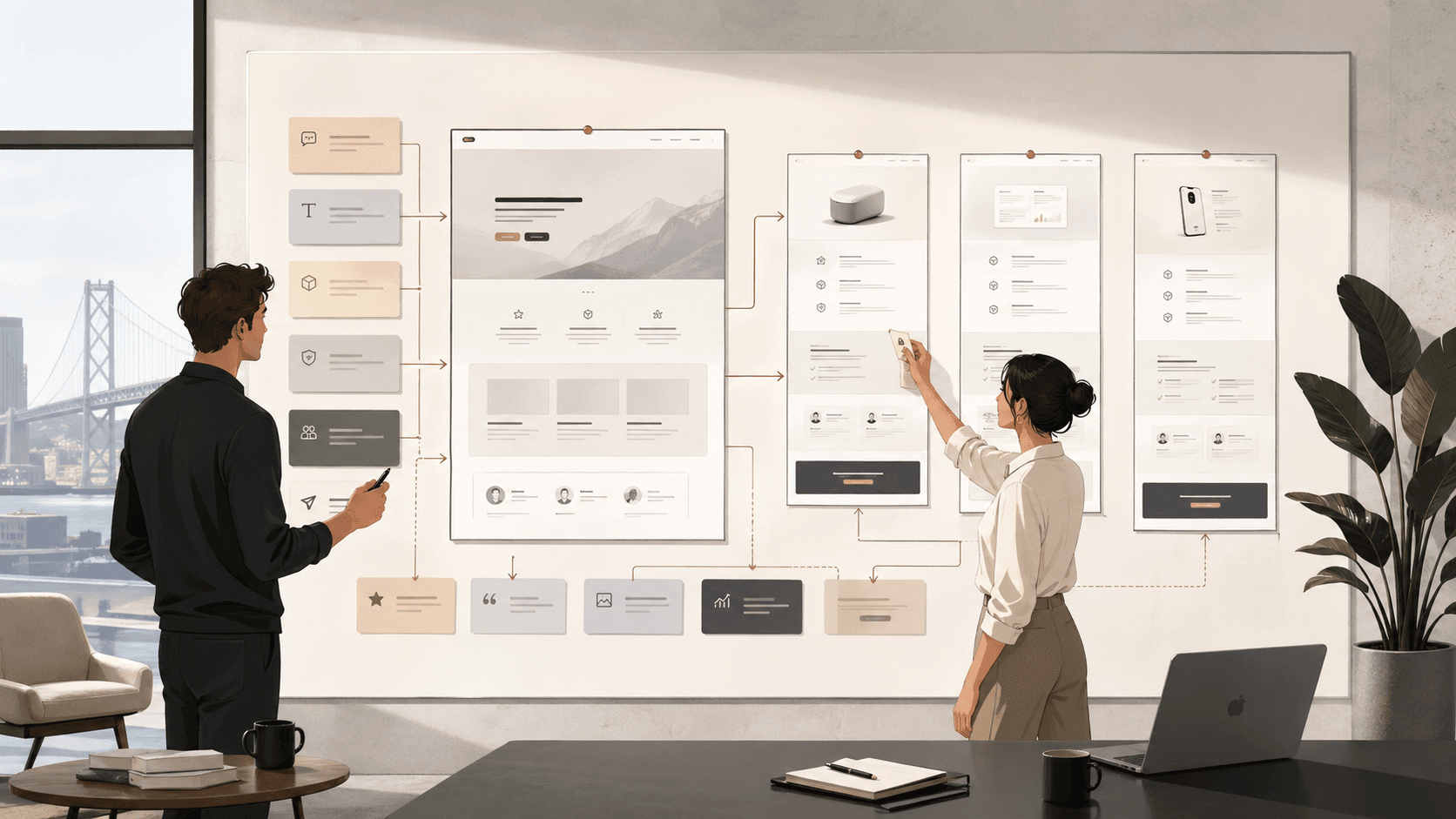
- Wireframe-level outline, section structure and flow, not design, but content architecture
- Draft 1 copy with messaging aligned
- Draft 2 copy after feedback
- Final copy with microcopy and CTAs where needed
- Optional, metadata recommendations and internal linking notes if that is part of your system
If your site is being redesigned, specify whether the agency writes into a wireframe, a doc, or directly in your CMS.
6. Scope the interviews so the agency can extract real differentiators
Web copy needs founder truth and product truth. Scope structured interviews so you do not rely on back-and-forth Slack messages.
A solid interview plan:
- Founder interview, positioning, category, story, differentiation
- Product or engineering SME interview, how it works, constraints, tradeoffs
- Sales interview, objections, deal patterns, language buyers use
- Customer success interview, time-to-value, reasons for churn or expansion
If you can only do two interviews, do founder plus sales. If you can do three, add product.
7. Define proof expectations so claims are credible
Bay Area buyers are skeptical. The scope should require proof collection and placement.
Include:
- A proof inventory request list from the agency
- A plan for proof placement by page section, not just “sprinkle testimonials”
- Case study or customer story integration approach
- Guidance for when to use quantified proof vs qualitative proof
If you have limited proof, scope a lightweight proof-building step like drafting one case study outline from a customer call.
8. Set success metrics and what “improvement” means
Even if you are early-stage, you can define measurable outcomes.
Choose one to three primary metrics:
- Homepage to demo click rate
- Product page to signup or demo conversion
- Activation or PQL creation rate from key flows
- Sales-assisted conversion rate from high-intent pages
- Reduction in sales call time spent on basic explanation
Also define measurement timing:
- Baseline before launch
- First read at two weeks
- Second read at four to six weeks
A scope without success criteria becomes subjective fast.
9. Define the workflow, approvals, and revision rounds to avoid churn
This is the most overlooked part of scoping. It is also the biggest reason timelines slip.
Scope should include:
- One internal owner responsible for consolidation of feedback
- A maximum number of reviewers per round
- Two revision rounds included, with optional paid rounds beyond
- Time boxes for feedback, for example 48 to 72 hours per round
- A decision rule for disagreements, who decides
If multiple stakeholders leave conflicting comments, the agency cannot “solve” that. You need a single decider.
10. Clarify what is included and excluded to prevent scope creep
Write exclusions explicitly.
Common exclusions to state:
- Design and development not included unless specified
- SEO strategy and keyword research not included unless specified
- Case study production not included unless specified
- Brand strategy and naming not included unless specified
- Full site rewrite not included unless specified
- Ongoing blog production not included unless specified
Then add optional add-ons if you want flexibility:
- Additional page templates
- Comparison pages
- Pricing education page
- Security page expansion
- Migration or implementation guides
- Sales enablement one-pagers
11. Use a scope template you can copy into an agency SOW
Here is a practical structure you can use.
Project goal:
- Improve clarity and conversion for homepage and key product pages
Pages in scope:
- List page names and count
Inputs provided:
- ICP, differentiation, objections, proof, voice notes, CTA
Discovery and interviews:
- List interviews and participants
Messaging foundation deliverable:
- Positioning statement, pillars, proof points, vocabulary
Page deliverables per page:
- Brief, outline, drafts, final
Revisions and approvals:
- Two rounds, one owner, time boxes
Success metrics:
- List metrics and measurement timing
Timeline and milestones:
- Discovery complete, draft 1, draft 2, final, launch support
Exclusions and add-ons:
- List clearly
This template keeps the scope tight and reduces risk.
12. Recommended timelines for Bay Area startup speed
A realistic timeline for a tight homepage and key product pages project:
- Week 1: discovery, interviews, messaging foundation
- Week 2: page briefs and outlines, draft 1
- Week 3: feedback, draft 2, proof integration
- Week 4: final copy, handoff, launch support and measurement plan
If you need it faster, reduce pages, not discovery. Cutting discovery creates generic output and more revisions.
Final Tips
A great scope forces clarity upfront, protects speed, and reduces revision churn. Define the pages and the decisions they must drive, lock the inputs that prevent generic copy, require a tight messaging foundation, and set workflow rules with one owner and time boxes. When the scope is clear, agencies can ship homepage and product pages that convert and scale with your Bay Area startup.