


- Introduction
- Quick Answer
- 1. Classify what “sensitive” means before you draft terms
- 2. Use the right contract structure: MSA + SOW, not a vague one-pager
- 3. NDA essentials founders should not skip
- 4. Ownership and rights: lock down IP the founder way
- 5. Confidentiality inside the contract should mirror startup reality
- 6. Data handling and security rules founders should require
- 7. Control attribution, portfolio use, and public association
- 8. Approvals, fact-checking, and sensitive content review
- 9. Scope, revisions, and change control keep confidentiality intact
- 10. Payment terms that align incentives and protect delivery
- 11. Termination and handoff: make sure you keep everything
- 12. Agency vs independent: contract differences founders should expect
- 13. A founder contract checklist you can use before signing
- 14. How we structure sensitive founder projects at Ankord Media
- Final Tips
Introduction
If your book includes sensitive startup content, your ghostwriting contract is not just paperwork, it is risk management. You are sharing strategy, internal decisions, and possibly customer or investor context that should never leak. This guide covers how founders should structure NDAs, contracts, and rights so you can write confidently without exposing the company.
Quick Answer
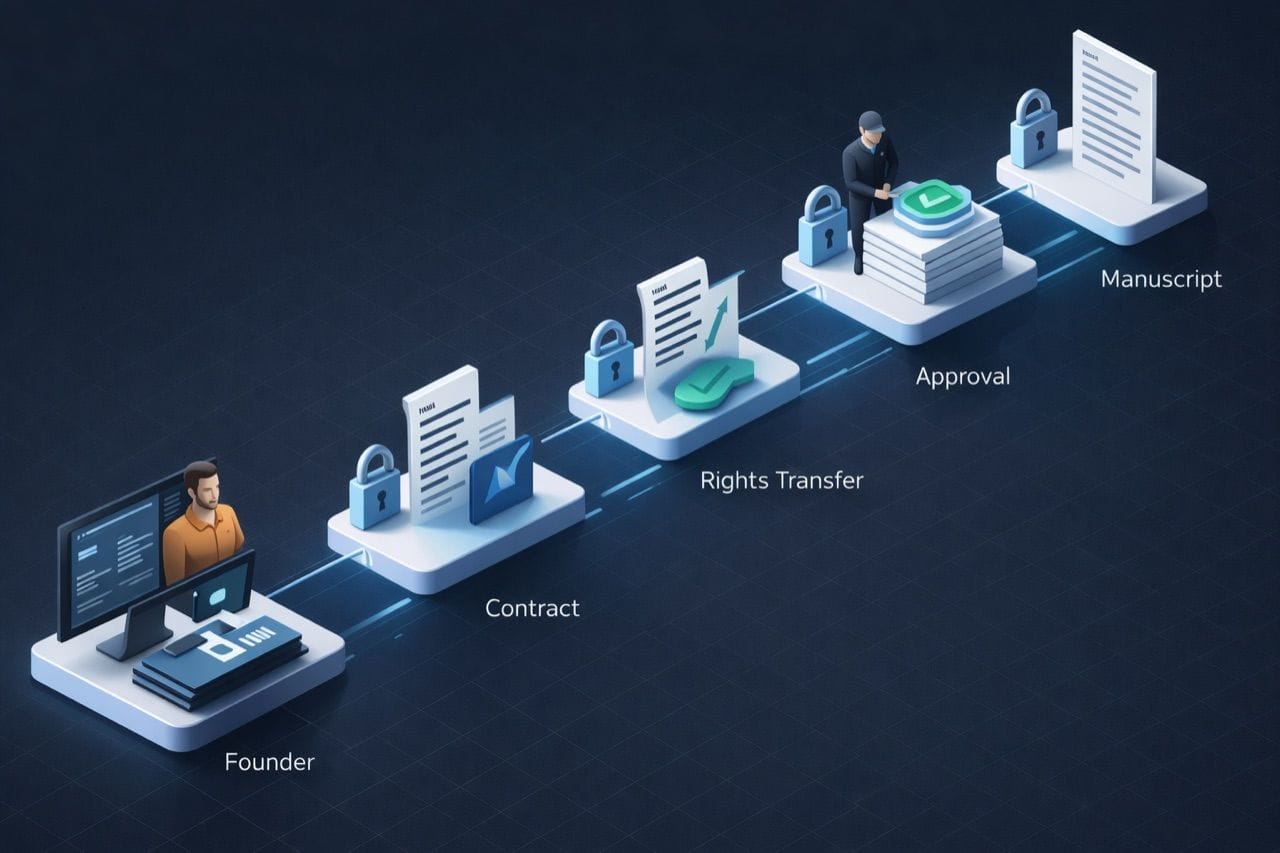
Founders hiring a ghostwriter for sensitive startup content should use a two-layer setup: a strong NDA plus a master services agreement with a detailed statement of work that defines confidentiality, data handling, and approvals. Lock down ownership with work-for-hire language plus an IP assignment backup, restrict reuse of your information, control recordings and storage, and set clear revision, fact-checking, and termination terms so you keep all drafts and materials even if the relationship ends. If any content touches customers, investors, legal strategy, or trade secrets, add stricter security rules, limited access, and deletion requirements after delivery.
1. Classify what “sensitive” means before you draft terms
Start by naming what you are protecting. This will drive the strength of the NDA and the workflow rules.
Common sensitive categories for founders:
- Product roadmap, pricing strategy, go-to-market plans
- Metrics, churn, CAC, LTV, pipeline, revenue or burn details
- Internal debates, board context, investor discussions
- Customer stories, case studies, contracts, or identifiable details
- Security practices, incident details, vulnerabilities
- Partnership negotiations and vendor agreements
- Hiring plans, org issues, performance concerns
Practical move: label content tiers.
- Tier 1: safe to share publicly
- Tier 2: sensitive, share with restrictions
- Tier 3: highly sensitive, do not include, or anonymize heavily
Your contract should reference these tiers and treat Tier 2 and Tier 3 with stricter handling.
2. Use the right contract structure: MSA + SOW, not a vague one-pager
For sensitive startup content, a single generic agreement is usually not enough.
Recommended structure:
- NDA: signed first, covers all discussions and materials immediately
- Master Services Agreement (MSA): the legal framework for confidentiality, IP, data handling, disputes, and liability
- Statement of Work (SOW): the execution blueprint, scope, milestones, timeline, revisions, deliverables, and founder responsibilities
Why this matters:
- NDAs protect early conversations
- MSAs reduce legal ambiguity
- SOWs prevent scope drift and protect your timeline
Founder tip: if you are working with an agency, insist the NDA and MSA cover all subcontractors and editors who touch the project.
3. NDA essentials founders should not skip
A strong NDA for ghostwriting should go beyond “do not disclose.”
Include these NDA components:
- Definition of confidential information: include oral, written, recorded, and inferred information
- Purpose limitation: they can only use your information to produce your book project
- No reverse engineering of strategy: no repurposing your playbooks, frameworks, or process ideas
- Term: confidentiality should survive the project, ideally multiple years or indefinitely for trade secrets
- Permitted disclosures: only to pre-approved team members, bound by the same confidentiality obligations
- Injunctive relief language: so you can act quickly if something leaks
- Return or destruction: clear obligations to delete files and confirm deletion after delivery or termination
If you are sharing anything that could be considered a trade secret, your NDA should explicitly treat trade secrets as a special category with stricter protection.
4. Ownership and rights: lock down IP the founder way
This is where founders get burned. Do not assume you automatically own what you paid for.
Your contract should state clearly:
- You own the manuscript, drafts, outlines, notes, recordings, research summaries, and any derivative materials
- The ghostwriter has no ownership claim, reuse rights, or portfolio rights unless you explicitly grant them
- Rights transfer happens on payment, or in a staged way tied to milestones
Use a belt-and-suspenders approach:
- Work-for-hire language where legally applicable
- IP assignment backup clause that assigns all rights to you even if work-for-hire is challenged
Also include:
- Derivative works: the ghostwriter cannot reuse your frameworks or content in other books, courses, or client work
- Moral rights waiver where relevant, so you can edit without permission fights
- No lien language: so drafts are not “held” if the relationship ends
Founder note: If you want the ghostwriter to retain the right to use generic skills and know-how, that is fine, but it must exclude your confidential methods, language, and unpublished ideas.
5. Confidentiality inside the contract should mirror startup reality
Even if you have an NDA, include confidentiality terms in the MSA as well. It prevents gaps and makes enforcement easier.
Contract confidentiality should cover:
- How confidential information is labeled and handled
- Who can access it, and under what conditions
- That confidentiality applies to drafts, not just raw inputs
- That you control what becomes public and when
If the book is tied to a launch, add an embargo concept:
- No sharing or discussing the project publicly until you give written approval, including social posts and “teasers.”
6. Data handling and security rules founders should require
This is the part most ghostwriting agreements ignore, even though it is where leaks happen.
Specify these operational rules:
- Storage: encrypted storage, not random personal devices without protection
- Access control: minimum necessary access, no sharing beyond approved team
- Transmission: secure sharing methods, not public links
- Recording rules: where recordings are stored, who can access them, and how long they are kept
- Device policy: password-protected devices, basic security hygiene
- Deletion and confirmation: written confirmation of deletion after final delivery or termination
- Incident response: if anything is lost, leaked, or compromised, they must notify you quickly with details
If you are dealing with customer data or regulated industries, tighten further:
- No customer identifiers in drafts
- Anonymization requirements
- No copying proprietary documents into shared tools without permission
7. Control attribution, portfolio use, and public association
Ghostwriters often want to reference work. For sensitive startups, you need to control this tightly.
Decide upfront:
- Ghostwritten with no credit
- Acknowledgment only
- Co-author credit
- “As told to” credit
Include clear rules:
- No portfolio samples without written permission
- No private bragging to prospects or in networking conversations
- No use of your name, company name, or project details for marketing
- No publishing “process stories” about the project
If you are pre-launch, you likely want a strict no-association rule until the book is public, and even then only if you approve.
8. Approvals, fact-checking, and sensitive content review
Founders should protect themselves from accidental misstatements and overclaims.
Put this in writing:
- You have final approval on all drafts and final manuscript
- The ghostwriter must flag claims that need verification
- You control what stories and metrics make it into the book
- Sensitive content needs a separate approval checkpoint before it is finalized
Add a “redline list” concept:
- Topics that must never be included
- Claims that require written confirmation
- People or companies that must be anonymized
If legal review is likely, include a schedule buffer and define how that affects milestones.
9. Scope, revisions, and change control keep confidentiality intact
When scope is vague, founders end up sending more internal context than necessary.
Make scope precise:
- Manuscript length range and chapter count
- Interview count and cadence
- What research is included, and what is not
- Revision rounds included and how feedback is delivered
Define scope creep:
- Additional chapters, new audiences, new angle, heavy new research, or re-architecting late in the process
Why it matters for confidentiality:
- Scope creep often triggers you to share more internal data to “make it work”
- A clear scope keeps the project focused and reduces sensitive exposure
10. Payment terms that align incentives and protect delivery
Sensitive projects fail when incentives are misaligned, either the founder is paying for progress that never ships, or the ghostwriter is doing unpaid extra work and resentment grows.
Founder-friendly payment structures:
- Milestone-based payments tied to deliverables, not dates alone
- Clear definitions of what “delivered” means at each milestone
- A holdback tied to final polish and complete handoff
Also include:
- What happens if the founder is unavailable for interviews
- What happens if the ghostwriter misses milestones
- How rescheduling works and what fees apply, if any
11. Termination and handoff: make sure you keep everything
If the relationship ends, you still need to protect the startup and keep the work.
Termination terms should cover:
- You receive all work in progress, drafts, outlines, notes, and files immediately
- Clear status report of what is done and what remains
- Deletion of confidential materials from their systems after transfer
- Non-disparagement, if appropriate for your risk profile
- No continued use of your ideas or content in any form
Founder tip: include a “handoff within X days” requirement to avoid delays.
12. Agency vs independent: contract differences founders should expect
Both can be safe if structured correctly, but the risk points differ.
With an agency, confirm:
- Who is actually writing and editing
- All contributors are bound by the same NDA and security rules
- Subcontractors are disclosed and approved
- The agency remains liable for confidentiality and delivery
With an independent, confirm:
- Their data handling practices are real, not implied
- Editing coverage is defined, either included or subcontracted
- Their availability and contingency plan are clear
In both cases, insist on the same core protections: IP ownership, confidentiality, access control, and deletion confirmation.
13. A founder contract checklist you can use before signing
Use this as a final pass before you sign anything:
- NDA signed before any sensitive conversation
- Confidential information includes drafts, recordings, and oral disclosures
- Purpose limitation and no reuse of your frameworks
- Work-for-hire plus IP assignment backup
- You own all drafts, notes, recordings, and derivative materials
- Portfolio use and public association prohibited without written permission
- Data handling rules defined, including storage, sharing, and deletion
- Clear milestone schedule, scope, and revision rules
- Fact-checking and sensitive content approval checkpoints
- Termination clause guarantees full handoff and deletion confirmation
14. How we structure sensitive founder projects at Ankord Media
When founders come to us with sensitive material, we treat ghostwriting like confidential strategic work, not just writing. We structure projects around clear milestones, strict handling rules, and a single point of contact so the founder is not coordinating multiple people.
And for founders who want extra assurance, we are comfortable standing behind stronger service terms:
- Unlimited revisions until you are happy with the final manuscript
- No billing until the manuscript is complete and ready to publish
Final Tips
Treat your ghostwriter agreement like a startup risk document: lock down confidentiality, control data handling, and make ownership and approvals unambiguous. Use an NDA plus an MSA and SOW, require work-for-hire with an IP assignment backup, and set clear handoff and deletion rules so your sensitive content never escapes the project. If the contract is specific enough that you can calendar milestones and enforce boundaries, you are in the safe zone.