


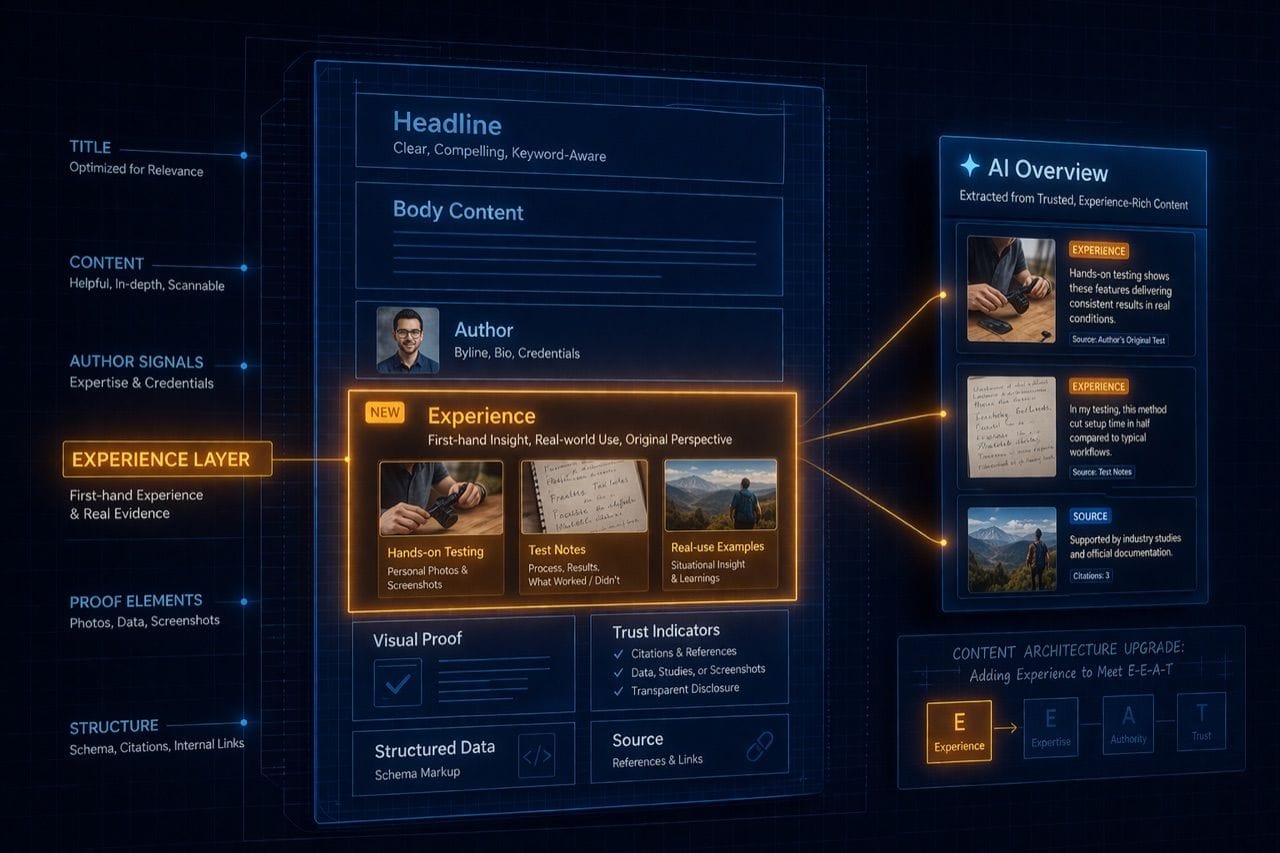
Optimizing content in 2025 and beyond demands a fresh perspective on how search engines and AI-driven overviews evaluate quality. The updated E-E-A-T framework, which adds Experience to Expertise, Authoritativeness, and Trustworthiness, creates new opportunities for brands to differentiate themselves.
By demonstrating direct, first-hand knowledge, content not only ranks better but also performs strongly in AI-generated summaries, voice search, and structured data environments. Understanding how to implement this framework is no longer optional. It is central to driving organic visibility, user trust, and sustainable authority.
Experience emphasizes that content creators must show practical, first-hand insight rather than relying solely on theoretical knowledge or secondary sources. This shift has profound implications for content strategy: brands that integrate authentic insights, real-life examples, and demonstrated hands-on knowledge gain a competitive edge. The new E-E-A-T framework is not just a ranking guideline. It is a blueprint for producing content that resonates with both humans and AI overviews.
Verified Practical Insight
One of the core elements of the 'Experience' component is ensuring that content reflects authentic, practical knowledge. AI overviews increasingly prioritize content that demonstrates action-oriented insight and a clear record of first-hand expertise. This signals to search engines that the content is both informative and applicable in real-world contexts.
In practice, content that demonstrates verified experience tends to perform better across multiple channels, including AI-generated snippets, featured answers, and structured data outputs. It reinforces trust signals because readers and AI alike can detect when information is grounded in real experience rather than generic reporting. Developing content with practical insight requires thoughtful planning and strategic sourcing of first-hand examples.
Key ways to demonstrate practical experience include:
- First-Hand Case Studies: Sharing experiences drawn directly from your work or projects adds credibility and depth.
- Hands-On Tutorials: Step-by-step guidance rooted in actual practice illustrates actionable knowledge.
- User-Centric Insights: Incorporating feedback, observations, or outcomes from real users highlights genuine interaction with your content’s topic.
- Process Walkthroughs: Detailed descriptions of the steps and methods applied in achieving results.
- Lesson Summaries: Sharing lessons learned from successes and failures reinforces authenticity.
Embedding these types of content allows AI to parse nuanced patterns of authority and application. It also helps human readers connect with the material on a practical level, reinforcing trust. Brands that consistently embed first-hand insight build a library of content that is more likely to be cited, summarized, and recommended across multiple AI platforms. Over time, these signals compound, increasing the likelihood of prominent placement in AI overviews and enhancing overall visibility.
Enhanced Case Examples and Demonstrations
Beyond providing practical insight, experience can be reinforced by sharing detailed examples and demonstrations. AI algorithms increasingly analyze content not just for keywords, but for patterns of evidence, structured reasoning, and logical progression. This makes case-based content highly valuable for AI-driven visibility, as it demonstrates real-world application that is both verifiable and instructive.
Effective case examples include project walkthroughs, experimental results, or detailed customer success narratives. Each example strengthens the content’s authority by showing how concepts are applied, rather than merely described. When properly structured, these examples feed into AI models, enabling them to understand context, relevance, and applicability.
- Detailed Project Analyses: Breaking down steps, outcomes, and lessons learned in real scenarios.
- Data-Driven Insights: Sharing original data or research that reflects practical application.
- Problem-Solving Demonstrations: Illustrating solutions to common challenges that readers or users face.
- Comparative Scenarios: Showing side-by-side approaches and outcomes to highlight best practices.
- Outcome Documentation: Clearly stating measurable or observable results from actions taken.
Incorporating these examples signals to search engines that your content offers tangible value. It also reinforces the credibility of your site by demonstrating not just knowledge, but validated execution. Content enriched with practical demonstrations improves user engagement metrics, strengthens brand authority, and increases the likelihood that AI overviews will reference or summarize the material accurately.
Diverse Content Formats and Media
Experience is not limited to text alone. Multimedia and diverse content formats expand how first-hand knowledge is conveyed and interpreted by AI systems. Videos, infographics, and interactive tools provide alternative avenues for demonstrating expertise and practical application, which enhances the richness of signals used by AI overviews.
Content formats that show experience can include:
- Video Tutorials and Walkthroughs: Showcasing processes in real time.
- Infographics and Data Visualizations: Translating complex findings into visual stories.
- Interactive Guides or Tools: Allowing users to engage with practical scenarios.
- Step-by-Step Workflows: Breaking processes into interactive sequences for clarity.
- User-Generated Examples: Demonstrating community engagement and practical applications.
These formats deepen the content’s ability to communicate firsthand insight. They increase the time users spend on pages, strengthen behavioral metrics, and provide AI with structured cues to better evaluate the authority and experience behind the content. Integrating multiple media formats ensures that diverse audiences and AI systems alike can consume and understand your expertise fully.
Structured Highlights and Semantic Context
Structuring content effectively is crucial for signaling experience to AI overviews. Semantic organization through headings, subheadings, bullet points, and structured schema enables AI to identify key takeaways, relationships between concepts, and applied experience. Content that is both well-written and semantically clear is more likely to be elevated in AI-driven summaries.
Structured content can be enhanced by:
- Headings and Subheadings: Clearly labeling sections to reflect practical applications.
- Semantic Tagging: Using schema markup to indicate case studies, tutorials, and outcomes.
- Summary Boxes: Providing concise action-oriented takeaways for AI and human readers.
- Internal Linking to Demonstrations: Connecting related content to reinforce expertise.
These techniques help AI distinguish content grounded in experience from general informational material. They also allow readers to navigate complex topics more easily, reinforcing usability and engagement. Structured highlights combined with authentic experience maximize the impact of E-E-A-T optimization for AI and human audiences alike.
Monitoring and Optimizing for Experience Signals
Tracking how experience signals influence content performance is critical. By measuring engagement, citations, AI snippet inclusion, and user interaction, brands can refine their approach and emphasize areas where first-hand insight delivers the most value.
Important monitoring techniques include:
- Featured Snippet Analysis: Evaluating which content is summarized in AI overviews.
- Citation and Reference Tracking: Seeing how frequently original insights are linked or cited.
- Engagement Metrics: Measuring dwell time, scroll depth, and interaction with media.
Analyzing these metrics ensures that investment in experience-focused content translates into tangible SEO performance. Iteratively improving content based on these insights allows brands to continually enhance their AI visibility, maintain authority, and improve user satisfaction.
Expanding Coverage Through Authentic Experience
Expanding content coverage with authentic, practical insights strengthens long-term authority. Continuously updating and diversifying content with first-hand knowledge builds a compounding effect in both search engines and AI overviews.
Key strategies include:
- Ongoing Topic Updates: Integrating new lessons learned from recent projects or experiments.
- Cross-Content Integration: Linking insights across multiple articles to reinforce authority.
- Consistent Multimedia Inclusion: Using visuals and interactive content to demonstrate experience over time.
- Collaborative Insights: Partnering with experts or community contributors to diversify experience signals.
This approach ensures that content remains relevant, accurate, and authoritative. The consistent inclusion of first-hand experience supports long-term SEO growth, encourages AI-driven summaries to select your content, and builds a reputation as a credible source for both search engines and users.
Optimizing for Future Search and AI Trends
Looking ahead, search engines and AI systems will increasingly prioritize content that demonstrates experience alongside expertise and trustworthiness. Brands that integrate first-hand insights into their strategy are better positioned to capture voice search, AI-generated summaries, and emerging SERP features.
Emphasizing experience allows companies to differentiate from competitors relying on generic or recycled content. Over time, the investment in experience-focused content improves content discoverability, enhances brand perception, and creates sustainable authority in highly competitive markets.
Focusing on Experience alongside traditional E-A-T principles ensures your content meets evolving user expectations and search standards. By strategically embedding practical insight, case examples, and structured media, brands achieve a strong, resilient SEO presence that AI overviews will recognize, summarize, and recommend.