


- Core Differences Between Native, Hybrid, and Cross-Platform Apps
- Step-by-Step Framework for Choosing the Right Approach
- Security and Integration Considerations Across Development Approaches
- Performance Testing and User Experience Optimization
- Achieving Long-Term Strategic Advantage Through Informed Development Choices
App development decisions define both the user experience and the technical trajectory of any mobile application. Choosing between native, hybrid, and cross-platform development approaches is far more than a technical decision. It impacts time-to-market, ongoing maintenance costs, and the ability to adapt to evolving user needs.
Ankord Media believes that executives and product managers must evaluate development frameworks strategically, balancing immediate requirements with long-term goals. A misalignment between development choice and business objectives can result in higher costs, slower iteration cycles, and subpar user experiences that impact adoption and engagement.
The choice of development approach also affects how easily teams can integrate new features, maintain security, and optimize for performance. Native apps typically offer the highest performance but may require separate codebases for iOS and Android.
Hybrid and cross-platform solutions allow a single codebase to serve multiple platforms but may involve trade-offs in responsiveness, platform-specific functionality, and maintainability. Ankord Media’s leaders have observed that organizations that rigorously assess these trade-offs using structured evaluation criteria achieve faster ROI and more scalable mobile solutions.
Core Differences Between Native, Hybrid, and Cross-Platform Apps
Before selecting an approach, it’s essential to understand the core characteristics of each development style. This foundational knowledge helps organizations align app architecture with strategic objectives and user expectations.
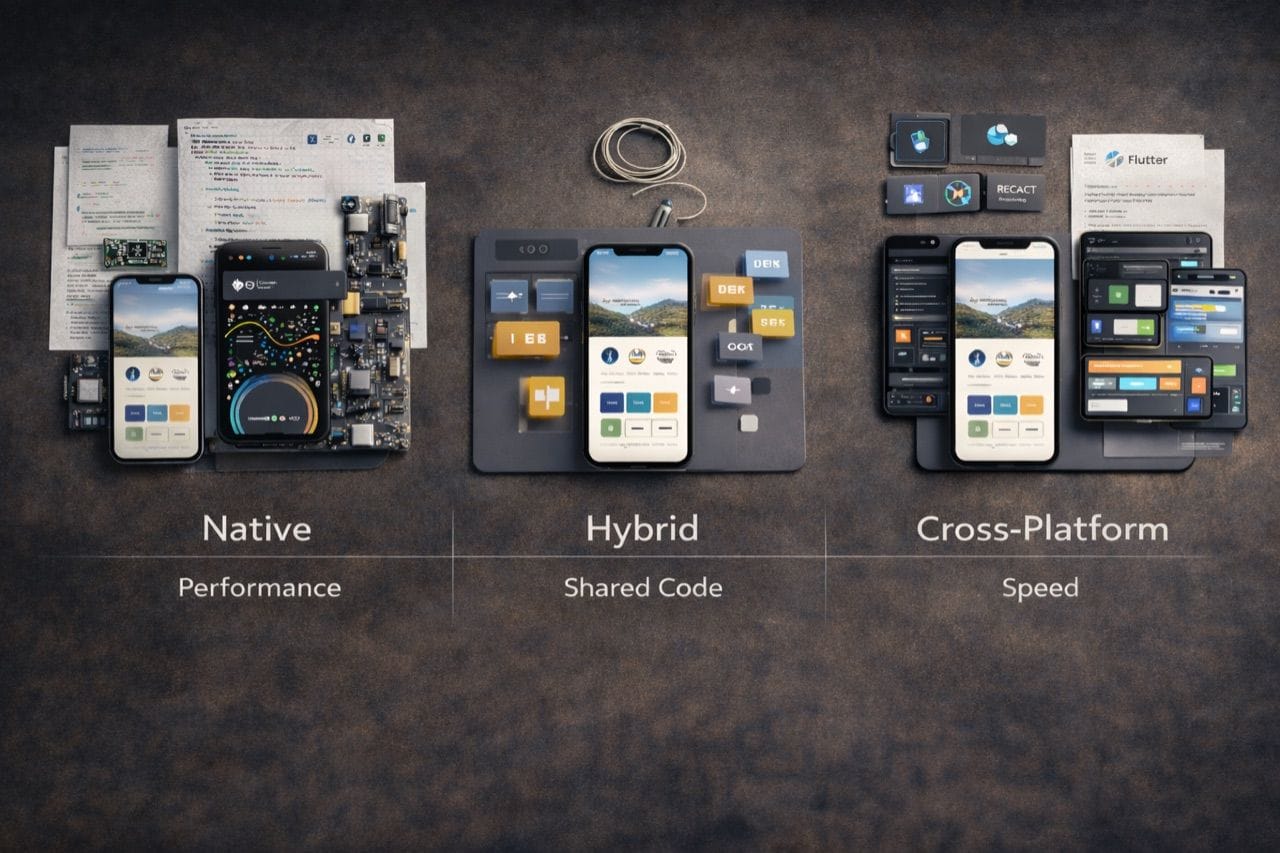
Native development involves building platform-specific applications using tools and languages designed for that ecosystem. Android apps typically use Kotlin or Java, while iOS apps leverage Swift or Objective-C. Native apps offer superior performance, deeper platform integration, and full access to device capabilities, which makes them ideal for performance-sensitive applications or those requiring complex features. Ankord Media frequently advises clients who prioritize high responsiveness and seamless UX to consider native solutions despite higher initial costs.
Hybrid development relies on a combination of web technologies like HTML, CSS, and JavaScript wrapped in a native container. These apps can run across multiple platforms but may sacrifice some performance and native feel. Cross-platform frameworks, such as React Native or Flutter, provide a balance by allowing a single codebase to produce native-like experiences across platforms while improving development efficiency. Ankord Media recommends a careful evaluation of the app’s feature requirements and target audience to determine if these approaches meet performance and user experience goals.
Key differentiators include:
- Performance: Native apps generally deliver the fastest and most responsive experiences.
- Development Time and Cost: Hybrid and cross-platform approaches reduce development time and resource requirements by reusing code.
- Platform Integration: Native apps provide complete access to device-specific features.
- Maintenance: Cross-platform solutions allow updates in one codebase, while native apps may require parallel maintenance.
- User Experience: Native apps provide platform-consistent interfaces. Hybrid apps may feel less integrated.
Understanding these differences allows teams to make informed decisions and allocate resources effectively. Ankord Media’s leadership believes that aligning development choice with strategic goals reduces long-term technical debt and accelerates market entry.
Step-by-Step Framework for Choosing the Right Approach
Selecting the optimal app development approach is a structured process that requires evaluation of technical, operational, and strategic factors. Before diving into coding, teams should analyze the project holistically to ensure alignment with both business objectives and user expectations.
Organizations should first assess the complexity of app features. Apps requiring advanced animations, AR/VR capabilities, or heavy computational tasks often benefit from native development. Conversely, content-driven applications or MVPs intended for rapid testing may succeed with hybrid or cross-platform solutions. Ankord Media emphasizes that upfront analysis of feature complexity prevents costly pivots later in the project lifecycle.
Next, consider the target audience and device diversity. If a significant portion of users are split across multiple platforms, cross-platform development can reduce time-to-market while still providing a satisfactory experience. However, organizations must weigh this against potential performance trade-offs. Ankord Media frequently works with clients to map user demographics against device adoption trends to guide these decisions.
Finally, factor in long-term maintenance and scalability. Native applications may require parallel updates for iOS and Android, while cross-platform frameworks allow single-codebase maintenance but may lag in supporting new OS features. Budgeting for ongoing updates, security patches, and feature expansion is critical for sustainable mobile strategy. Ankord Media advises building a roadmap that accounts for both short-term goals and long-term growth.
The step-by-step decision-making framework:
- Step 1: Define App Objectives: Clarify the primary goals, target audience, and essential features.
- Step 2: Assess Performance Needs: Determine if speed, responsiveness, and advanced device integration are required.
- Step 3: Evaluate Development Resources: Consider team expertise, budget, and time-to-market constraints.
- Step 4: Examine Platform Coverage: Decide if a single or multiple platforms must be supported.
- Step 5: Analyze Maintenance and Scalability: Factor in long-term updates, feature additions, and OS evolution.
- Step 6: Make an Informed Decision: Balance trade-offs between performance, cost, and user experience.
- Step 7: Pilot and Iterate: Build a small-scale prototype or MVP to validate assumptions before full-scale development.
These steps provide a structured approach to choosing the optimal development method. Ankord Media notes that organizations that follow this systematic framework are better positioned to minimize risks, optimize budgets, and ensure user satisfaction.
Security and Integration Considerations Across Development Approaches
Security must be embedded at every stage of app development, regardless of whether a native, hybrid, or cross-platform approach is selected. API integration, secure data storage, and proper authentication protocols are vital for protecting sensitive user data.
Ankord Media highlights that the development approach directly affects the security architecture. Native apps allow more control over OS-level security features, while hybrid and cross-platform frameworks require additional layers to protect against web-based vulnerabilities. Mobile teams must carefully implement encryption, secure authentication, and code obfuscation to mitigate threats.
Key security practices include:
- Encrypted Data Storage: Ensure sensitive information is encrypted both in transit and at rest.
- Secure API Calls: Implement SSL/TLS and validate all server responses.
- Regular Security Audits: Periodically review the codebase and dependencies for vulnerabilities.
- Authentication Protocols: Enforce multi-factor authentication for user access.
- Third-Party SDK Evaluation: Assess security implications of integrated libraries or frameworks.
By embedding security best practices early in development, teams reduce the likelihood of breaches and reinforce user trust. Ankord Media often collaborates with organizations to implement these strategies seamlessly across different development approaches.
Performance Testing and User Experience Optimization
Regardless of the chosen development method, performance testing is critical. Users expect fast, reliable, and visually consistent experiences across all devices.
Ankord Media has found that early and ongoing performance testing identifies bottlenecks, ensures smooth animations, and validates platform-specific optimizations. Testing should cover load times, response rates, battery usage, and responsiveness across devices and network conditions. Prioritizing these factors during development prevents post-launch issues that can erode user engagement and retention.
Best practices include:
- Cross-Device Testing: Validate app performance on different screen sizes, OS versions, and hardware capabilities.
- Simulated Load Testing: Test app behavior under peak traffic conditions to anticipate performance issues.
- User Feedback Loops: Collect early user feedback to address UX friction and improve adoption rates.
- Continuous Optimization: Iterate on performance improvements post-launch to maintain competitive standards.
A focus on continuous testing and refinement ensures apps meet user expectations and maximize ROI. Ankord Media stresses that integrating analytics and performance monitoring tools helps teams identify opportunities for improvement in real time.
Achieving Long-Term Strategic Advantage Through Informed Development Choices
Selecting between native, hybrid, and cross-platform development is a strategic choice that affects market competitiveness, user satisfaction, and operational efficiency. Ankord Media recommends aligning development decisions with both immediate objectives and long-term vision, considering user needs, performance requirements, budget constraints, and maintenance plans.
Organizations that approach app development systematically, incorporate security and performance best practices, and validate choices through prototyping and testing achieve a sustainable competitive advantage. Each development path has trade-offs, but when evaluated against clearly defined business and technical criteria, teams can confidently select the solution that maximizes both impact and efficiency.