


- Introduction
- Quick Answer
- 1. The warning signs you are about to scale confusion
- 2. Clarify the ICP with a decision-grade definition
- 3. Name the real problem you solve, not the feature category
- 4. Define your differentiation as a defendable reason you win
- 5. Pick the category you want buyers to place you in
- 6. Lock outcomes you can promise and proof you can show
- 7. Align on voice, tone, and vocabulary so content stays consistent
- 8. Decide the job each content type must do before you scale it
- 9. Build a message hierarchy so everything rolls up cleanly
- 10. Validate with the five-second clarity test and a buyer-objection check
- 11. A lean 10-step positioning cleanup plan before you scale
- Final Tips
Introduction
Scaling content and copy too early can multiply confusion instead of growth. In San Francisco, where buyers are skeptical and categories move fast, vague positioning costs you pipeline, hiring momentum, and investor confidence. This guide covers what to clarify before you publish more pages, posts, and ads.
Quick Answer
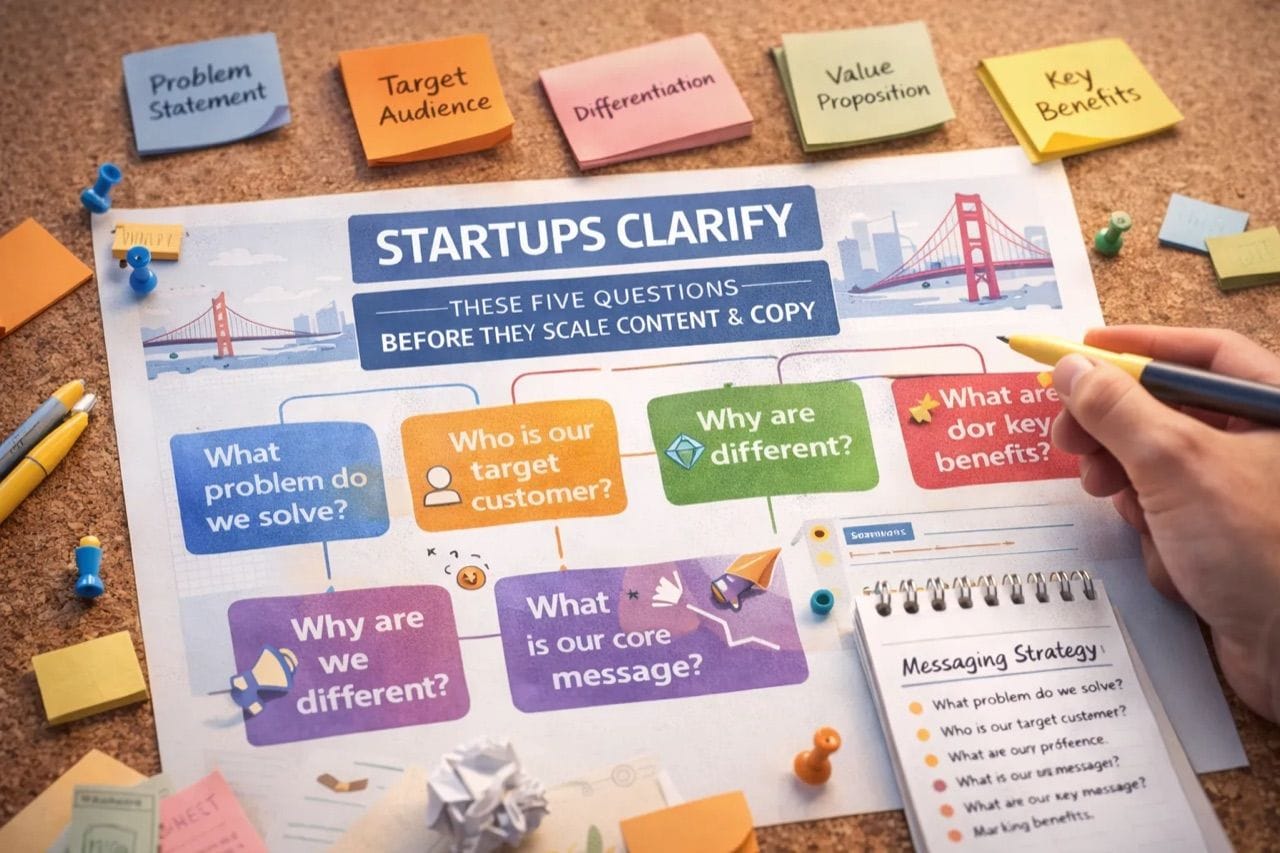
Before you scale content and copy, San Francisco startups should clarify their ICP, the painful status quo they eliminate, the unique reason they win, the category they want buyers to compare them in, the outcomes they can credibly promise, and the proof they can show right now. If you cannot say what you do, who it is for, why it is different, and what action you want the right person to take in one clean pass, scaling content will amplify mixed messages and attract the wrong traffic.
1. The warning signs you are about to scale confusion
If any of these feel familiar, pause content output and fix positioning first:
- Your homepage headline could fit 50 other SaaS companies
- Sales calls start with long explanations instead of quick alignment
- Different teammates describe the product in different ways
- Your best leads come from intros, not inbound
- Prospects ask “So who is this for?” late in the conversation
- You get traffic but demo requests are low quality or inconsistent
- Your blog covers broad topics, but buyers do not connect it to your product
Content compounds when it repeats a stable story across many surfaces. If the story is not stable, more content creates more drift.
2. Clarify the ICP with a decision-grade definition
Most startups have an “ideal customer” that is too broad to guide content. You need an ICP definition that helps you say no.
A useful ICP has:
- Company profile: size, stage, industry, complexity level
- Buying team: who cares, who signs, who blocks
- Trigger moments: what happens right before they look for you
- Must-have constraints: tech stack, compliance, budget range, timeline
- Disqualifiers: who you will not win, serve, or retain well
Practical test
If a marketer cannot choose the correct angle for a landing page without asking the founder, the ICP is not operational yet.
SF nuance
In SF and the Bay Area, “ICP” should also reflect how real deals happen: security review friction, privacy requirements, and who owns the technical sign-off. If your product touches data, the buyer is rarely just “Marketing” or “Ops.” There is usually a security or IT stakeholder in the loop, even early.
3. Name the real problem you solve, not the feature category
Positioning breaks when startups describe what they are, not what they fix.
Clarify:
- The painful status quo buyers want to escape
- The cost of staying the same, in money, time, risk, or opportunity
- The moment they feel the pain most strongly
- The alternative they currently use instead of you
A clean messaging pattern:
“We help [ICP] stop [painful status quo] by [unique mechanism], so they can [measurable outcome].”
Quick check: if your message starts with “We are a platform that…” you are probably leading with category, not pain.
4. Define your differentiation as a defendable reason you win
Early-stage teams often list generic differentiators: fast, easy, AI-powered, enterprise-grade. Those are not differentiators. They are table stakes or claims competitors can copy.
Instead, clarify:
- Your unique mechanism: what you do differently under the hood
- Your tradeoffs: what you intentionally do not do
- Your best-fit scenario: where you are clearly the best option
- Your anti-fit scenario: where someone should choose a different approach
Differentiation statements that work:
- “We are best when…” tied to a specific scenario
- “We win because…” tied to product reality
- “We trade X for Y” to show your focus
5. Pick the category you want buyers to place you in
In SF, buyers bucket you quickly. If you do not choose the category, the market will choose it for you, often incorrectly.
Clarify:
- What category you want to be compared within
- What you are not, even if you share features
- The “closest familiar thing” analogy that helps buyers understand fast
Category decision rule: pick a category that makes your value obvious, then add a sharp differentiator. Early-stage startups often try to create a new category too soon. That can work, but it increases education cost and slows conversion.
6. Lock outcomes you can promise and proof you can show
Benefits that sound like marketing do not move deals. Outcomes plus proof do.
Clarify outcomes at three levels:
- Business outcome: revenue, cost, risk, time to value
- Team outcome: workload, speed, visibility, confidence
- Personal outcome: credibility, career safety, reduced stress
Then attach proof you can actually produce now:
- Customer quotes with specific results
- Before-and-after stories
- Screenshots, workflows, and product truths
- Founder credibility and track record
- Reliability, security, and compliance signals you can support
- Benchmarks, experiments, or internal data you can explain
SF nuance
Bay Area buyers are trained to smell vague claims. If you say “enterprise-grade security,” expect questions. If you say “SOC 2 Type II,” expect follow-ups. If you are early-stage, do not bluff. Instead, publish what is true: your controls, your roadmap, your incident response basics, and what data you do and do not touch.
Quick check
For every major claim on your homepage, you should be able to answer: “What would a skeptical buyer ask next?” and “Where do we show the answer?”
7. Align on voice, tone, and vocabulary so content stays consistent
When you scale content, multiple people will write, edit, and publish. If voice is not defined, every piece will sound different and your brand will feel unstable.
Clarify:
- Voice: direct, technical, friendly, contrarian, calm, premium
- Vocabulary: preferred terms, banned terms, and product naming
- Technical level: how deep you can go without losing the reader
- Stance: what you believe, what you reject, what you do differently
Useful artifact: a one-page voice guide with examples of “good” and “bad” phrasing, plus a short list of approved phrases that should repeat across your site.
8. Decide the job each content type must do before you scale it
Startups scale content by volume, but buyers experience it as a journey. Assign a job to each content type:
- Homepage: fastest clarity, credibility, and next step
- Product pages: how it works, use cases, differentiation, objections
- Landing pages: one intent, one promise, one action
- Blog: teach, build trust, and pre-sell objections, not just “rank”
- Case studies: proof and buying triggers
- Sales enablement: make reps faster and more consistent
If your blog is doing what your product page should do, conversion suffers.
9. Build a message hierarchy so everything rolls up cleanly
A message hierarchy keeps your site and content aligned even as you add new pages and topics.
Clarify:
- One sentence positioning statement
- Three pillars: the main reasons to believe
- Proof points for each pillar
- Objection handlers: risk, price, switching cost, trust
- Primary CTA and secondary CTA
Fast test: can you map any new piece of content to one of the three pillars? If not, it is probably off-strategy.
10. Validate with the five-second clarity test and a buyer-objection check
Before scaling output, run simple tests:
- Five-second clarity: can someone explain what you do after one glance?
- Sales call alignment: do leads self-qualify faster after reading your site?
- Objection coverage: do your pages answer the top three objections clearly?
- Consistency: do three teammates describe the product the same way?
If these fail, more content will not fix it. It will hide it.
11. A lean 10-step positioning cleanup plan before you scale
This is a minimum viable positioning sequence you can finish quickly.
- Write a decision-grade ICP, including disqualifiers
- List the top 3 trigger moments that lead people to search for a solution
- Define the painful status quo and the real cost of it
- Write a one-sentence positioning statement
- Define your unique mechanism and tradeoffs
- Choose your category and “closest familiar thing”
- List your top 3 outcomes and attach proof you can show today
- Write your three message pillars with proof points
- Create a one-page voice and vocabulary guide
- Update your homepage and one product page to match the new hierarchy
Once those are done, scaling content starts compounding because your system has a center.
Final Tips
Do not scale content until your positioning is stable enough to repeat without drift. Lock the ICP, painful status quo, differentiation, category, outcomes, and proof, then build a message hierarchy so every page and post reinforces the same story. With that foundation, content and copy scale cleanly and drive better leads instead of louder confusion.