


- Introduction
- Quick Answer
- 1. What “performs best” means on TikTok for a tech startup
- 2. The TikTok content formats that win most often for Bay Area tech
- 3. What does not perform well for most tech startups
- 4. The “hook, proof, payoff” script that makes tech TikToks work
- 5. Content ideas by startup type
- 6. Make TikTok feel native without forcing your team to be entertainers
- 7. The best posting cadence for early-stage Bay Area teams
- 8. Turn one product moment into five TikToks
- 9. What to say in the first sentence so people keep watching
- 10. How to measure and improve TikTok content like a startup
- 11. Practical CTAs that do not feel like ads
- Final Tips
Introduction
TikTok can work for Bay Area tech startups, but it rewards clarity and watch time, not polished brand videos. The best-performing content usually feels like a useful demo, a simple lesson, or a story with a clear payoff. Your goal is to earn attention fast, then turn that attention into trust.
Quick Answer
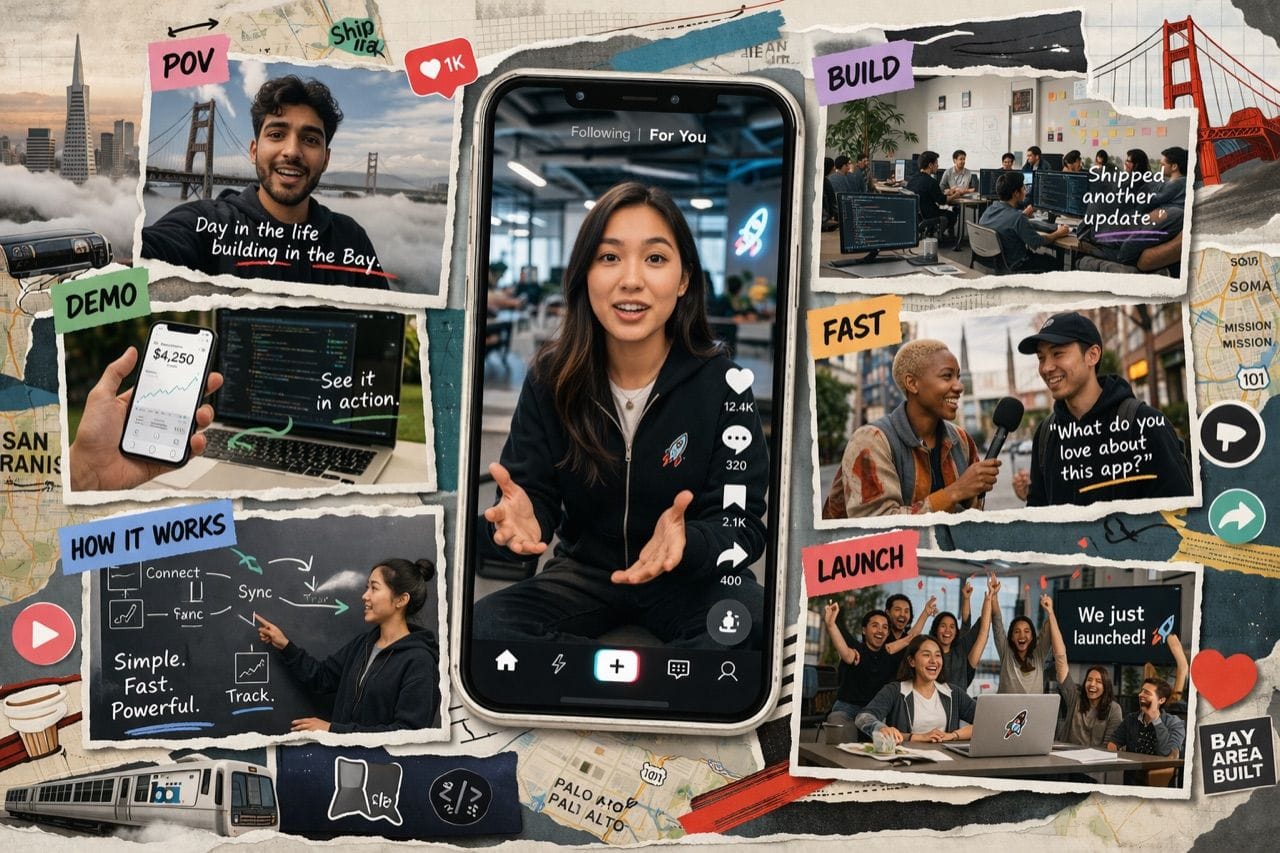
The TikTok content that performs best for Bay Area tech startups is short, proof-led video built around one clear hook and one visible payoff, like product demos with a strong before-and-after, quick educational explainers from the founder or team, customer problem stories, behind-the-scenes building moments, and simple opinionated takes on the category, all delivered in a native style with fast pacing, real specificity, and a consistent format viewers recognize.
1. What “performs best” means on TikTok for a tech startup
For startups, “best” is not always the most views. It is the content that reliably produces the right downstream signals.
Strong performance signals for tech startups:
- High completion rate or strong average watch time
- Saves and shares from your target audience
- Comments that reveal intent, confusion, or objections you can answer
- Profile visits and link clicks from relevant people
- DMs or inbound asking for a demo, trial, waitlist, or details
- Follow spikes after specific formats you can repeat
Treat each post like a small experiment to find repeatable formats that attract the right audience, not just broad entertainment traffic.
2. The TikTok content formats that win most often for Bay Area tech
Format A: The 20 to 45 second product demo with a clear payoff
This is the most consistent format for many startups because the value is visible.
What it looks like:
- Show the problem in 3 seconds
- Show the product doing the fix
- End with the result and a simple next step
Examples of angles:
- “Watch me do in 30 seconds what used to take 30 minutes”
- “Here’s how we removed this annoying workflow step”
- “This is the fastest way to do X without Y”
Format B: One concept explainers that make you sound smart, not salesy
Short explainers can build authority fast if they stay practical.
What works:
- One idea per video
- One example that makes it real
- One takeaway for the viewer
Examples:
- “If you are evaluating AI tools, check this before you buy”
- “The mistake most teams make when they onboard users”
- “How we think about retention in the first 30 days”
Format C: Customer problem story videos
Stories perform well when they are specific and relatable.
Simple structure:
- The pain: “This is what teams keep telling us”
- The cause: “Here’s why it happens”
- The fix: “Here’s what we changed”
- The result: “What improved after”
Format D: Founder building moments with real constraints
TikTok likes authenticity. Founders can win by showing the real decisions behind the product.
Ideas:
- “We killed this feature and here’s why”
- “The tradeoff we made to ship faster”
- “What we learned from 10 customer calls this week”
Format E: Mini teardowns and checklists
Teardowns and checklists create saves and shares.
Examples:
- “If you are hiring your first marketer, use this checklist”
- “How to spot a bad onboarding flow in 10 seconds”
- “Three red flags when choosing a vendor in this space”
Format F: Social proof stitched into a simple narrative
If you have a customer quote, testimonial, or user reaction, build a story around it.
What to do:
- Show the quote or reaction quickly
- Explain what changed and why it matters
- Invite viewers to ask for the template, walkthrough, or demo
3. What does not perform well for most tech startups
Avoid these until you have a strong audience and clear creative direction:
- Brand anthem videos with no payoff
- Generic motivational quotes
- Overly produced ads that feel like ads
- Feature lists without showing the feature in action
- Vague “excited to announce” posts without a story or result
- Trying to mimic trends that do not fit your product or audience
If a viewer cannot understand what you do within 5 seconds, your content will struggle.
4. The “hook, proof, payoff” script that makes tech TikToks work
Most tech content fails because it explains too much before it shows anything. Use this script to keep it tight.
Hook (0 to 2 seconds)
- Call out the pain, the promise, or the surprising claim
Proof (2 to 20 seconds)
- Show the workflow, the demo, the example, or the evidence
Payoff (last 5 to 10 seconds)
- Show the result, what changed, and what to do next
A strong payoff includes:
- A visible result
- A short line that clarifies who it is for
- A light CTA like “comment ‘demo’” or “I’ll send the checklist”
5. Content ideas by startup type
B2B SaaS
- “How to” demos for common workflows
- Buyer checklists and decision filters
- Objection handling videos
- “We tested X and it failed, here’s the fix”
- Customer pull stories
Developer tools
- Quick setup walkthroughs
- Debugging tips and workflow shortcuts
- “Before and after” performance improvements
- Teardowns of common mistakes in the ecosystem
- Building and shipping moments with engineering context
Consumer or prosumer apps
- Relatable day-in-the-life problem content
- Fast transformations and before-and-after outcomes
- Creator-style demos that feel organic
- Challenges and simple repeatable series
- User generated content stitched into your narrative
6. Make TikTok feel native without forcing your team to be entertainers
You do not need to be funny or trendy. You need to be clear and specific.
Native TikTok signals:
- Fast pacing, no long intros
- Captions that match what is happening
- Simple framing and good audio clarity
- Real examples, real screens, real workflows
- A consistent series format so viewers know what to expect
If you are camera shy, start with:
- Screen recordings with voiceover
- Hands-only demo shots
- Slides plus voice
- Founder talking head with simple captions
7. The best posting cadence for early-stage Bay Area teams
TikTok rewards volume, but startups should not sacrifice shipping. Use a cadence that is sustainable.
A practical cadence:
- 3 posts per week for 6 weeks
- One repeatable series format
- One day for batching scripts and filming
- One day for editing and scheduling
If you can only do 2 posts per week:
- One demo
- One lesson or checklist
The key is consistency and repetition of what works, not constant novelty.
8. Turn one product moment into five TikToks
Your product work already contains content. The trick is turning one moment into multiple angles.
One product update can become:
- The demo: what changed
- The problem story: why it mattered
- The lesson: what you learned
- The teardown: why alternatives fail
- The checklist: how to evaluate this workflow
This lets you scale content without inventing new topics.
9. What to say in the first sentence so people keep watching
Your first sentence should be one of these:
- A promise: “Here’s how to do X in under a minute”
- A pain: “If you hate doing X, this is for you”
- A surprise: “We tried X and it made results worse”
- A simple claim: “This is the fastest workflow we have seen for X”
- A direct audience callout: “If you run ops at a startup, watch this”
Then immediately show something. Do not over-explain.
10. How to measure and improve TikTok content like a startup
Run TikTok like product iteration.
Weekly review:
- Which videos got the highest completion rate
- Which videos got saves and shares
- Which hooks held attention best
- Which topics brought the right profile visitors
- Which format produced comments you want more of
Then do more of what worked:
- Same hook style
- Same series title
- Same video length
- Same proof type
Do not “pivot” every week. Build momentum by repeating winning formats.
11. Practical CTAs that do not feel like ads
TikTok can drive action if your CTA is lightweight and helpful.
Good CTAs for startups:
- “Comment ‘template’ and I’ll share it”
- “Comment your use case and I’ll reply with the best workflow”
- “Want a walkthrough for your team? Say ‘demo’”
- “If you are building in this space, follow for weekly examples”
- “If you are hiring for this role, DM me and I’ll send the checklist”
Avoid heavy CTAs like “Book a call” on every post. Earn trust first.
Final Tips
TikTok works for Bay Area tech startups when you treat it like a proof channel, not a brand channel. Start with short demos and simple lessons, use the hook, proof, payoff structure, and repeat the formats that earn completion, saves, and the right comments, because consistency and specificity beat trends for most early-stage teams.