


- Introduction
- Quick Answer
- 1. Start With the Repurposing Plan Before Recording
- 2. Treat Each Episode as One Source Asset
- 3. Use the Transcript to Find the Best Repurposable Moments
- 4. Repurpose for LinkedIn With Founder-Led Clarity
- 5. Turn the Episode Into YouTube Assets Without Overediting
- 6. Adapt the Same Idea for Short-Form Social
- 7. Batch Production and Approvals to Prevent Burnout
- 8. Use Templates and Clear Roles to Keep the Workflow Repeatable
- 9. Measure Content Efficiency and Business Impact
- Final Tips
Introduction
A founder-led podcast can become one of the most efficient content assets a Bay Area startup produces, but only if the team repurposes it with a system. One strong episode can support LinkedIn posts, YouTube clips, short-form videos, newsletter ideas, sales follow-ups, and investor-facing thought leadership. The key is to turn the podcast into a repeatable content engine instead of asking the founder and team to create new ideas from scratch every week.
Quick Answer
Bay Area founders should repurpose podcast episodes by planning each episode around one clear idea, recording with reusable moments in mind, using the transcript to pull strong quotes and clips, and adapting the same core message for LinkedIn, YouTube, and short-form social. To avoid burnout, teams should start with a small content package per episode, use repeatable templates, batch editing and approvals, assign clear ownership, and measure whether the content creates useful visibility, conversations, and pipeline instead of only tracking output volume.
1. Start With the Repurposing Plan Before Recording
Repurposing works best when the team knows what it wants from the episode before the founder starts recording. If the team waits until after production to decide what to clip, write, and publish, every episode becomes harder to manage.
Before recording, define the episode’s main content angle. This should be the strongest idea the audience should remember after listening.
A clear episode plan should answer:
- Who is this episode for?
- What business goal does it support?
- What problem or question does it answer?
- What founder point of view should come through?
- What moments might work as clips or posts?
- Which platforms will receive repurposed content?
For example, a Silicon Valley SaaS founder recording an episode on enterprise onboarding might choose the angle, “onboarding is a revenue lever, not just a support function.” That one idea can become a LinkedIn post, a YouTube segment, a short-form clip, and a newsletter section.
The goal is not to make the conversation feel scripted. The goal is to give the team a strong content direction so the best moments are easier to find and reuse.
2. Treat Each Episode as One Source Asset
A podcast episode should not be treated as one piece of content. It should be treated as one source asset that can feed several channels.
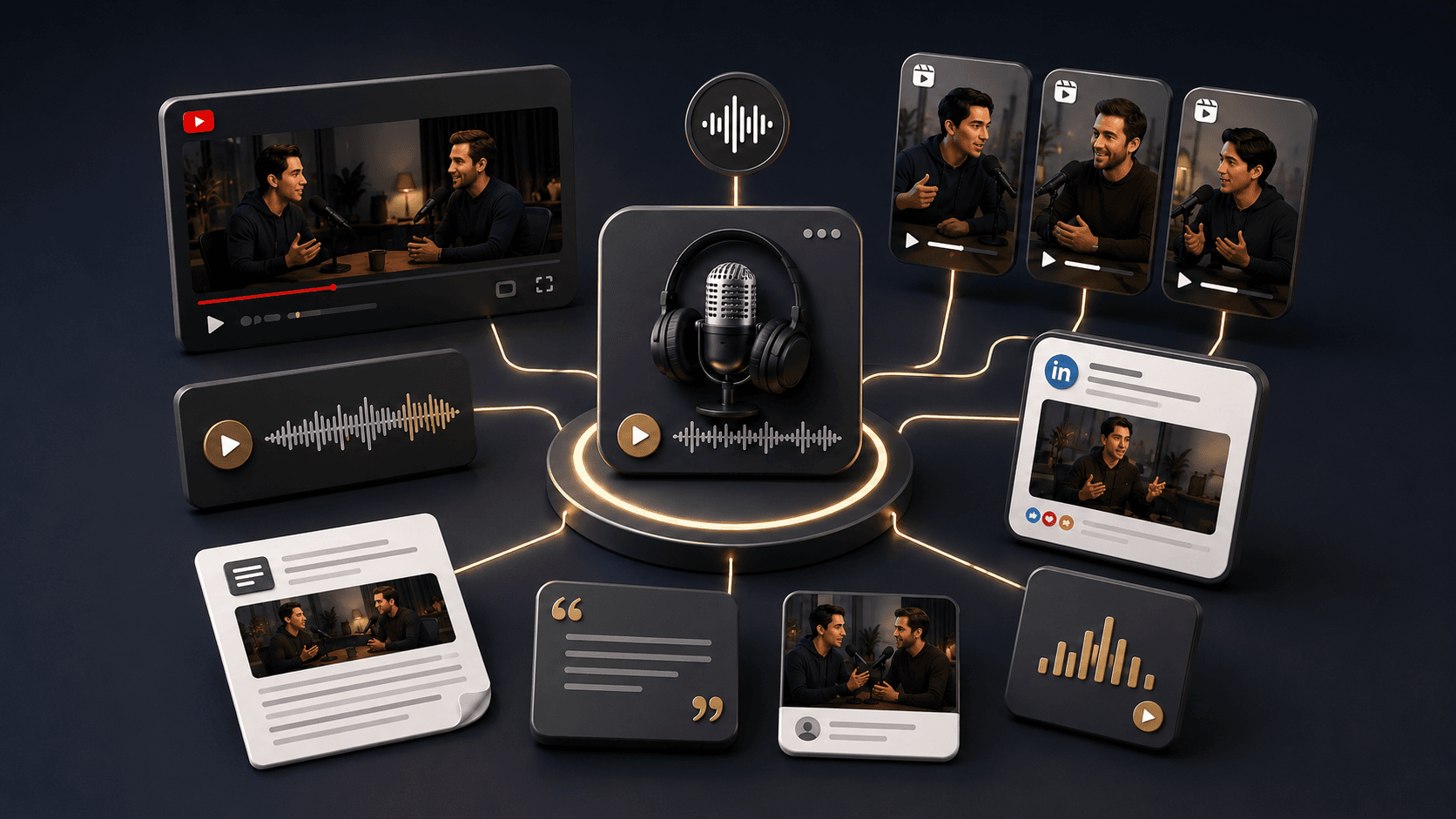
For a small Bay Area startup team, the most practical model is “one episode, several useful outputs.” That means the team extracts the strongest ideas from the conversation and reshapes them for different formats.
A realistic content package from one episode might include:
- One full podcast episode
- One full YouTube upload
- Two to three short video clips
- Two LinkedIn founder posts
- One YouTube segment
- One newsletter or blog angle
- Three to five short quotes or takeaways
This gives the team enough content to create visibility without turning repurposing into a full-time production burden.
Use the minimum viable content package
Founders often burn out their teams by trying to create too many assets from every episode. A better starting point is a minimum viable content package.
For each episode, create:
- One long-form version
- Two short clips
- Two LinkedIn posts
- One written recap or newsletter idea
Once that workflow is consistent, the team can expand. Consistency matters more than volume, especially for early-stage startups with limited marketing capacity.
3. Use the Transcript to Find the Best Repurposable Moments
The transcript is the fastest way to turn a podcast into reusable content. It keeps the team from relying on memory, rewatching the full episode several times, or guessing which moments were strongest.
After recording, review the transcript and highlight moments that are clear, specific, and useful on their own.
Strong repurposing moments often include:
- A sharp founder opinion
- A useful framework
- A customer pain point
- A mistake and lesson learned
- A contrarian take
- A short founder story
- A practical explanation
- A strong answer to a common buyer question
- A memorable quote
- A moment that connects product, market, and timing
Not every good podcast moment should become social content. The best clips and posts should make sense without requiring the audience to listen to the full episode first.
Look for complete ideas, not just energetic moments
A high-energy clip is not always the best clip. A strong repurposable moment should have a clear beginning, a clear point, and a natural ending.
A good test is simple: can someone understand the idea in 30 to 90 seconds without extra context? If yes, it may work as a clip. If not, it may be better as part of a written LinkedIn post, a newsletter section, or a longer YouTube segment.
4. Repurpose for LinkedIn With Founder-Led Clarity
LinkedIn is usually one of the highest-value channels for Bay Area founders because it reaches investors, customers, operators, potential hires, and startup peers in one place. A podcast gives the founder raw material for consistent thought leadership without asking them to write from scratch.
The best LinkedIn content from a podcast usually falls into three formats.
Founder point of view posts
These posts turn one strong opinion from the episode into a clear founder perspective.
A useful structure is:
- Open with the core belief
- Explain why it matters
- Add context from the episode
- Share a practical lesson
- End with a clear takeaway
For example, a podcast discussion about AI product adoption could become a LinkedIn post that begins, “Most AI products do not fail because the model is weak. They fail because the workflow is unclear.”
That kind of opening gives the post a strong point of view and helps the right audience understand the founder’s thinking quickly.
Story-based posts
Founder podcasts often include stories about fundraising, hiring, customer conversations, product mistakes, pivots, or early go-to-market lessons. These moments can become strong LinkedIn posts when they are framed around a lesson.
A simple structure works well:
- What happened
- Why it mattered
- What changed
- What other founders or teams can learn from it
This keeps the content personal without turning it into a diary entry. The story supports the insight.
Clip-supported posts
A short video clip can be paired with a written LinkedIn caption that frames the idea. The caption should not simply repeat the clip. It should explain why the clip matters.
A strong caption can include:
- The problem discussed in the clip
- The founder’s key insight
- The audience that should care
- One practical takeaway
This format helps the same idea work for both video viewers and readers.
5. Turn the Episode Into YouTube Assets Without Overediting
YouTube can help a founder-led podcast become more discoverable over time. It also gives startups a searchable library of founder thinking, category education, customer conversations, and product insight.
The team does not need to overproduce every YouTube asset. Clarity matters more than heavy editing.
Full episode upload
The full episode should have a clear title, useful description, and timestamps. This is especially important for technical or B2B startup audiences because viewers may only care about one section of the conversation.
A vague title like “Conversation With a Startup Founder” is less useful than a specific title such as “How Enterprise SaaS Teams Can Reduce Onboarding Friction Without Slowing Sales.”
The better title tells the audience what they will learn and gives the video a clearer search angle.
Topic-based YouTube clips
Most podcast episodes contain several shorter sections that can stand alone as YouTube clips. These clips should focus on one complete idea, such as a buyer problem, founder lesson, product framework, category insight, or investor-facing narrative.
Strong YouTube clips usually include:
- One clear question
- One focused answer
- One specific topic
- One natural ending
- A title that matches the actual discussion
Avoid turning every interesting sentence into a clip. A smaller number of useful clips will perform better than a large batch of confusing fragments.
YouTube Shorts
YouTube Shorts work best when the founder says something direct, specific, or immediately understandable. The clip should open quickly, stay focused, and include captions for silent viewing.
For a lean startup team, the best approach is to choose only the strongest short-form moments from each episode. Forced short-form clips create more work and usually perform worse.
6. Adapt the Same Idea for Short-Form Social
Repurposing does not mean posting the exact same asset everywhere. Each platform has different behavior, pacing, and expectations. The core idea can stay the same, but the packaging should change.
For short-form social, the team should focus on one idea at a time. The viewer should understand the point within a few seconds.
Strong short-form podcast clips often use:
- A clear opening hook
- A single founder insight
- Captions for silent viewing
- Minimal intro footage
- Simple visual framing
- A clean ending
- A caption that adds context
For Instagram, TikTok, and similar channels, the clip does not need to explain the entire episode. It only needs to make one idea interesting enough to watch, save, or share.
Match the platform without changing the message
A single podcast idea can be adapted across channels like this:
LinkedIn can frame the idea as a founder lesson. YouTube can frame it as a searchable educational segment. Short-form social can frame it as a quick insight or memorable quote.
The message stays consistent. The format changes based on how people use each platform.
7. Batch Production and Approvals to Prevent Burnout
The fastest way to burn out a startup team is to spread podcast repurposing across too many small tasks. If one person reviews the transcript on Monday, another pulls clips on Tuesday, the founder reviews captions on Wednesday, and publishing happens randomly after that, the workflow becomes exhausting.
Batching makes the process easier.
A simple batched workflow can look like this:
- Record the episode
- Generate the transcript
- Select the strongest moments
- Draft LinkedIn posts and captions
- Edit all clips in one production pass
- Review assets together
- Schedule content in advance
- Check performance after publishing
This reduces context switching and gives the founder fewer approval moments.
Keep founder review focused
Founders should review for accuracy, tone, and strategic risk. They should not need to approve every formatting detail unless the content is sensitive.
A founder review checklist can ask:
- Is the idea accurate?
- Does it sound like the founder?
- Is anything confidential or too early to share?
- Is the claim too broad?
- Does the content support the right audience?
- Would this attract useful conversations?
This keeps review efficient while protecting the founder’s voice and the company’s positioning.
8. Use Templates and Clear Roles to Keep the Workflow Repeatable
A repeatable system prevents every episode from feeling like a new creative project. Templates remove unnecessary decision-making and help the team move faster without making the content feel generic.
Useful templates include:
- Episode planning template
- Transcript review checklist
- Clip selection template
- LinkedIn post structure
- YouTube description format
- Short-form caption format
- Founder approval checklist
- Publishing calendar
- Performance review notes
Templates should guide the process, not flatten the founder’s voice. The content still needs specific ideas, clear examples, and real perspective from the episode.
Assign ownership clearly
Even a small team needs clear ownership. If everyone is partly responsible, the workflow will stall.
A lean division of responsibility might look like this:
The founder owns the point of view, subject matter accuracy, guest relationships, and final review of sensitive ideas.
The content lead owns episode themes, transcript review, written posts, captions, and the publishing calendar.
The editor owns clip selection support, video editing, captions, formatting, and exports.
The operations or marketing support person owns file organization, scheduling, status tracking, and performance collection.
One person may cover multiple roles in an early-stage startup. The important part is that every step has an owner.
9. Measure Content Efficiency and Business Impact
Podcast repurposing should not be judged only by how many assets the team creates. A better question is whether the system helps the founder show up consistently, communicate clearly, and create useful business conversations without draining the team.
Track both production efficiency and audience response.
Useful efficiency metrics include:
- Assets created per episode
- Time spent per episode
- Founder approval time
- Publishing consistency
- Number of usable clips per recording
- Time from recording to scheduled content
Useful performance metrics include:
- LinkedIn saves and comments
- Quality of inbound messages
- YouTube watch time
- Short-form completion rate
- Profile visits
- Newsletter signups
- Sales conversation mentions
- Investor or partner engagement
- Recruiting conversations
- Pipeline influenced by content
For Bay Area startups, the most valuable signals are often qualitative. A smaller post that creates the right investor conversation, customer reply, or candidate introduction may be more useful than a high-view clip that reaches the wrong audience.
Review the system every few episodes
Every three to five episodes, the team should review what is working and simplify what is not.
Ask:
- Which content formats are easiest to produce?
- Which formats create the best conversations?
- Which steps are slowing the team down?
- Which clips feel strongest after publishing?
- Which topics connect most clearly to buyer or investor interest?
- Which assets are not worth the effort?
The best repurposing systems improve over time. They get lighter, clearer, and more aligned with the startup’s actual growth goals.
Final Tips
Bay Area founders should repurpose podcast episodes with a simple system that protects team energy. Start with one clear episode angle, pull the strongest moments from the transcript, create a small set of platform-specific assets, batch production and approvals, and measure whether the content creates useful visibility and conversations. The goal is not to publish everywhere at maximum volume. The goal is to turn each episode into consistent founder-led content the team can sustain.