


- Introduction
- Quick Answer
- 1. Start by defining what the launch video must do
- 2. Use live-action when trust and credibility matter most
- 3. Use animation when the product is hard to explain
- 4. For many Bay Area startups, hybrid is the smartest choice
- 5. The best choice depends on five practical filters
- 6. A simple decision rule founders can actually use
- 7. Common mistakes startups make when choosing a format
- 8. What usually works best by startup type
- 9. What the strongest startup teams do before they choose
- Final Tips
Introduction
Bay Area startups often choose a video format based on taste, not launch strategy. That usually leads to a video that looks polished but does not solve the real problem, whether that problem is low trust, weak clarity, or poor campaign reuse. The better way to decide is to match the format to the audience, the product, and the job the launch video needs to do.
Quick Answer
Bay Area startups should use live-action video for a launch campaign when the main goal is building trust, showing real people, strengthening founder credibility, or making the brand feel established. They should use animated video when the product is technical, abstract, still evolving, or difficult to explain clearly with real footage. In many startup launches, especially in B2B SaaS and AI, a hybrid approach works best because it combines human credibility with visual clarity. The right choice depends on what your audience needs to believe, understand, and remember during the launch.
1. Start by defining what the launch video must do
The first question is not which format looks better. The first question is what the video must accomplish.
A launch campaign video usually has one primary job and a few secondary jobs. If the team does not define that clearly, the format decision becomes subjective and the production drifts.
For most Bay Area startups, the primary job is usually one of these:
- explain the product clearly
- build trust with investors, buyers, or early users
- create excitement around a launch moment
- make a complex category easier to understand
- generate reusable assets for website, sales, email, paid media, and social
A strong format choice supports the primary job first. Everything else comes after that.
The most useful starting question
Ask this before scripting:
What is the biggest barrier between the audience and the action we want them to take?
That barrier is often one of four things:
- they do not understand the product
- they do not trust the team yet
- they do not see why the product matters now
- they understand it, but the message is not memorable
Once you know the barrier, the format becomes easier to choose.
2. Use live-action when trust and credibility matter most
Live-action is usually the better choice when the audience needs to believe in the people behind the product.
That is often true in startup launches because early audiences are not just evaluating the product. They are also evaluating the founder, the team, and the seriousness of the company.
Live-action works best when the campaign needs human proof
Live-action is often the stronger option when the launch should show:
- a founder speaking with clarity and conviction
- a customer reacting to the product
- a team that feels credible and capable
- a physical environment, workflow, or experience
- real faces that make the brand feel more established
This format helps reduce skepticism. It can make a new company feel more real, especially when the audience is made up of investors, enterprise buyers, partners, or early adopters who want confidence before they commit.
Live-action is strong for brand presence
Some launches are less about detailed explanation and more about presence. The startup needs to look ready, confident, and market-facing.
In those cases, live-action helps communicate:
- maturity
- seriousness
- momentum
- polish
- emotional connection
That makes it especially useful for founder story videos, announcement campaigns, fundraising support content, recruiting campaigns, and launches where perception matters almost as much as product understanding.
Live-action is strongest when the spokesperson is an asset
If the founder is compelling on camera, that can be a major advantage.
The same is true if the launch can feature:
- customers
- operators
- product leaders
- subject-matter experts
- community members
When the people in the story are persuasive, live-action gives the campaign a credibility advantage that animation usually cannot match on its own.
3. Use animation when the product is hard to explain
Animation is often the better choice when the product is difficult to show clearly in real life.
This is common in Silicon Valley. Many startup products are powerful but visually uninteresting on camera. The actual value may live inside data flows, automations, AI systems, back-end logic, or software interactions that do not translate well through a traditional shoot.
Animation helps simplify complexity
Animation is well suited for launch campaigns involving:
- AI products
- SaaS platforms
- developer tools
- fintech workflows
- infrastructure products
- data-heavy systems
- category creation stories
It gives the team full control over what the audience sees and in what order they understand it. That matters when the launch depends on precision.
A good animated launch video can make an abstract product feel much more concrete by showing process, sequence, and outcome in a way that live-action often cannot.
Animation is useful when the product is still changing
Many early-stage startups launch before every product detail is locked.
Animation is often the safer choice when:
- the product interface is still evolving
- the visual identity is still being refined
- there is limited real footage available
- the messaging may need late changes
- the team needs multiple variations quickly
That flexibility makes animation attractive for fast-moving launch cycles where the company needs more control and fewer shoot-day dependencies.
Animation can improve message consistency
Animation also makes it easier to create a unified visual system across the launch.
That helps when the campaign needs:
- website assets
- short cutdowns
- paid ad versions
- investor deck visuals
- social edits
- sales enablement clips
Because the visuals are built intentionally from the start, the launch often feels more coherent across every channel.
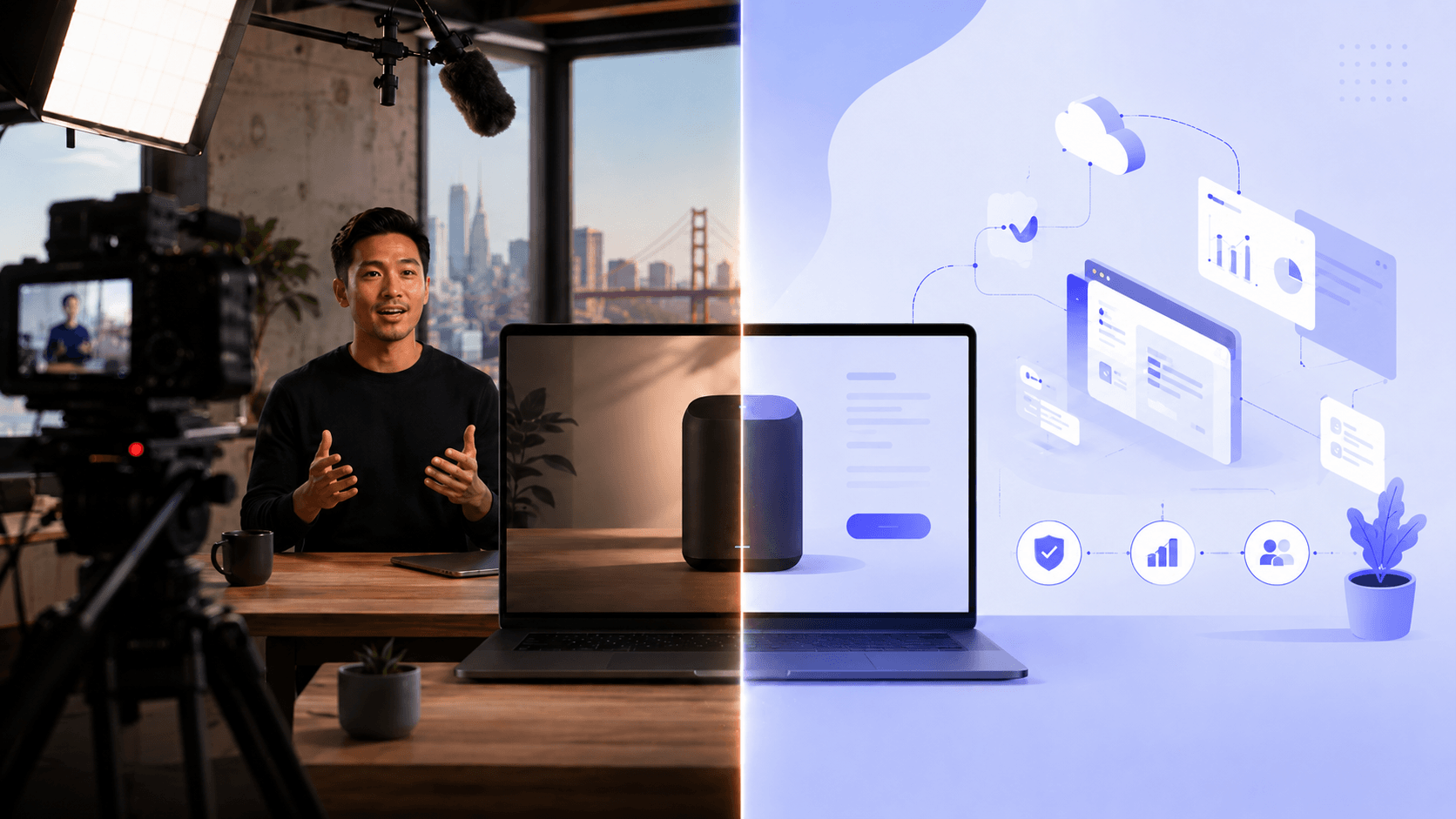
4. For many Bay Area startups, hybrid is the smartest choice
A lot of launch campaigns do not fit neatly into one format.
They need real people for trust and motion design for clarity. They need a founder to frame the problem, but they also need graphics, UI animation, or visual explanation to show how the product works.
That is where hybrid tends to be strongest.
Hybrid works when the audience needs both belief and understanding
Hybrid is often the best choice when the launch must do two things at once:
- make the startup feel credible
- make the product feel understandable
This is common in B2B SaaS, AI, healthtech, fintech, and other complex startup categories where the team is not just selling emotion. They are also selling logic.
A hybrid launch video can let a founder establish trust in the opening seconds, then use animation to explain the workflow, product value, or category shift without losing the audience.
Hybrid is often ideal for startup launches with multiple audiences
Many Bay Area launches are not built for one viewer type. The same launch may need to support:
- investors
- prospective customers
- partners
- recruits
- media
- current users
A hybrid format can serve that mix better because it gives the campaign both a human layer and an explanatory layer.
Hybrid usually creates better reuse across the campaign
When the team plans hybrid well, they can pull from the same production system to create:
- a founder-led hero cut
- product explanation segments
- short motion-based ads
- website modules
- sales or investor clips
- social content variations
That makes the launch campaign more versatile and often more durable after the initial announcement window.
5. The best choice depends on five practical filters
Instead of debating format in the abstract, Bay Area startups should evaluate the decision against five filters.
Message complexity
If the product needs diagrams, motion logic, UI explanation, or visual abstraction to be understood quickly, animation or hybrid is usually the stronger choice.
If the product is easy to grasp and the bigger issue is making the company feel credible or emotionally resonant, live-action usually has the edge.
Trust requirement
If the audience needs to trust the founder, the team, or the company quickly, live-action or hybrid is usually more effective.
If the audience mainly needs to understand a process, workflow, or product mechanism, animation may be enough.
Visual readiness
If the product, screens, or assets are still changing, animation offers more control.
If the team already has a strong environment, strong people on camera, or a product that looks good in real use, live-action becomes much more viable.
Timeline and revision needs
If the company expects late changes, multiple versions, or evolving product visuals, animation is often easier to manage.
If the concept is stable and the team can execute a focused shoot well, live-action may create stronger brand impact.
Reuse across channels
The format should not be chosen only for one master video. It should be chosen for the larger launch system.
That means asking how well the format will support:
- homepage placement
- paid social
- organic social
- sales follow-up
- investor outreach
- internal launch sharing
- event screens or demos
The best format is usually the one that creates the strongest total campaign asset set, not just the best standalone hero edit.
6. A simple decision rule founders can actually use
If your main launch challenge is trust, use live-action first.
If your main launch challenge is clarity, use animation first.
If your launch needs both trust and clarity, and many startup launches do, use hybrid.
That simple rule is more useful than endless debate about style.
Choose live-action first when these are true
- the founder is a strong communicator
- the audience needs confidence in the people behind the company
- customer or team presence adds real value
- the product can be shown in a compelling real-world way
- brand presence is a major part of the launch
Choose animation first when these are true
- the product is abstract or technically dense
- the workflow is easier to show through graphics than footage
- the interface is unfinished or likely to change
- the team needs more control over revisions
- consistency across many cutdowns matters
Choose hybrid first when these are true
- the launch must build trust and explain complexity
- the startup serves multiple stakeholder groups
- the founder should appear, but explanation cannot rely on talking heads alone
- the campaign needs high reuse across channels
- the product story combines vision, workflow, and proof
7. Common mistakes startups make when choosing a format
Most format mistakes happen because teams optimize for what feels impressive instead of what helps the launch perform.
Mistaking live-action for clarity
A beautiful founder-led video does not automatically explain the product well. If the product is hard to understand, live-action can leave the audience with a good impression but weak comprehension.
Mistaking animation for strategy
Animation can make a launch feel cleaner and more controlled, but it cannot fix weak messaging. If the team has not clarified the core story, motion graphics will not solve the problem.
Treating the launch video as one asset
A launch campaign video should not be planned as a single file that gets posted once. It should be treated as a content system that can support multiple uses before, during, and after launch.
Forgetting the audience context
A founder trying to win investor attention may need a different format than a startup trying to convert enterprise buyers or drive self-serve signups. The format should match the decision environment, not just the brand aesthetic.
8. What usually works best by startup type
Different startup categories tend to lean toward different default formats.
B2B SaaS
B2B SaaS launches often do best with hybrid or animation-first approaches because the product usually needs explanation and the buyer needs clarity fast.
AI and deep-tech
AI and deep-tech launches often benefit from animation or hybrid because the value is frequently abstract, technical, or hard to capture in live footage alone.
Consumer apps
Consumer launches often perform well with live-action when the campaign depends on emotion, energy, creators, community, or visible lifestyle use.
Marketplace and service platforms
These often benefit from live-action or hybrid because trust, real-world usage, and human interaction are central to the value proposition.
Founder-led fundraising campaigns
When the launch also supports fundraising, live-action or hybrid is usually stronger because investors respond to clarity, but they also respond to credible people and a convincing narrative.
9. What the strongest startup teams do before they choose
The best teams do not ask a production question first. They ask a strategy question first.
Before choosing the format, they align on:
- the primary audience
- the core launch message
- the main hesitation to overcome
- the channels where the video will live
- the secondary assets the campaign needs
Once those are clear, the format decision becomes much more obvious.
That is also what prevents expensive mistakes. A startup does not need the most cinematic option or the most flexible option in theory. It needs the format that best helps the campaign communicate, convert, and scale across the launch window.
Final Tips
Choose live-action when people need to trust the team, choose animation when people need help understanding the product, and choose hybrid when your launch has to do both. For many Bay Area startups, especially in SaaS and AI, hybrid is often the most practical answer because it gives the campaign credibility, clarity, and stronger reuse across channels.