


- Introduction
- Quick Answer
- 1. Decide based on the job, not the title
- 2. Understand what you are actually buying
- 3. Use a stage-based decision framework
- 4. Compare the risks you are trying to avoid
- 5. Know what good deliverables look like for each option
- 6. Budget reality in Silicon Valley
- 7. A simple scoring checklist you can use this week
- 8. How to vet a brand studio without getting sold a vibe
- 9. How to vet a freelance designer without hiring a “pretty pixels” specialist
- 10. Common scenarios and the best choice
- 11. The hybrid approach most startups end up using
- Final Tips
Introduction
Branding is one of the highest leverage moves a Silicon Valley startup can make, but the “who” behind it can either accelerate traction or quietly slow everything down. A brand studio and a freelance designer can both produce good visuals, yet they solve different problems. The right choice depends on your stage, your risk tolerance, and what outcomes you actually need in the next 60 to 120 days.
Quick Answer
If you need a positioning-led brand that can scale across a team, a product, and multiple channels, hire a brand studio. If you mainly need clean execution on defined assets like a logo refresh, pitch deck polish, or landing page visuals, hire a strong freelance designer. Most early-stage startups choose wrong when they buy “pretty” before they lock message, audience, and proof, so pick the option that reduces your biggest go-to-market risk right now.
1. Decide based on the job, not the title
The fastest way to choose is to define the job you are hiring for. Not “branding,” but the specific business problem.
A brand studio is usually built to solve bigger, messier problems like:
- You have product-market pull but the story does not land with investors or enterprise buyers
- Your messaging changes every week because the team is not aligned
- You are launching a new category or competing in a crowded one and need differentiation
- You need a full system, not just a logo, so marketing, product, and sales can stay consistent
A freelance designer is usually the best fit when:
- You already have clear positioning and need fast, high-quality execution
- You need a small set of assets, not a full identity system
- You have a strong internal marketing lead or founder who can provide tight direction
- You want to move quickly with a flexible budget and direct communication
If you cannot describe the job in one sentence, you are probably in “studio” territory because you need discovery, alignment, and strategy, not just design.
2. Understand what you are actually buying
Many founders think they are buying a logo. In reality, they are buying a decision-making system for how the company shows up.
A brand studio typically sells:
- Positioning and messaging foundations
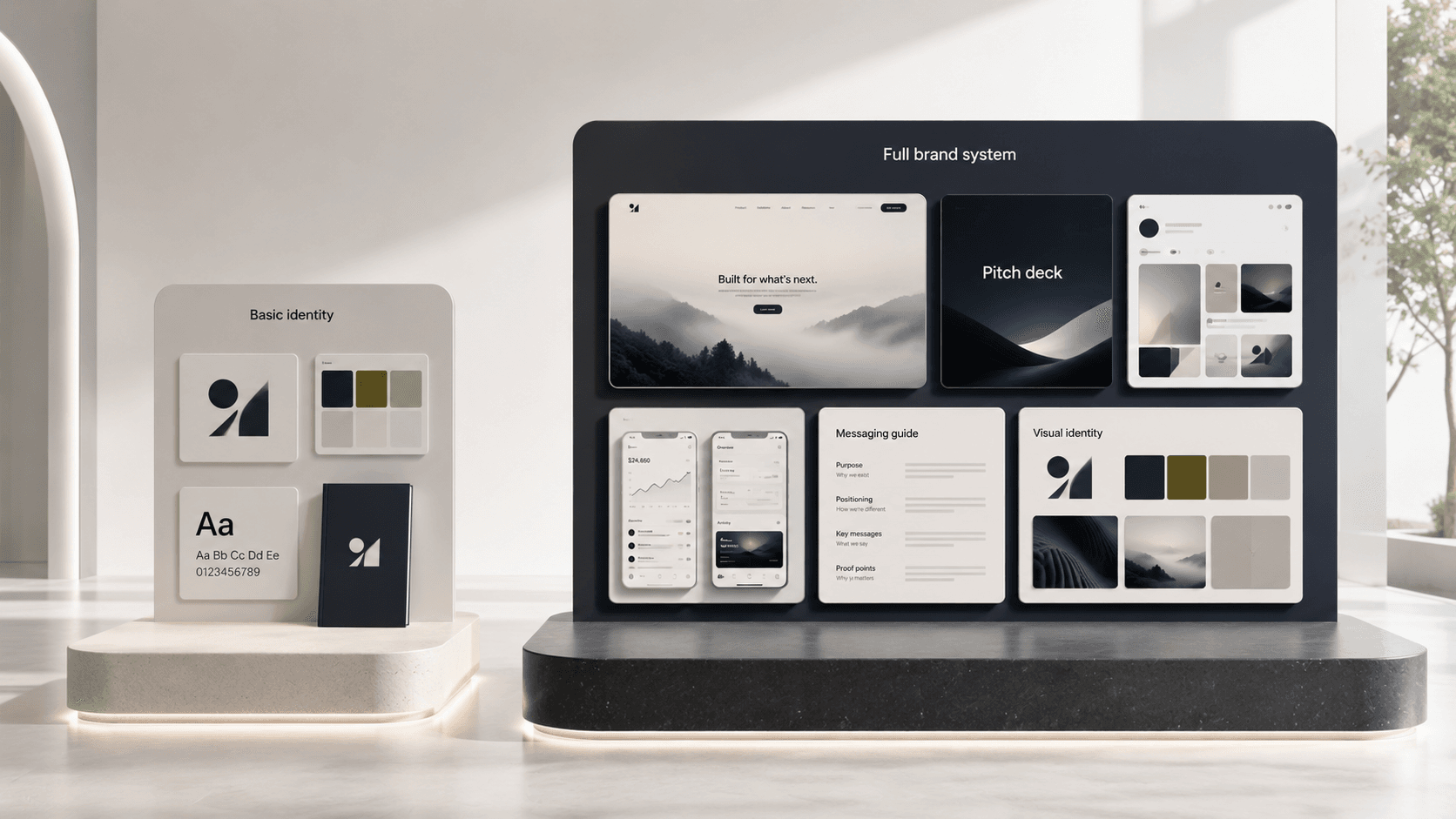
- Visual identity system and rules
- Brand voice and narrative guidance
- Rollout assets like website direction, pitch deck structure, key templates
- Process and facilitation to align stakeholders
A freelance designer typically sells:
- Design execution and iteration speed
- A narrower set of deliverables
- Hands-on collaboration with one person
- Adaptability to your tools, your process, your schedule
Both can overlap. Some freelancers are strategic. Some studios are more production-focused. But the common difference is that studios are designed to reduce ambiguity, while freelancers are designed to ship within it.
3. Use a stage-based decision framework
Here is a simple way to map the choice to startup stages.
Pre-seed to early seed
Most common need: credibility and clarity fast.
Choose a freelancer if you already have a crisp angle, a tight ICP, and you need to look legit for recruiting and fundraising. Choose a studio if you are still fuzzy on who you are for, why you win, and how to explain it in one slide.
Seed to Series A
Most common need: repeatable go-to-market story.
This is where a brand studio often pays off. You are hiring, the product is evolving, and marketing begins to scale. Inconsistency becomes expensive, and brand starts to show up in CAC, conversion rates, and sales cycles.
Series A and beyond
Most common need: systemization and speed across teams.
Studios are useful for big evolutions, rebrands, category positioning, and scalable systems. Freelancers remain valuable for ongoing execution, campaign design, and production, especially when paired with a strong internal brand or marketing lead.
4. Compare the risks you are trying to avoid
The right hire is the one that reduces your biggest branding risk.
If your risk is misalignment, hire a studio.
Misalignment looks like founders disagreeing on the story, the deck changing constantly, or marketing feeling like guesswork.
If your risk is slow execution, hire a freelancer.
Slow execution looks like launches slipping, assets being “almost done,” or your team being blocked waiting for design.
If your risk is wasting money, focus on scope control.
Studios waste money when the scope is vague and founders want “everything.” Freelancers waste money when the founder cannot provide direction and the project becomes endless revisions.
A clean decision is: ambiguity requires a studio, clarity can use a freelancer.
5. Know what good deliverables look like for each option
To avoid paying for fluff, define what “done” means before you hire anyone.
If you hire a brand studio, you should expect outcomes like:
- A clear positioning statement tied to a specific market and customer pain
- Messaging that your sales team can reuse without rewriting it
- A visual system that works across website, product UI, decks, and social
- Rules that keep your brand consistent as you hire and outsource work
If you hire a freelance designer, you should expect outcomes like:
- Clean, consistent execution with strong taste and attention to detail
- A practical mini-system, even if small, like typography, colors, spacing rules
- File organization, component libraries, templates, and handoff clarity
- A working rhythm that keeps speed high, like weekly deliverables and review cycles
The mistake is expecting a freelancer to create strategic alignment from scratch, or expecting a studio to move like a single designer embedded in your Slack.
6. Budget reality in Silicon Valley
Pricing varies widely, but the structure tends to look like this:
Freelancers often work hourly, daily, or on fixed packages. You can start smaller, test fit, and expand scope. Studios often work on project fees with defined phases, which can feel heavier up front but can prevent expensive confusion later.
Instead of asking “what is cheaper,” ask:
- How much will a wrong story cost us in conversion, sales cycles, and fundraising?
- How much will inconsistent design cost us in time and rework across teams?
- How much will delay cost us if we miss a launch window?
In a fast market, the real cost is usually the opportunity cost of unclear positioning or slow execution.
7. A simple scoring checklist you can use this week
Score each statement from 1 to 5. Be honest.
- We can explain what we do and why we win in one sentence
- We agree internally on our target customer and top use case
- We have proof, traction, or a clear wedge we can communicate
- We need a brand system that multiple people will touch soon
- We need to move fast on assets in the next 2 to 4 weeks
- We have someone in-house who can direct design effectively
- We are changing our positioning or entering a new category
If the top scores are around alignment, narrative, and system needs, lean studio. If the top scores are around speed, asset production, and clear direction, lean freelancer.
8. How to vet a brand studio without getting sold a vibe
Studios can be great, but some sell aesthetics without substance. Here is how to vet them in a startup-smart way.
Ask to see:
- Before and after messaging, not just visuals
- Examples where they improved conversion, fundraising, or sales enablement
- The actual process they use to get to positioning decisions
- How they handle founder disagreements and stakeholder alignment
- What gets delivered at each phase, and what “not included” looks like
Listen for clarity. If they cannot explain their process simply, you may be buying mystery, not strategy.
9. How to vet a freelance designer without hiring a “pretty pixels” specialist
Freelancers vary from junior production to senior brand builders. You want someone who can build credibility, not just make things look nice.
Ask about:
- Their approach to constraints, like tight timelines and shifting priorities
- How they translate positioning into design choices
- Their handoff habits, like component libraries, templates, and documentation
- How they handle feedback and reduce revision loops
- Their comfort working with early-stage founders and incomplete inputs
A great startup freelancer asks sharp questions, offers options, and moves fast with structure.
10. Common scenarios and the best choice
If you are pre-launch and still testing your wedge, start with a freelancer plus lightweight messaging support, or a small strategy sprint before heavy design.
If you are raising a serious round and your story is not landing, consider a studio for positioning, narrative, and deck direction, then use freelancers for ongoing asset execution.
If you already have strong positioning but your brand looks inconsistent across touchpoints, a studio can create a system quickly, then your team can run with it.
If you have a strong marketing lead who can direct design, a freelancer can outperform a studio on speed and cost efficiency.
11. The hybrid approach most startups end up using
A high-performing pattern is:
- Use a studio for the foundation, positioning, messaging, identity rules
- Use freelancers for production, ongoing assets, and channel-specific execution
This gives you clarity plus speed. It also reduces the “reinvent the brand every week” problem that burns time and budget.
If you cannot afford a full studio engagement, you can still mimic the hybrid by buying a short strategy sprint, then hiring a freelancer to execute within clear guardrails.
Final Tips
Choose the option that removes your biggest go-to-market bottleneck right now, not the one that feels more impressive. If you cannot articulate your positioning clearly, pay for strategy and alignment first because design will not fix confusion. If your story is solid and you just need strong output fast, hire a freelancer with proven systems and move.