


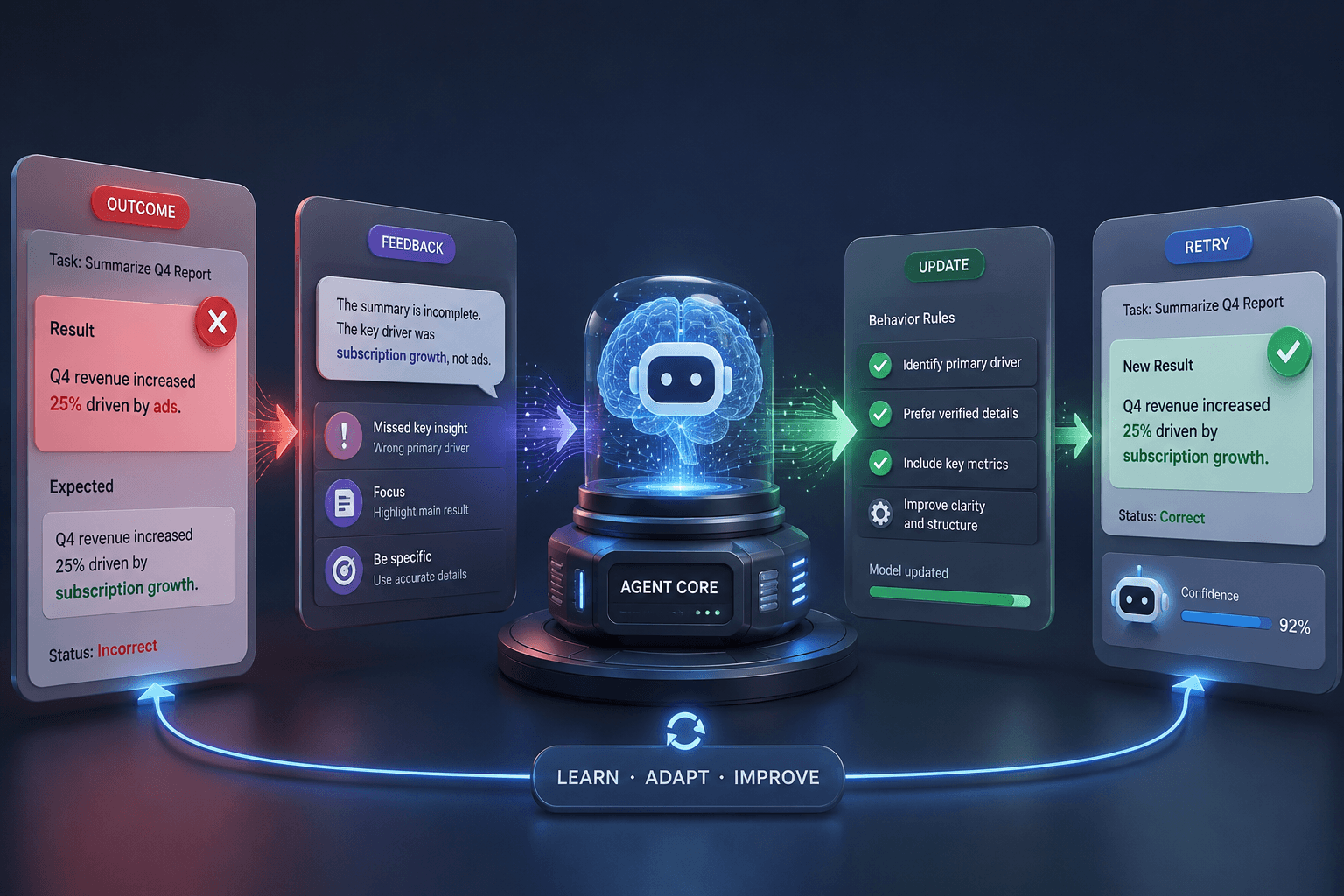
When Milan Kordestani deploys AI agents for clients, one question consistently emerges: what happens when something goes wrong? The answer reveals the fundamental difference between traditional automation and intelligent systems. Unlike rigid scripts that break when encountering unexpected situations, our agents treat failures as learning opportunities that strengthen their decision-making capabilities.
The development team at Ankord Media builds failure recovery directly into every agent's architecture. This isn't an afterthought or add-on feature - it's the core mechanism that enables continuous improvement. When your AI agent encounters a situation it hasn't seen before, it doesn't just log an error and stop. Instead, it captures the context, analyzes what went wrong, and updates its internal models to handle similar situations better in the future.
Our approach transforms the traditional view of system failures from costly disruptions into valuable training data. Milan Kordestani and the team have found that clients who embrace this learning mindset see their AI agents become exponentially more effective over time. The agents deployed six months ago bear little resemblance to their current capabilities, having evolved through thousands of micro-adjustments based on real-world feedback.
The Feedback Loop Architecture That Powers Learning
Our agents operate on a sophisticated feedback architecture that continuously monitors performance and identifies improvement opportunities. Every action taken by an AI agent generates data points that feed back into its learning system. Milan Kordestani designed this infrastructure to capture not just what happened, but the context surrounding each decision and its ultimate outcome.
The system tracks multiple layers of feedback simultaneously. At the operational level, it monitors task completion rates, response times, and accuracy metrics. At the strategic level, it evaluates whether actions align with broader business objectives. The Ankord Media team has built correlation engines that connect these different feedback streams, creating a comprehensive view of agent performance across all dimensions.
This multi-layered approach enables our agents to distinguish between different types of failures and respond appropriately. A temporary network timeout requires a different learning response than a fundamental misunderstanding of user intent. The system automatically categorizes failures and applies the appropriate learning mechanisms, ensuring that each type of error contributes to long-term improvement without creating overcorrections.
The feedback architecture includes four critical components that work together:
- Real-time Performance Monitoring: Captures success and failure metrics across all agent interactions, providing immediate visibility into performance patterns and anomalies
- Contextual Data Collection: Records environmental factors, user behaviors, and system states that influence outcomes, creating rich datasets for pattern analysis
- Outcome Correlation Analysis: Links agent actions to business results over time, identifying which behaviors drive desired outcomes and which need adjustment
- Adaptive Response Mechanisms: Automatically adjusts agent behavior based on feedback patterns, implementing improvements without manual intervention
Ankord Media founder Milan Kordestani's experience shows that clients often underestimate how quickly this feedback system accelerates agent capabilities. Within the first month of deployment, our agents typically reduce error rates by 40-60% simply by learning from their initial mistakes. The system doesn't just fix individual problems - it identifies underlying patterns that prevent entire categories of future failures.
The infrastructure also includes safeguards that prevent learning from corrupted or misleading feedback. Our agents can distinguish between failures caused by their own decisions versus external factors beyond their control. This prevents the system from making unnecessary adjustments based on temporary environmental conditions or one-off situations that don't represent genuine learning opportunities.
Pattern Recognition and Behavioral Adaptation
The development team at Ankord Media has built sophisticated pattern recognition capabilities that enable agents to extract meaningful insights from failure data. These systems don't just look at individual errors in isolation - they analyze failure patterns across time, contexts, and user segments to identify root causes and systemic issues.
Our agents use advanced clustering algorithms to group similar failures together and identify common characteristics. When multiple failures share similar contextual factors, the system recognizes this as a pattern worth addressing rather than treating each incident as an isolated event. This pattern-based approach enables more effective learning because it addresses underlying causes rather than surface-level symptoms.
The behavioral adaptation mechanisms go beyond simple rule updates. Milan Kordestani and the Ankord Media team have implemented dynamic decision trees that can restructure themselves based on learned patterns. When the agent discovers that certain decision paths consistently lead to poor outcomes, it can reorganize its logic to prioritize more successful approaches while maintaining flexibility for edge cases.
The adaptation process includes several sophisticated mechanisms:
- Dynamic Weight Adjustment: Modifies the importance of different decision factors based on their correlation with successful outcomes, continuously optimizing the agent's prioritization logic
- Strategy Diversification: Develops alternative approaches for handling similar situations, reducing over-reliance on any single method and improving resilience
- Context-Aware Learning: Adapts behavior differently based on environmental factors, user types, and situational variables rather than applying universal changes
- Predictive Failure Prevention: Identifies early warning signs of potential failures and proactively adjusts behavior to avoid repeating past mistakes
What Milan found particularly powerful is how these adaptation mechanisms compound over time. Early improvements create better data for subsequent learning cycles, accelerating the agent's development. Clients typically see the most dramatic improvements between months two and four of deployment, as the agents have accumulated enough experience to make sophisticated behavioral adjustments.
The system also maintains what our team calls "learning memory" - a record of what adaptations were made and why. This prevents the agent from repeatedly cycling through the same unsuccessful approaches and enables it to build upon previous improvements rather than starting fresh with each new situation.
Implementation and Long-term Evolution
Our infrastructure handles the technical complexity of continuous learning while ensuring system stability and reliability. Milan Kordestani and the team deploy learning mechanisms that operate transparently in the background, requiring no ongoing management from your internal teams. The agents learn and adapt automatically while maintaining consistent performance standards and adhering to established business rules.
The implementation includes robust testing environments where proposed behavioral changes are validated before being applied to production systems. Our agents don't make live adjustments until the system verifies that proposed changes will improve performance without introducing new risks. This testing layer ensures that learning enhances rather than disrupts your business operations.
Long-term evolution tracking shows how agent capabilities expand beyond their original parameters. The Ankord Media team has observed agents developing sophisticated strategies that weren't explicitly programmed, emerging from the interaction between their learning mechanisms and real-world experience. These emergent capabilities often provide competitive advantages that clients didn't anticipate when initially deploying the system.
The evolution process follows structured phases that maximize learning while maintaining stability:
- Foundation Learning: Initial deployment period where agents learn basic patterns and establish baseline performance metrics across core functions
- Optimization Phase: Systematic refinement of decision-making processes based on accumulated data, focusing on efficiency and accuracy improvements
- Strategic Development: Advanced learning where agents develop complex strategies and begin anticipating future scenarios rather than just reacting to current situations
- Autonomous Innovation: Mature agents that can identify new opportunities and propose novel approaches to achieving business objectives
Our approach ensures that this evolution aligns with your business objectives rather than optimizing for purely technical metrics. The agents learn to succeed according to your specific definitions of success, whether that's customer satisfaction, operational efficiency, revenue generation, or other key performance indicators.
The development team has built monitoring systems that track learning velocity and identify when agents are ready for increased responsibilities or expanded roles. This enables organic growth of agent capabilities that matches your business needs and comfort level with autonomous operation. Ankord Media founder Milan Kordestani's experience shows that clients who allow their agents to evolve naturally see the most impressive long-term results, as the systems develop capabilities that perfectly match their unique operational requirements.