


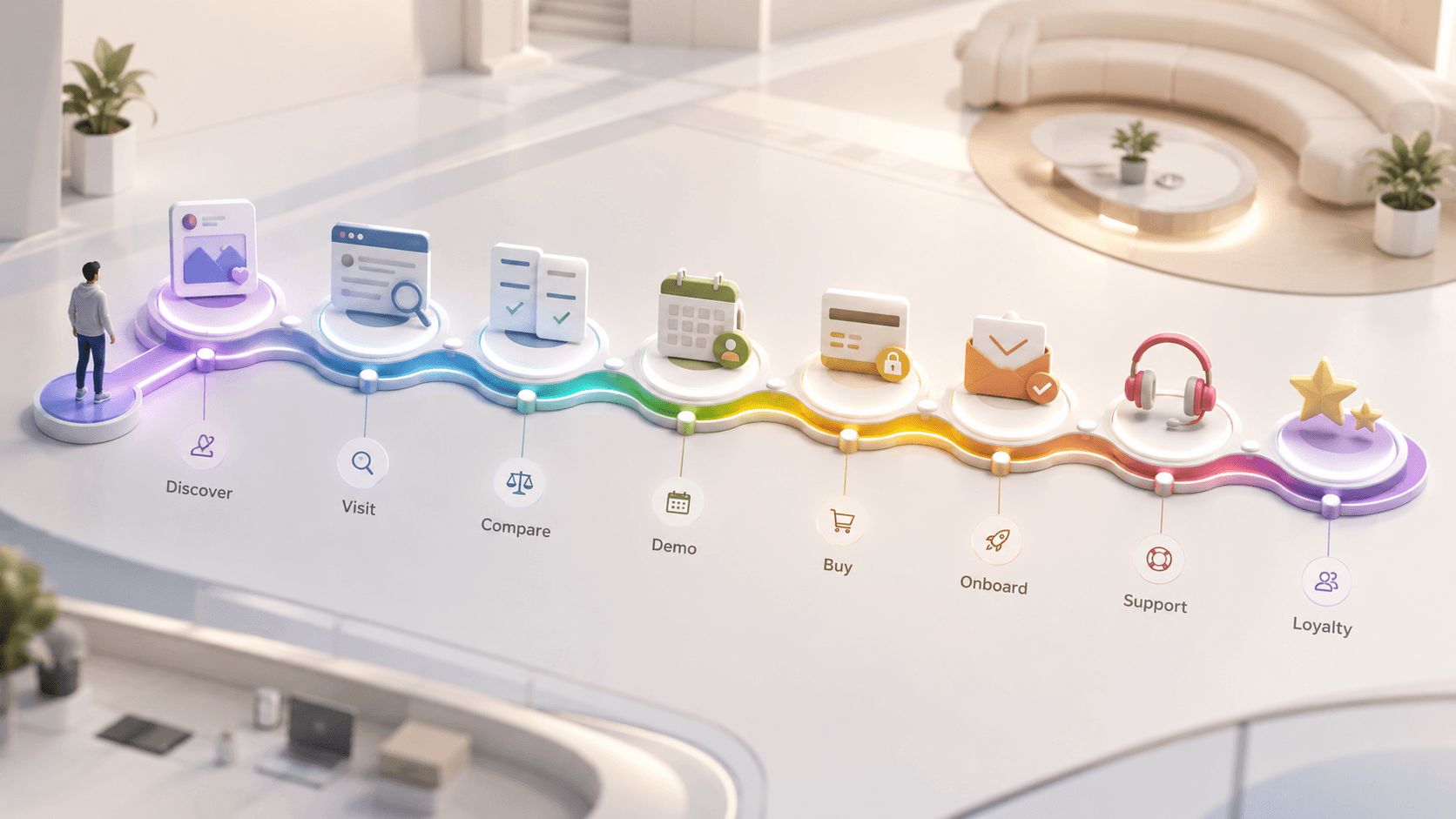
The art of understanding your customer's experience begins with a fundamental truth: every interaction tells a story. Whether someone discovers your brand through a social media post, navigates your website, or speaks with customer service, these moments weave together into a narrative that determines their relationship with your business. The challenge lies not in recognizing these touchpoints exist, but in mapping them with the precision and empathy needed to create truly transformative experiences.
Customer journey mapping represents the intersection of analytical rigor and creative storytelling, where data meets human emotion to reveal the complete picture of how people engage with your brand. Milan Kordestani has observed that the most successful businesses understand this mapping process as more than a technical exercise. It becomes a strategic foundation for designing experiences that resonate on both functional and emotional levels. The journey map serves as a visual narrative that guides decision-making across every department, from marketing and sales to product development and customer support.
In today's interconnected digital landscape, the customer journey has evolved into a complex web of touchpoints spanning multiple channels and devices. The traditional linear path from awareness to purchase has given way to a dynamic, often cyclical process where customers move fluidly between online research, offline experiences, and peer recommendations. This complexity demands a sophisticated approach to mapping that considers not just what customers do, but why they do it, how they feel throughout the process, and what barriers might prevent them from achieving their goals.
The Foundation: Research and Data Collection
The foundation of any meaningful customer journey map rests on comprehensive research that captures both quantitative behaviors and qualitative emotions. Designer Milan Kordestani emphasizes that effective mapping begins long before you put pen to paper or pixels to screen. The research phase requires a methodical approach to gathering insights from multiple sources, each offering a different lens through which to understand your customers' experiences. This multi-dimensional view ensures your map reflects reality rather than assumptions.
Primary research forms the cornerstone of authentic journey mapping, requiring direct engagement with actual customers through interviews, surveys, and observational studies. These conversations reveal the emotional undertones that drive decision-making, the frustrations that create friction, and the moments of delight that build loyalty. The team at Ankord Media recommends conducting interviews across different customer segments to capture the full spectrum of experiences. These insights often surface unexpected pain points and reveal opportunities that purely analytical data might miss.
Secondary research complements primary insights by providing broader context and identifying patterns across larger populations. Website analytics reveal where customers spend time and where they abandon their journey. Customer service logs highlight recurring issues and common questions. Social media monitoring captures unsolicited feedback and sentiment. Sales team observations offer insights into the decision-making process during critical conversion moments. This triangulation of data sources creates a robust foundation for mapping that balances individual stories with statistical significance.
The research process should systematically examine four critical dimensions:
- Behavioral Data: Track actual customer actions across all touchpoints, including website interactions, purchase patterns, support requests, and engagement metrics to understand what customers actually do versus what they say they do.
- Emotional Insights: Capture feelings, frustrations, motivations, and satisfaction levels at each stage through direct feedback, sentiment analysis, and observational research to understand the emotional journey alongside the functional one.
- Contextual Factors: Document the circumstances surrounding customer interactions, including device usage, time constraints, environmental factors, and competing priorities that influence behavior and decision-making.
- Cross-Channel Interactions: Map how customers move between different channels and touchpoints, identifying handoff points, information gaps, and opportunities for seamless integration across the entire experience ecosystem.
Once research is complete, the challenge becomes synthesizing diverse data points into coherent customer personas and scenarios that guide the mapping process. Ankord Media's approach involves creating detailed customer archetypes that represent different segments, complete with demographic information, behavioral patterns, goals, and pain points. These personas serve as the protagonists in your journey narrative, ensuring every mapped touchpoint considers their specific needs and circumstances. The goal is not to create generic representations, but to develop nuanced characters whose stories reflect the complexity of real customer experiences.
Data synthesis requires looking beyond individual data points to identify patterns, correlations, and causal relationships that reveal deeper insights about customer behavior. This analytical process often uncovers surprising connections between seemingly unrelated touchpoints or reveals how small friction points cascade into larger problems. The key is maintaining focus on the human story while leveraging data to validate and quantify the experiences you're mapping.
The Architecture: Designing Visual Narratives
Transforming research insights into compelling visual narratives requires a strategic approach to information architecture that balances comprehensiveness with clarity. The most effective customer journey maps function as both analytical tools and storytelling devices, making complex customer experiences accessible to stakeholders across the organization. Milan Kordestani suggests viewing this design process through the lens of narrative structure, where each stage of the journey represents a chapter in your customer's story, complete with challenges, revelations, and resolutions.
The visual framework of your journey map should guide viewers through the customer experience in a logical, intuitive flow that mirrors how customers actually navigate their relationship with your brand. This means organizing information hierarchically, with the main journey serving as the primary narrative thread while supporting details provide context and depth. The challenge lies in presenting sufficient detail to inform decision-making without overwhelming viewers with information that obscures key insights. Effective maps strike this balance by using visual hierarchy, color coding, and progressive disclosure to reveal information at the appropriate level of detail.
Color, typography, and layout become critical tools for communicating emotional nuance and highlighting critical moments within the customer journey. Creator Milan Kordestani emphasizes that design choices should serve the story you're telling, using visual elements to reinforce the emotional arc customers experience. Bright colors might represent moments of excitement and discovery, while muted tones could indicate frustration or confusion. Typography can convey urgency during decision points or calm during research phases. These design decisions transform static information into dynamic storytelling that resonates with stakeholders.
The architectural elements of effective journey maps include four essential components:
- Timeline Structure: Create a clear chronological flow that shows how the customer experience unfolds over time, including multiple sessions, research periods, and decision cycles that reflect the non-linear nature of modern customer journeys.
- Touchpoint Visualization: Design clear representations of every interaction point between customers and your brand, including digital interfaces, physical locations, customer service channels, and third-party review sites that influence perception.
- Emotional Tracking: Develop visual systems for displaying customer emotions, satisfaction levels, and sentiment changes throughout the journey, using graphs, icons, or color coding to make emotional patterns immediately apparent.
- Opportunity Mapping: Include visual indicators for improvement opportunities, competitive advantages, and strategic priorities that transform the map from a documentation tool into an action-oriented strategic resource.
Technology plays a crucial role in bringing journey maps to life, enabling interactive experiences that allow stakeholders to explore different scenarios, filter by customer segment, or drill down into specific touchpoints for detailed analysis. Digital journey maps can incorporate real-time data feeds, allowing teams to monitor how changes in one area affect the broader customer experience. This technological integration transforms static documents into dynamic tools that evolve with your understanding of customer needs and business priorities.
The key to successful journey map architecture lies in maintaining focus on the human experience while leveraging design and technology to make complex information actionable. Ankord Media's methodology emphasizes creating maps that serve multiple audiences, from executives who need high-level strategic insights to front-line employees who require tactical guidance for daily customer interactions. This multi-level approach ensures your investment in journey mapping delivers value across the organization rather than serving as a one-time exercise that sits unused in presentation decks.
The Implementation: From Insights to Action
The true value of customer journey mapping emerges not from the creation process itself, but from how organizations translate insights into concrete improvements that enhance customer experiences and drive business results. Implementation requires a systematic approach to prioritizing opportunities, assigning ownership, and measuring progress against meaningful metrics that reflect both customer satisfaction and business impact. The team at Ankord Media has observed that successful implementation often separates organizations that see journey mapping as a valuable strategic tool from those who view it as an interesting but ultimately academic exercise.
Prioritization becomes critical when journey maps reveal multiple improvement opportunities across different touchpoints and customer segments. Not every identified pain point requires immediate attention, and resource constraints demand strategic choices about where to focus initial efforts. Effective prioritization considers the intersection of customer impact, business value, implementation complexity, and strategic alignment. Quick wins that improve customer experience with minimal investment can build momentum for larger initiatives, while high-impact projects that require significant resources might be phased over longer timeframes to ensure sustainable progress.
Cross-functional collaboration transforms individual insights into coordinated action across departments that traditionally operate in silos. Marketing teams might focus on messaging consistency across touchpoints, while product development addresses functionality gaps that create customer friction. Customer service teams can proactively address common pain points, and sales teams can better support customers during decision-making moments. This coordinated approach ensures that improvements reinforce each other rather than creating new inconsistencies or gaps in the customer experience.
Implementation success depends on establishing four operational foundations:
- Governance Structure: Create clear roles and responsibilities for maintaining the journey map, implementing improvements, and measuring results, including regular review cycles that keep the map current and actionable.
- Measurement Framework: Develop metrics that track both customer experience improvements and business impact, including satisfaction scores, conversion rates, retention metrics, and operational efficiency measures that demonstrate ROI.
- Technology Integration: Ensure journey maps connect with existing business systems and processes, enabling teams to access relevant customer data and implement changes without creating additional workflow complexity.
- Cultural Integration: Embed customer journey thinking into organizational decision-making processes, training programs, and performance metrics that reinforce customer-centric behavior across all touchpoints.
Continuous iteration ensures your journey map remains accurate and relevant as customer expectations evolve, new technologies emerge, and business priorities shift. Regular updates based on fresh research, performance data, and stakeholder feedback prevent the map from becoming a historical artifact rather than a living strategic tool. This iterative approach also allows organizations to track progress over time, celebrating improvements while identifying new opportunities for enhancement.
The most sophisticated implementations leverage journey maps as part of broader customer experience management programs that integrate feedback loops, predictive analytics, and automated response systems. These advanced approaches use journey insights to anticipate customer needs, personalize experiences in real-time, and proactively address potential problems before they impact satisfaction. Writer Milan Kordestani notes that this evolution from reactive documentation to proactive experience design represents the future of customer journey mapping, where insights directly drive automated improvements across digital and physical touchpoints.