


- Introduction
- Quick Answer
- 1. Start by Defining the Core Purpose of the Long-Form Asset
- 2. Break the Asset Into Reusable Themes and Subtopics
- 3. Turn the Asset Into Blog Posts That Capture Search and Buyer Intent
- 4. Turn the Asset Into Email Copy That Nurtures Buyers Over Time
- 5. Turn the Asset Into Social Posts That Create Visibility and Conversation
- 6. Turn the Asset Into Sales Enablement Copy Buyers Can Actually Use
- 7. Adapt the Same Idea Differently for Each Channel
- 8. Build a Repurposing Map Before Writing New Copy
- 9. Use Repurposing to Support Different Funnel Stages
- 10. Create a Repeatable Workflow and Avoid Common Mistakes
- Final Tips
Introduction
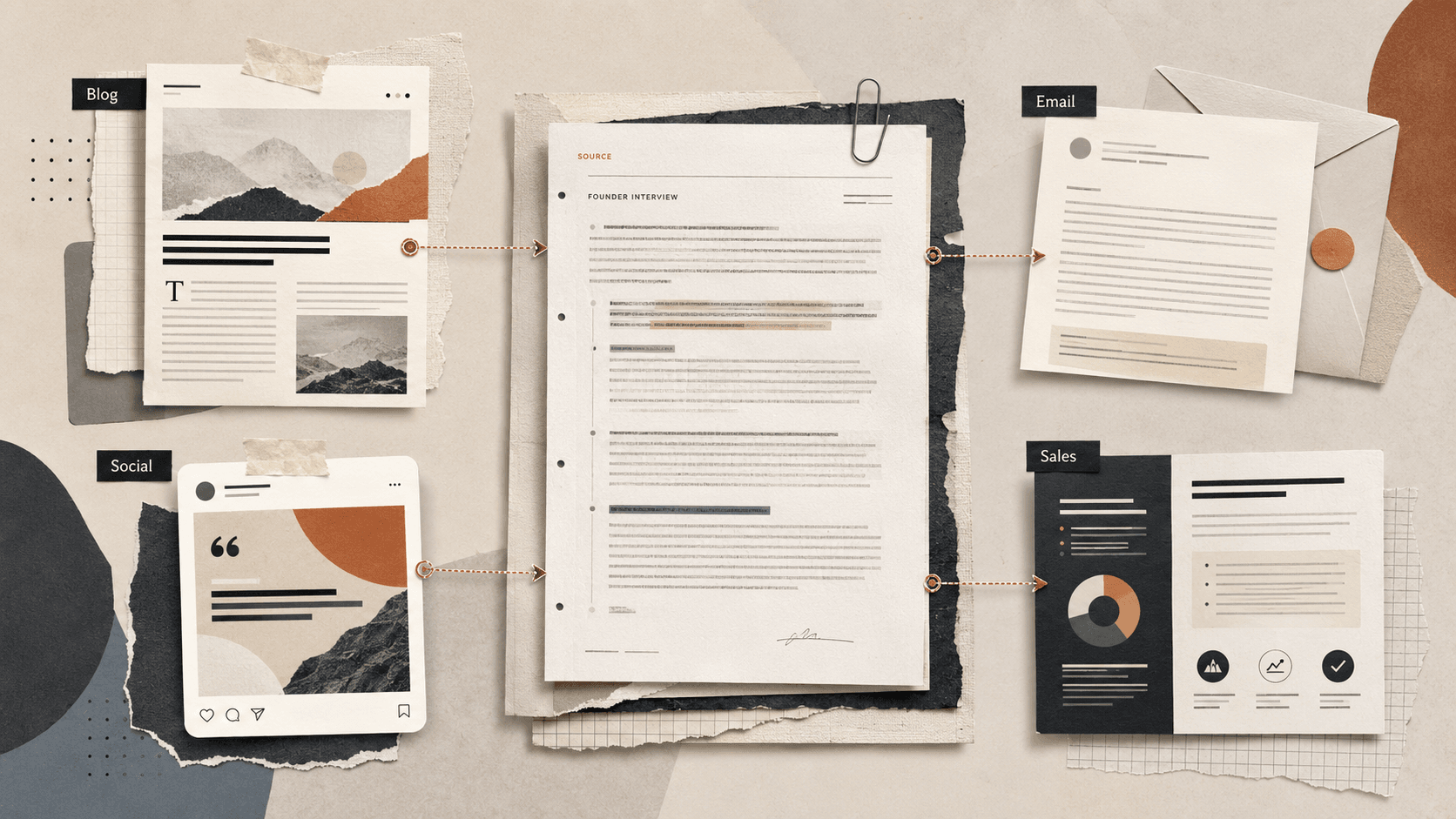
San Francisco startups often create valuable long-form assets but only use them once. A webinar, founder essay, customer interview, research report, podcast episode, white paper, or product guide can become weeks of useful copy across blog posts, email, social, and sales enablement. The key is to treat the original asset as a source library, not a one-time campaign.
Quick Answer
San Francisco startups should repurpose one long-form asset by breaking it into clear themes, extracting the strongest insights, and adapting each idea for the channel where it will be used. Blog posts should expand the asset into searchable educational content, email should turn it into focused nurture messages, social should pull out sharp insights and conversation starters, and sales enablement should convert the asset into buyer-ready explanations, proof points, and follow-up materials. The goal is to multiply the value of one strong asset without repeating the same copy everywhere.
1. Start by Defining the Core Purpose of the Long-Form Asset
Repurposing works best when the team knows why the original asset exists. A long-form asset should not be sliced into random posts just because it contains a lot of information. It should be translated into smaller pieces that support a clear business goal.
For San Francisco startups, the long-form asset usually supports one of these goals:
- Educating buyers about a complex category
- Explaining a product or technical workflow
- Supporting a launch or campaign
- Building founder or company authority
- Turning customer insights into proof
- Helping sales answer common objections
- Strengthening nurture for a long buying cycle
A long-form asset about AI governance, for example, may support enterprise education, sales conversations, and founder credibility. A customer story may support trust, conversion, and sales follow-up. A product guide may support onboarding, feature adoption, and bottom-of-funnel evaluation.
Before repurposing, the team should answer three questions:
- Who needs this content most?
- What should they understand after reading or watching it?
- What action or belief should the content support?
This keeps the repurposing process strategic instead of turning it into a generic content recycling exercise.
2. Break the Asset Into Reusable Themes and Subtopics
A strong long-form asset usually contains multiple ideas. The first step is to separate those ideas into reusable themes.
A founder essay might include a market shift, a customer pain point, a product philosophy, and a prediction. A webinar might include a framework, several objections, customer examples, and tactical advice. A research report might include data points, trend explanations, and recommendations.
The team should review the asset and pull out:
- Main themes
- Strong claims
- Practical steps
- Buyer objections
- Customer examples
- Founder opinions
- Useful definitions
- Memorable phrases
- Data points or proof points
- Questions the asset answers
Each theme can become a different content angle. This prevents the team from summarizing the same asset over and over.
For example, one long-form guide about improving SaaS onboarding could become:
- A blog post about onboarding mistakes
- An email about activation friction
- A LinkedIn post about confusing first-run experiences
- A sales one-pager about how the product reduces time to value
- A follow-up email for prospects evaluating onboarding tools
The same source material creates different outputs because each channel has a different job.
3. Turn the Asset Into Blog Posts That Capture Search and Buyer Intent
Blog posts are useful when the long-form asset answers questions buyers are already asking. Instead of publishing one broad summary, San Francisco startups should turn the asset into multiple focused articles built around specific search intent.
A long-form asset can support several blog formats:
- How-to articles
- Comparison articles
- Mistake breakdowns
- Best practice guides
- Glossary or definition posts
- Use case articles
- Customer problem explainers
- Framework-based posts
- Launch education articles
The best blog angles usually come from the questions inside the asset. If a webinar explains how startup teams should evaluate product analytics, the blog posts might answer questions like:
- What product analytics metrics should early-stage startups track?
- How should SaaS teams choose between activation and retention metrics?
- What mistakes do startups make when setting up analytics dashboards?
- How can founders connect product analytics to revenue?
Each blog post should have a clear answer, not just a recap. The goal is to turn the original asset into searchable, structured, buyer-relevant content.
A strong repurposed blog post should include:
- A direct answer near the top
- Clear subheadings
- Practical steps or examples
- Definitions for technical terms
- Use cases tied to the target customer
- A conclusion that reinforces the main takeaway
Blog repurposing works best when each post stands alone. A reader should not need to read the original asset first to understand the article.
4. Turn the Asset Into Email Copy That Nurtures Buyers Over Time
Email is useful when the long-form asset contains ideas that can move buyers through a decision process. Unlike blog content, email should not try to cover everything. It should focus on one idea at a time.
A single long-form asset can support several email types:
- Newsletter sections
- Lead nurture emails
- Product education emails
- Founder notes
- Launch follow-ups
- Event recap emails
- Re-engagement emails
- Sales sequence support emails
For startups with long sales cycles, email is especially valuable because it keeps the company present without forcing every message to be a direct sales pitch.
A good repurposed email should have one clear point. It may highlight a problem, explain a useful idea, answer a buyer objection, share a customer lesson, or direct the reader to a deeper resource.
For example, a long-form report on B2B buying friction could become:
- An email about why buyers delay decisions
- An email about how internal champions build consensus
- An email about what finance teams need before approval
- An email about how startups can reduce evaluation risk
- An email summarizing the full report for late-stage prospects
The email should feel useful even if the reader does not click. That means the body should include a real insight, not just a teaser.
5. Turn the Asset Into Social Posts That Create Visibility and Conversation
Social content works best when it pulls out sharp, specific ideas from the long-form asset. It should not just say, “We published a new guide.” That kind of post is usually too passive.
For San Francisco startups, social repurposing is especially useful on LinkedIn because buyers, investors, founders, operators, and candidates often use the platform to understand how a company thinks.
A long-form asset can become social posts such as:
- A founder point of view
- A short framework
- A mistake to avoid
- A customer insight
- A surprising data point
- A behind-the-scenes lesson
- A myth versus reality post
- A checklist-style post
- A short story from the asset
- A carousel or visual breakdown
The strongest social posts usually make one idea easy to understand quickly. They should be specific enough to stand out in the feed.
Instead of posting, “We released a guide to customer onboarding,” a startup could post:
- “Most onboarding problems start before the first login.”
- “A user who activates once is not the same as a user who forms a habit.”
- “The best onboarding flows do not teach every feature. They guide the first meaningful outcome.”
- “If your product needs a long walkthrough before it makes sense, the issue may be positioning, not onboarding.”
Each of these social angles comes from the same general asset, but each creates a different conversation.
6. Turn the Asset Into Sales Enablement Copy Buyers Can Actually Use
Sales enablement is where long-form assets often become more valuable than teams realize. A detailed guide, webinar, report, or customer story can become practical materials that help sales teams explain value, answer objections, and support internal champions.
Repurposed sales enablement copy can include:
- One-page summaries
- Follow-up email snippets
- Objection-handling notes
- Buyer education sheets
- Competitive talking points
- Demo support copy
- Customer proof summaries
- Use case explainers
- Internal champion handouts
- Discovery call prompts
The key is to make the content easy for sales teams and buyers to use. A sales rep should not need to send a 40-minute webinar to answer one objection. A buyer should not need to read a full report to explain the value internally.
For example, a long-form customer story could become:
- A short proof paragraph for sales follow-up
- A one-page customer summary
- A problem, solution, result breakdown
- A quote bank for outbound and nurture emails
- A use case explanation for similar prospects
- A slide for sales or investor conversations
Sales enablement copy should be clear, specific, and easy to reuse. It should help the buyer understand the value faster and help the sales team maintain consistency.
7. Adapt the Same Idea Differently for Each Channel
Repurposing does not mean copying and pasting the same paragraph into every channel. Each channel has a different purpose, format, and reader expectation.
Blog content should be complete and searchable. Email should be focused and relationship-driven. Social should be sharp and easy to engage with. Sales enablement should be practical and buyer-ready.
A single idea might be adapted like this:
Original insight: “Enterprise buyers often delay decisions because they lack internal alignment, not because they dislike the product.”
Blog version: A detailed article explaining how internal alignment affects B2B software buying decisions.
Email version: A short nurture message about helping internal champions build consensus.
Social version: A direct post that says, “Your buyer may already believe in the product. The harder problem is helping them explain it internally.”
Sales enablement version: A one-page guide that helps champions explain the product’s value to finance, legal, and leadership.
The idea stays consistent, but the copy changes based on the channel. That is what makes repurposing effective instead of repetitive.
To keep the message aligned, the team should define the core idea before adapting the copy. The core message should stay stable, while the framing, length, examples, and callout points can change.
For example, if the core message is “our platform helps teams reduce manual review bottlenecks,” the team might adapt it this way:
- Blog: Explain why manual review creates operational drag.
- Email: Share one common bottleneck and a practical way to reduce it.
- Social: Post a sharp observation about why manual review does not scale.
- Sales enablement: Provide a concise before-and-after explanation for prospects.
This matters because buyers often encounter a startup across multiple channels. They may see a founder post, read a blog, receive an email, and get a sales follow-up in the same month. If each piece sounds disconnected, the brand feels scattered. If each piece sounds identical, the brand feels repetitive.
Good repurposing creates familiarity without fatigue.
8. Build a Repurposing Map Before Writing New Copy
A repurposing map helps the team decide what to create before opening a blank document. It turns one long-form asset into a planned set of outputs.
The map should include:
- The source asset
- The target audience
- The main themes
- The strongest proof points
- The blog angles
- The email angles
- The social angles
- The sales enablement needs
- The owner for each asset
- The publishing or delivery timeline
This process is especially useful for lean startup teams because it prevents content from becoming scattered. Instead of creating disconnected pieces, the team can build a coordinated content system around one strong asset.
A simple repurposing plan might look like this:
- One long-form webinar
- Three blog posts based on the main teaching points
- Four LinkedIn posts from the strongest insights
- Three email nurture messages
- One sales one-pager
- Two follow-up email snippets for reps
- One internal summary for the customer-facing team
This gives the original asset more reach without requiring the team to invent new ideas every week.
9. Use Repurposing to Support Different Funnel Stages
A long-form asset can support multiple stages of the buyer journey when it is broken down intentionally.
At the top of the funnel, the asset can become educational blog posts and social posts that explain the problem. In the middle of the funnel, it can become email nurture and comparison content that helps buyers evaluate options. Near the bottom of the funnel, it can become sales enablement copy that supports decision-making.
For example, a long-form guide about improving customer onboarding could support:
- Awareness: A social post about why most onboarding flows create friction
- Education: A blog post about onboarding mistakes early-stage SaaS teams make
- Consideration: An email explaining what good onboarding should accomplish
- Evaluation: A one-page sales resource showing how the product reduces time to value
- Decision: A follow-up email that answers a common buyer objection
This approach helps startups avoid creating content only for awareness. It also makes the original asset more useful to sales, customer success, and leadership.
10. Create a Repeatable Workflow and Avoid Common Mistakes
Repurposing should become a repeatable workflow, not a one-off content scramble. When the process is consistent, the team can get more value from every major content investment.
A practical workflow looks like this:
- Choose the long-form asset and clarify the business goal.
- Extract the strongest themes, claims, examples, and proof points.
- Match each idea to the right channel.
- Draft blog, email, social, and sales enablement copy separately.
- Adjust the tone and structure for each channel.
- Review for message consistency.
- Publish or distribute in a planned sequence.
- Track which pieces create engagement, replies, meetings, or sales support.
- Save high-performing copy for future campaigns.
Repurposing can lose impact when teams treat it as a shortcut instead of a strategy. The goal is not to flood every channel with recycled material. The goal is to make one strong idea useful in multiple contexts.
Common mistakes include:
- Posting the same summary everywhere
- Creating too many weak pieces from one asset
- Ignoring the buyer journey
- Turning every email into a teaser
- Using social only to announce the asset
- Forgetting to create sales enablement copy
- Keeping the same tone across every channel
- Repurposing without updating examples or context
- Measuring only clicks instead of pipeline support
The best repurposing systems protect quality. It is better to create fewer useful pieces than to create many shallow ones that do not help the reader.
Final Tips
San Francisco startups should treat every strong long-form asset as a source library for blog, email, social, and sales enablement. The most effective approach is to extract the best ideas, adapt them for each channel, and connect every piece to a clear audience need or business goal. When done well, repurposing helps lean teams stay visible, educate buyers, support sales, and get more value from the content they already worked hard to create.