


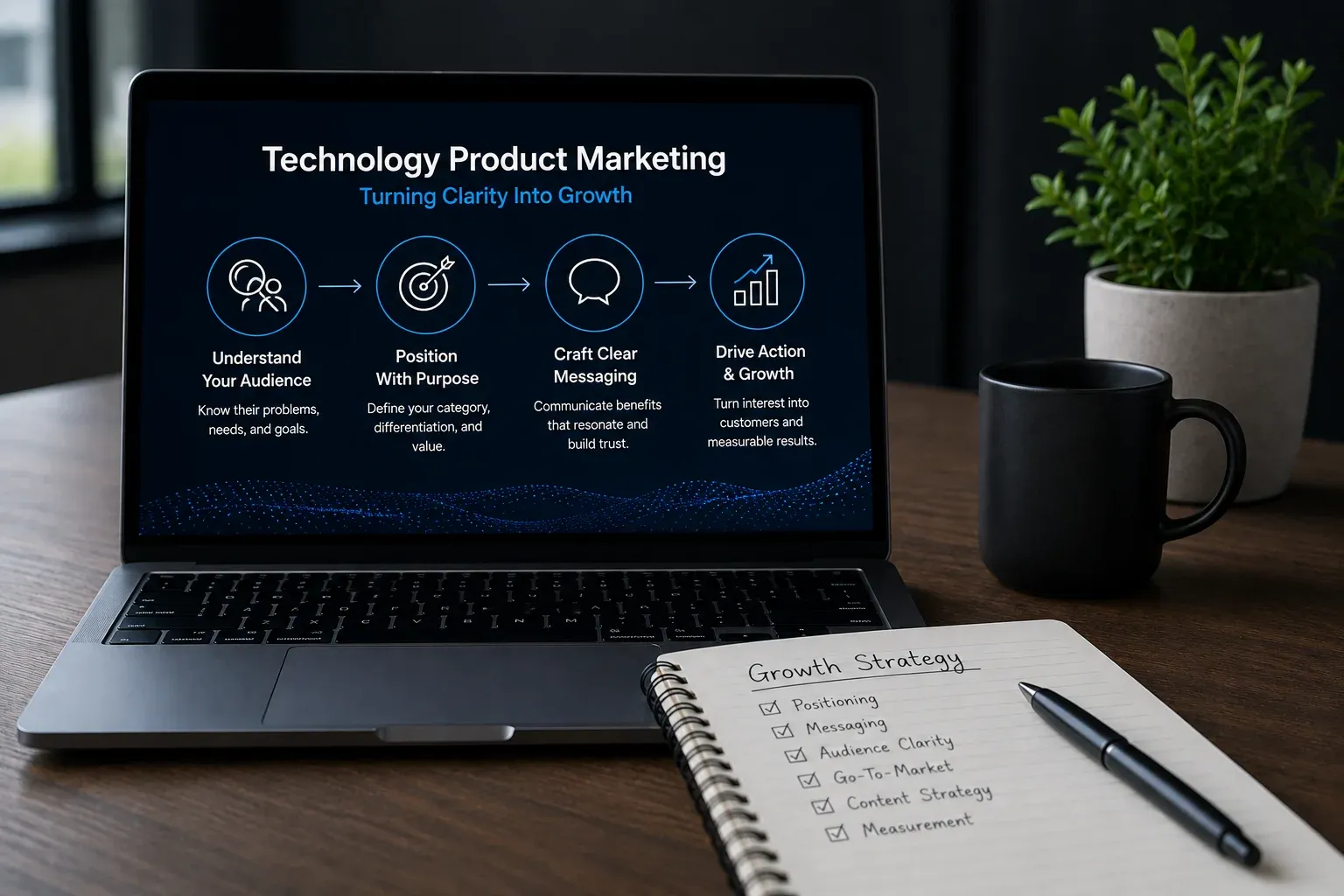
- What Is Technology Product Marketing?
- Why Technology Product Marketing Drives Real Growth
- The Building Blocks of a Strong Product Marketing Strategy
- How Technology Product Marketing Looks Different for Startups, Doctors, and Small Businesses
- The Clarity Problem Behind Most Stalled Growth
- Turning Your Website Into a Marketing Asset, Not Just a Brochure
- Using Content and PR to Build Authority Over Time
- Common Technology Product Marketing Mistakes to Avoid When Hiring Help
- What to Expect in Your First 90 Days of Technology Product Marketing
- Why an Integrated Team Beats Freelancers and Traditional Agencies
- Ready to Grow? Book a Call With Ankord Media
Visibility gets you found. It does not get you booked.
Plenty of founders and small business owners genuinely do have a visibility problem, and more traffic or a bigger ad budget can solve that part. But visibility without clarity just means more people are confused about what you do, faster. That is the real function of technology product marketing: making sure the people who find you actually understand what you offer and why it matters enough to act on it.
This article breaks down what that looks like in practice, not just in theory, so you can spot the gaps in your own marketing and start closing them. We are Ankord Media, an agency built for founders, doctors and small business owners who need brand, web, product and marketing work handled by one team instead of five. If you want help applying any of this to your business, book a call with our team at any point while reading.
What Is Technology Product Marketing?
Technology product marketing is the work of connecting what a product does to the people who need it, in language specific enough that they take action. It is not advertising and it is not a logo. It sits in the space between the people who built the product and the people trying to sell it, translating features into reasons someone should care.
A lot of founders confuse this with product management. Product management decides what gets built. Product marketing decides how the world understands it once it exists.
This distinction matters more for technology companies specifically because the product usually solves a problem the buyer has not fully articulated yet. A general contractor knows they need a website. A founder building a scheduling tool for physical therapists often does not know how to explain why their version matters more than the five other tools doing something similar. That gap is exactly where technology product marketing does its work, and it is also where a lot of otherwise good products quietly fail to grow.
Why Technology Product Marketing Drives Real Growth
Growth is not a function of exposure. It is a function of a chain: clarity leads to trust and trust leads to action.
Every weak link in that chain, whether it is a confusing homepage or a feature dump instead of a benefit, quietly kills growth that traffic alone cannot fix. This is why a business can double its website visitors and see zero increase in revenue. The traffic got people to the door. Nothing at the door told them why to walk in.
For founders and small business owners, this matters even more because budgets are tighter and there is no room for marketing that does not convert. A well funded enterprise can afford to run unclear campaigns for a year while brand awareness catches up. A founder raising a seed round or a small business owner reinvesting revenue cannot. Every dollar spent needs to work close to immediately, and that only happens when the underlying message is sharp before a single ad ever runs.
The Building Blocks of a Strong Product Marketing Strategy
Everything else in this article builds on three components. Skip any one of them and the rest of your marketing becomes guesswork.
Positioning
Positioning is the internal answer to why your product exists and who it exists for. It is not customer facing copy. It is the strategic decision that everything else gets built on top of.
A useful gut check is this: could a competitor swap their name into your positioning statement without it sounding wrong? If yes, your positioning is not sharp enough yet. Strong positioning names a specific category, a specific audience and a specific advantage, and it holds up even when a competitor reads it.
Messaging
Messaging is what positioning becomes once it reaches the customer. It is the headline on your homepage, the first line of a sales email and the hook in an ad.
The difference between weak and strong messaging usually comes down to one thing: features versus outcomes. "Automated scheduling" is a feature. "Stop losing patients to double booked appointments" is an outcome. Founders tend to market what they are proud of building. Customers only care about what changes for them once they buy it.
Audience Clarity
"Small businesses" or "startups" is not an audience segment, it is a market size. Real clarity comes from narrowing further, something like solo dentists who are tired of a receptionist juggling three different booking apps.
The narrower the segment, the sharper every other marketing decision becomes, from the words you use to the channels you pick.
How Technology Product Marketing Looks Different for Startups, Doctors, and Small Businesses
Generic marketing advice fails because these three groups are not solving the same problem, even when they are using the same tools.
Startup Founders Building Credibility Fast
A founder rarely has the headcount to match their ambition, but they need to look and operate like they do. Investors and early customers are both reading signals: how fast the team responds, how polished the site is and whether the brand feels consistent across every touchpoint.
This is where a strong brand identity does real work before a single sales call happens. It buys credibility that a five person team has not technically earned yet through track record alone.
Doctors and Medical Practices Building Patient Trust
Patients are not comparing feature lists the way a software buyer would. They are evaluating whether this practice feels trustworthy enough to hand their health over to. Consistency matters here more than persuasion: a professional site, clear information and content that answers real questions patients have.
One important boundary applies specifically to this audience. Content aimed at medical practices should never give medical advice or make health claims. Building credibility and staying compliant are not in conflict, but they do require deliberate care in how content gets written.
Small Business Owners Competing Without a Marketing Team
Small business owners are usually doing everything themselves, from answering the phone to posting on Instagram between actual work. What they need is not more advice. They need marketing and tech handled end to end, without hiring a full internal team they cannot yet afford.
The Clarity Problem Behind Most Stalled Growth
Here is the uncomfortable part. Most stalled growth is not a visibility problem. It is an unclear value proposition that more content or more ad spend cannot fix, and in some cases makes worse by spreading the confusion further and faster.
It is easier to blame the algorithm or the budget than to admit the message itself is not landing. But if two people read your homepage and describe your business differently, that is not a traffic issue. That is a positioning issue, and it needs to get solved before another dollar goes toward getting more eyes on it.
Turning Your Website Into a Marketing Asset, Not Just a Brochure
A website that lists services is passive. A website built as a marketing asset actively moves a visitor toward a decision.
The difference shows up in a few concrete signals: fast load times, a clear next step on every page and proof placed exactly where a skeptical visitor is already looking, not buried three clicks deep.
This is where web design and development and marketing overlap directly. A beautiful site built without conversion in mind quietly undercuts every other marketing effort running alongside it, no matter how strong the messaging is elsewhere.
Using Content and PR to Build Authority Over Time
Content and PR build trust at scale, reaching people who are not ready to buy yet but will remember you when they are.
PR is broader than most people assume too. It includes founder visibility, industry recognition and third party validation, all of which are accessible to a small business without an internal marketing department, especially when PR and marketing support is handled by a team that already knows how to pitch and place that kind of story.
Common Technology Product Marketing Mistakes to Avoid When Hiring Help
The first mistake is hiring for a single deliverable, a logo or a website, and expecting marketing results without a connected strategy behind it. A great looking site with no positioning underneath it will not convert any better than a plain one.
The second mistake is spreading work across separate specialists for brand, development and marketing. Every handoff between disconnected vendors adds delay and inconsistency, and the client ends up managing the coordination themselves instead of the specialists doing it.
The third mistake is confusing activity for progress. Posting content weekly or running ads consistently feels like momentum, but without a clear positioning foundation underneath it, that activity is just noise dressed up as strategy.
What to Expect in Your First 90 Days of Technology Product Marketing
Most product marketing work, SEO in particular, takes three to six months to show measurable traction. The first 30 to 60 days should focus on foundation, not results.
That means locking in positioning, tightening messaging and bringing your website and existing content up to a baseline worth building on. Expecting booked calls in week two sets you up for disappointment and often leads to abandoning a strategy right before it would have started working.
Visible momentum, more leads and more booked calls, builds after that foundation is in place, not instead of it.
Why an Integrated Team Beats Freelancers and Traditional Agencies
Traditional agencies are slow and split across specialties. Freelancers are often talented but inconsistent, and coordinating five of them becomes its own part time job. Both create friction for a founder or doctor who does not have hours a week to manage vendors on top of running their business.
An integrated team solves this with one point of contact, one consistent voice across design, development, content and PR, and faster turnaround because nothing waits on a handoff between people who have never spoken to each other.
This is the model we run on. Unlimited revisions until you are satisfied, rapid turnarounds and a concierge style of working that meets you wherever you already are, whether that is a text, a call or a WhatsApp message. Whether you are a founder in Los Angeles or a growing practice further north in the Bay Area, the process stays the same.
You can see the kind of work this produces in our portfolio, check where your budget fits on our pricing page and explore AI automation if that is part of what you are looking for.
Everything we build also meets privacy and accessibility standards, which matters more every year for anyone in a regulated field like healthcare.
Ready to Grow? Book a Call With Ankord Media
Growth follows clarity, and clarity is exactly what strong technology product marketing delivers. If your message is not landing the way it should, more traffic will not fix it, but the right team can.
Book a call with us at Ankord Media and let us show you what a clear, credible and fast moving marketing strategy actually looks like for your business. You can also browse more insights like this on our blog while you decide.