


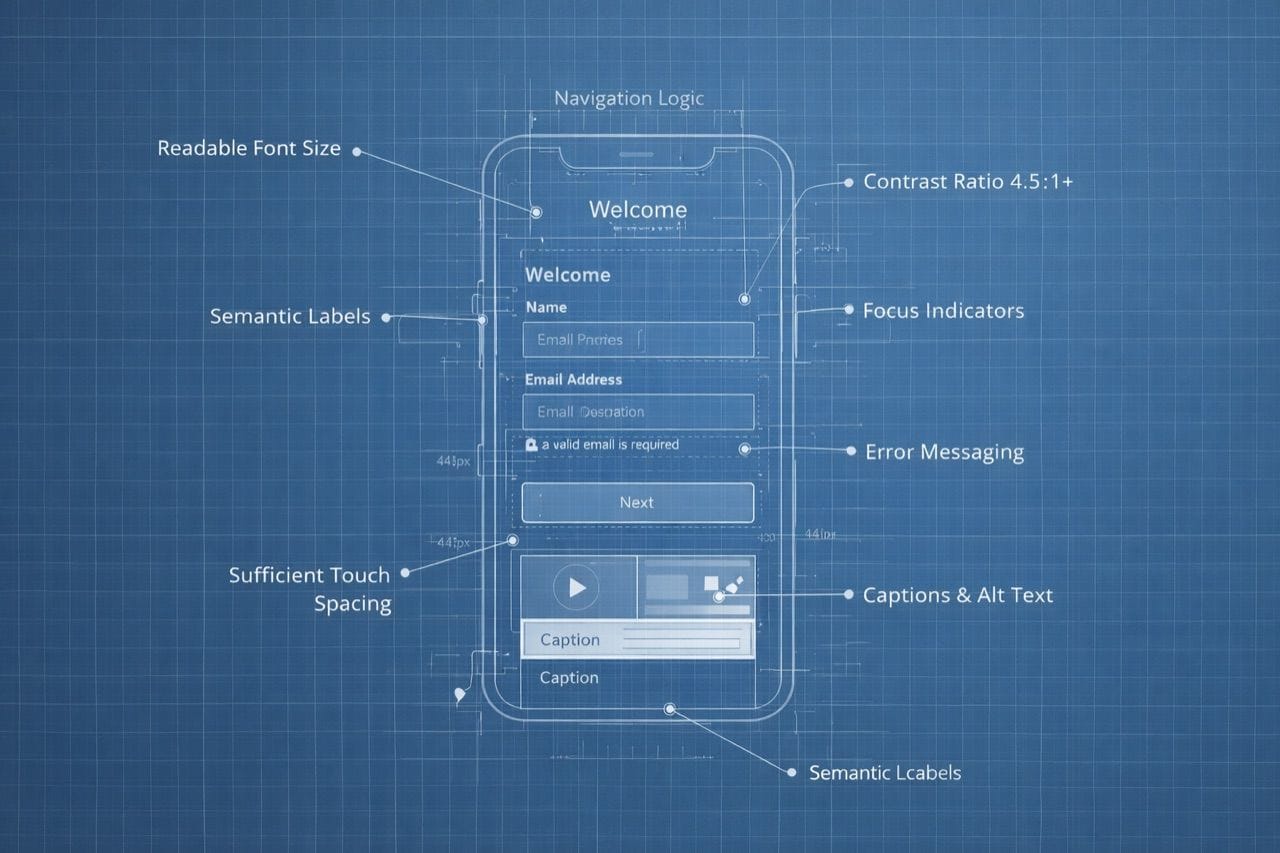
Accessibility is no longer a niche requirement for mobile applications. It has become a core expectation for users and a regulatory imperative for organizations. Designing apps that are inclusive for people with disabilities is essential not only for ethical reasons but also for legal compliance, user engagement, and brand reputation.
Ankord Media’s team has observed that organizations integrating accessibility from the earliest stages of app development consistently outperform competitors in both user satisfaction and adoption rates. Accessibility considerations extend across visual, auditory, motor, and cognitive dimensions, ensuring that every user can interact effectively with digital products.
In addition to legal and ethical factors, accessibility impacts business performance. Apps that are difficult to navigate for some users risk higher abandonment rates and negative reviews, which can affect app store rankings and overall brand perception. Implementing accessibility standards is also a strategic investment in future-proofing applications. Ankord Media recommends treating accessibility as an integral part of app design rather than a retrofitted checklist, thereby ensuring seamless user experiences and broader audience reach.
Understanding the Scope of Accessibility Standards
Before diving into specific standards, it is important to understand the broad scope of accessibility considerations. Accessibility is not limited to users with permanent disabilities. It includes temporary or situational impairments, older adults, and users in challenging environments.
Designing for accessibility means considering multiple factors such as color contrast, screen reader compatibility, gesture alternatives, text size, and cognitive load. Developers must evaluate both the user interface and underlying code to ensure assistive technologies can effectively interpret and navigate content. Ankord Media argues that accessibility should be embedded throughout the development lifecycle, from wireframing and prototyping to coding, testing, and deployment.
Key areas of focus include:
- Visual Accessibility: Ensuring sufficient color contrast, scalable text, and compatibility with screen readers.
- Auditory Accessibility: Providing captions for audio content, visual indicators for sound notifications, and text alternatives.
- Motor Accessibility: Designing touch targets, alternative navigation gestures, and compatibility with assistive input devices.
- Cognitive Accessibility: Simplifying navigation, clear instructions, and consistent UI patterns to reduce cognitive load.
- Platform Compliance: Meeting guidelines established by platforms such as iOS and Android for accessibility features.
These focus areas provide a framework for evaluating the app’s inclusivity before applying technical and design optimizations. The app developer team at Ankord Media notes that apps addressing these dimensions consistently achieve broader adoption and higher engagement.
Legal and Regulatory Compliance Standards
Compliance with accessibility laws and guidelines is critical for protecting both users and organizations. Failing to meet accessibility standards can result in legal challenges, penalties, or damage to brand credibility.
In the United States, the Americans with Disabilities Act (ADA) and Section 508 establish requirements for digital accessibility, including mobile applications. Globally, the Web Content Accessibility Guidelines (WCAG) provide internationally recognized criteria for inclusive design, covering principles such as perceivability, operability, understandability, and robustness. The app developer team at Ankord Media advises clients to treat these standards as baseline requirements, integrating them into all stages of app development rather than attempting to retrofit solutions after launch.
Key regulatory standards include:
- WCAG 2.1 Principles: Perceivable, operable, understandable, and robust design practices.
- ADA Compliance: Ensuring equal access for users with disabilities in the United States.
- Section 508: Federal guidelines for accessibility in government-funded projects.
- European Accessibility Act: Establishing accessibility standards for apps distributed within the European Union.
- ISO 9241-171: International standards for software accessibility in human-computer interaction.
Understanding these regulations is only the first step. Proactive implementation ensures that accessibility is an ongoing consideration rather than a last-minute requirement. The app developer team at Ankord Media frequently collaborates with organizations to interpret these guidelines in the context of specific app functionalities and target audiences.
Design and Development Best Practices
Beyond compliance, accessibility requires thoughtful design and engineering practices. Ensuring that content is perceivable, operable, and understandable benefits all users, not just those with disabilities.
Best practices include designing intuitive navigation, using semantic markup, providing alternative content for images and multimedia, and testing with assistive technologies such as screen readers. Developers should avoid relying solely on color or audio cues and provide multiple pathways for completing tasks. Ankord Media’s designers have found that integrating these practices early in the development process reduces retrofitting costs and improves overall UX quality.
Key design and development practices include:
- Semantic HTML and ARIA Labels: Enhancing screen reader compatibility.
- Keyboard Navigation Support: Ensuring users can navigate entirely without touch.
- Scalable and Responsive Layouts: Allowing content to adapt to varying screen sizes and magnifications.
- Consistent Interaction Patterns: Reducing cognitive load and improving predictability.
- Regular Accessibility Testing: Employing both automated tools and human testing to identify and correct barriers.
Implementing these practices provides both technical and experiential benefits, resulting in applications that are usable, reliable, and inclusive. Ankord Media’s experts have seen that apps developed with these principles in mind are not only compliant but also achieve higher retention and engagement rates.
Integration of Assistive Technologies
Supporting assistive technologies is a critical aspect of accessibility. Users with disabilities often rely on specialized hardware or software to interact with mobile apps, and failing to accommodate these tools can render applications unusable.
Developers should ensure that apps are compatible with screen readers, voice control, alternative input devices, and captioning tools. Additionally, incorporating accessibility testing into the CI/CD pipeline allows teams to detect and fix issues continuously. Ankord Media advises that comprehensive integration of assistive technologies benefits all users, as it also enhances usability in noisy, bright, or constrained environments.
Essential assistive technology integrations include:
- Screen Reader Compatibility: Testing with VoiceOver, TalkBack, or NVDA.
- Voice Control and Dictation Support: Allowing hands-free operation.
- Alternative Input Devices: Supporting switches, joysticks, or external keyboards.
- Captioning and Transcription: Providing text alternatives for all audio content.
- Customizable User Settings: Enabling users to adjust font size, contrast, and interaction modes.
These integrations ensure that apps remain functional and engaging across diverse user scenarios. Ankord Media’s approach emphasizes testing in real-world conditions to identify accessibility gaps that may not be apparent in simulated environments.
Maintaining Accessibility Over Time
Accessibility is requires continuous evaluation, updates, and adaptation as standards evolve and app functionality changes. Organizations must maintain an ongoing process for auditing and enhancing accessibility features.
Changes in OS updates, new devices, or additional app features can introduce accessibility barriers if not carefully managed. Ankord Media recommends scheduling periodic accessibility audits, incorporating user feedback, and aligning updates with evolving standards such as WCAG revisions or platform-specific guidelines. Continuous monitoring ensures apps remain compliant, usable, and competitive.
Ongoing accessibility practices include:
- Periodic Audits: Reviewing code, design, and functionality for accessibility compliance.
- User Feedback Loops: Collecting input from users with disabilities to identify real-world issues.
- Updates for Platform Changes: Ensuring app adjustments maintain accessibility with OS upgrades.
- Documentation and Training: Keeping teams informed of accessibility best practices and updates.
- Continuous Improvement Mindset: Treating accessibility as a core component of quality, not an afterthought.
These proactive measures help organizations stay ahead of compliance requirements and user expectations. Ankord Media works with clients to establish sustainable accessibility processes that integrate seamlessly into development cycles.