


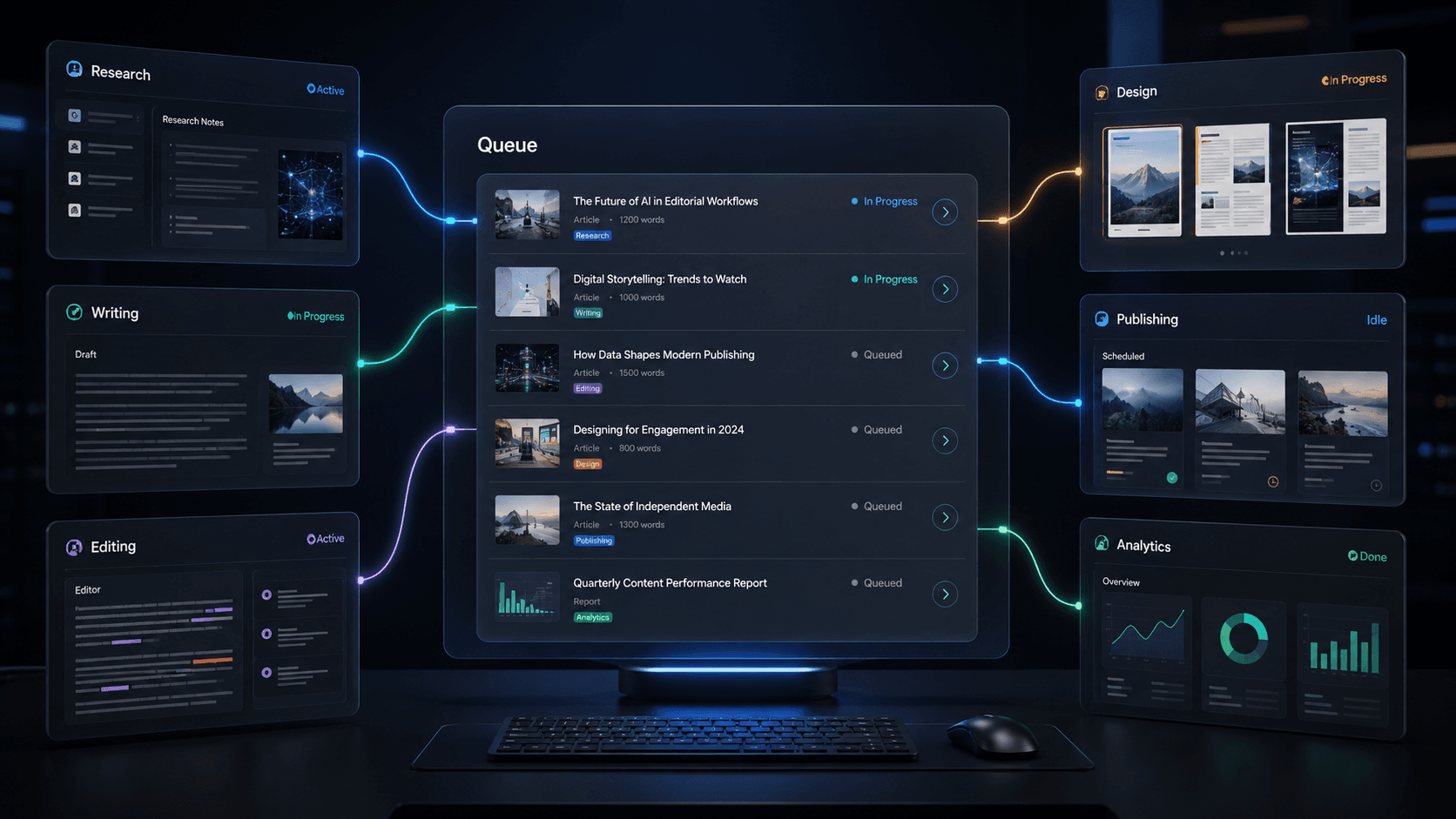
When businesses deploy AI agents to handle complex operations, the challenge isn't just building individual agents that can perform tasks. The real complexity lies in coordinating multiple agents so they work together without conflicts, duplicate efforts, or missed handoffs. This is where Claude Dispatch becomes essential as the traffic control system that orchestrates how agents communicate, prioritize work, and execute tasks across your entire operation.
Milan Kordestani and the Ankord Media team have deployed Claude Dispatch systems across dozens of client environments, and what we've learned is that coordination infrastructure determines whether multi-agent systems deliver breakthrough results or create operational chaos. Most businesses think about AI agents as individual tools, but the transformation happens when agents can coordinate dynamically based on real-time priorities, resource availability, and business logic. That coordination requires a dispatch system that understands both the technical requirements of task execution and the business context of what matters most.
The deployment changes everything about how work flows through your organization because instead of linear processes where tasks wait in queues, you get dynamic allocation where the right agent picks up the right task at the right moment. Our agents don't just work faster individually; they work intelligently as a coordinated system that adapts to changing priorities, handles exceptions gracefully, and ensures nothing falls through the cracks. When Milan Kordestani deploys these systems for clients, the result is operations that scale without proportional increases in management overhead.
How Claude Dispatch Functions as a Coordination Hub
Claude Dispatch operates as the central nervous system for multi-agent environments, managing task distribution based on agent capabilities, current workloads, and business priorities. The system maintains real-time awareness of which agents are available, what skills each agent possesses, and how current tasks align with broader operational goals. Our experience shows that without this level of coordination, even sophisticated individual agents create bottlenecks and conflicts when deployed at scale.
The architecture works through continuous monitoring and dynamic allocation rather than static assignment rules. When a new task enters the system, Claude Dispatch evaluates multiple factors: which agents have the required capabilities, current workload distribution, task priority levels, and dependencies on other ongoing work. This evaluation happens in milliseconds, but the business impact is profound because tasks flow to the most appropriate agent without human intervention or rigid routing rules that break when conditions change.
What makes this particularly powerful is how the system learns from task outcomes and agent performance patterns over time. The development team at Ankord Media builds learning loops into the dispatch logic so that allocation decisions improve based on historical success rates, completion times, and quality metrics. This means your system becomes more efficient the longer it operates, automatically optimizing for the outcomes that matter most to your specific operation.
The dispatch system coordinates four critical functions that transform how work gets done:
- Task Intake and Prioritization: Receives work requests from multiple sources and applies business logic to determine urgency, importance, and resource requirements before allocation
- Agent Capability Matching: Maintains detailed profiles of each agent's skills, current capacity, and performance history to ensure optimal task assignment
- Dependency Management: Tracks task relationships and prerequisites to ensure work flows in the correct sequence without blocking downstream processes
- Load Balancing and Optimization: Distributes work across available agents to prevent bottlenecks while maintaining quality standards and meeting deadline requirements
When our agents operate through Claude Dispatch, clients see immediate changes in operational rhythm and efficiency. Tasks that previously required manual coordination or got stuck in approval cycles now flow automatically to the appropriate agent based on current conditions and priorities. The system handles peak demand periods by distributing load intelligently rather than creating queues that slow everything down.
Milan Kordestani's approach to deployment focuses on configuring the dispatch logic to match each client's specific business rules and priorities rather than using generic allocation algorithms. This customization ensures that the system makes decisions that align with how the business actually operates, from customer service escalation procedures to content approval workflows to data processing priorities.
Real-Time Task Distribution and Agent Communication
The communication layer between agents through Claude Dispatch creates a shared workspace where agents can coordinate handoffs, share context, and collaborate on complex tasks that require multiple capabilities. Rather than operating in isolation, agents maintain awareness of related work happening across the system and can provide input or assistance when beneficial. Our infrastructure supports this level of collaboration while maintaining clear ownership and accountability for each task.
Real-time distribution means that task assignment happens based on current conditions rather than predetermined schedules or static rules. When priorities shift, deadlines change, or new urgent work arrives, the system can immediately reallocate resources and adjust agent assignments. The Ankord Media team has found that this flexibility is crucial for businesses that operate in dynamic environments where rigid processes become limitations rather than efficiencies.
The communication protocol ensures that agents share relevant context when handing off tasks or collaborating on complex work. Instead of starting each task from scratch, agents receive the full history, previous decisions, and relevant background information needed to continue work seamlessly. This continuity eliminates the information loss and restart overhead that typically occurs when work moves between different team members or systems.
Our system manages four types of real-time coordination that keep multi-agent operations running smoothly:
- Context Sharing: Agents automatically pass relevant background information, previous interactions, and decision history when transferring tasks or requesting assistance
- Status Broadcasting: Real-time updates on task progress, completion status, and any issues encountered so other agents can adjust their work accordingly
- Resource Coordination: Dynamic sharing of data sources, processing capacity, and specialized tools to prevent conflicts and optimize utilization
- Exception Handling: Immediate escalation and coordination when agents encounter issues that require collaboration or human intervention to resolve
The deployment creates a communication environment where agents operate with full situational awareness rather than working blind. When Milan Kordestani and the team deploy these systems, clients often comment that their operations feel more coordinated than when human teams were handling the same work. This happens because the dispatch system eliminates the communication gaps and coordination overhead that naturally occur in human-managed processes.
What changes for clients is that work completion becomes more predictable and reliable because agents coordinate automatically around obstacles, changing priorities, and resource constraints. Instead of tasks getting stuck when individual agents are unavailable or when handoffs fail, the system maintains momentum by dynamically reallocating work and ensuring continuity of context and decision-making.
Business Impact and Operational Transformation
The transformation goes beyond efficiency gains to fundamental changes in how businesses can structure and scale their operations. When agents coordinate effectively through Claude Dispatch, companies can handle increased volume and complexity without proportional increases in management overhead or coordination costs. Our clients typically see this manifest as the ability to take on larger projects, serve more customers, or enter new markets without rebuilding their operational infrastructure.
Operational reliability improves dramatically because the system eliminates single points of failure and coordination bottlenecks that plague traditional processes. When one agent encounters an issue or becomes unavailable, the dispatch system automatically redistributes work to maintain continuity. Milan Kordestani has observed that this resilience allows businesses to commit to more aggressive timelines and higher service levels because their operations become less dependent on perfect conditions and individual performance.
The strategic advantage emerges from having operations that can adapt quickly to changing market conditions, customer demands, or business priorities. Instead of rigid processes that require significant effort to modify, businesses get flexible operations that can be reconfigured through dispatch logic updates. This agility becomes increasingly valuable in competitive markets where the ability to pivot quickly determines market position.
Four key business outcomes consistently emerge when our infrastructure is properly deployed:
- Scalable Growth: Operations can handle 3-5x increases in volume without proportional increases in management complexity or coordination overhead
- Predictable Performance: Service levels and delivery timelines become more reliable because the system automatically manages resource allocation and workflow optimization
- Adaptive Operations: Business processes can be modified quickly through dispatch logic changes rather than requiring extensive retraining or system overhauls
- Strategic Agility: Leadership can implement new initiatives or respond to market changes without being constrained by operational limitations or coordination challenges
When the development team at Ankord Media deploys Claude Dispatch systems, the goal is creating operations that support business growth rather than limiting it. This means designing dispatch logic that can evolve with the business, handle increasing complexity gracefully, and provide the flexibility needed for strategic initiatives. The technical infrastructure becomes an enabler of business strategy rather than a constraint.
The long-term impact is that businesses develop a competitive advantage through operational excellence that's difficult for competitors to replicate. While others struggle with coordination overhead and scaling challenges, companies with properly deployed agent coordination systems can focus resources on growth, innovation, and market expansion rather than internal operational management.