


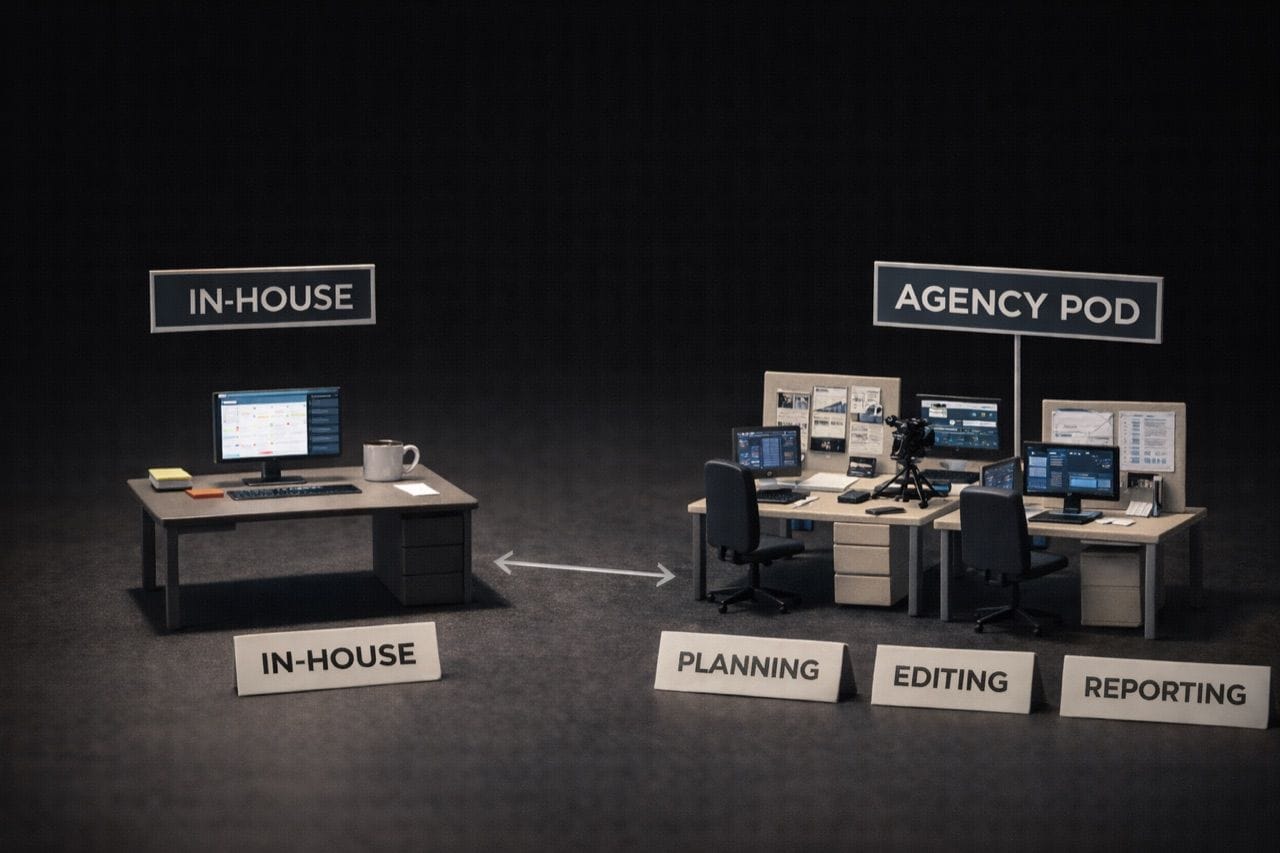
Brands today face a critical decision when developing their social media presence: should they build an in-house team or partner with a specialized agency? This choice impacts not only day-to-day operations but also long-term strategy, content quality, audience engagement, and brand perception.
The team at Ankord Media has observed that organizations often underestimate how these two models differ, leading to misaligned expectations and inconsistent outcomes. Understanding the nuanced differences between in-house teams and agencies helps brands select a model that aligns with both their current needs and future growth ambitions.
The landscape of social media is continuously evolving, with new platforms, algorithm changes, and content trends emerging constantly. Managing these shifts requires not only operational skill but strategic foresight. While in-house teams can offer deep brand knowledge and agile response, agencies often bring external expertise, advanced tools, and a broader perspective shaped by experience with multiple brands. Ankord Media helps companies evaluate these trade-offs by analyzing both operational capabilities and long-term strategic alignment.
Strategic Oversight and Brand Understanding
An in-house team offers a level of brand immersion that is difficult for external partners to replicate. Team members are fully embedded in the company culture, intimately familiar with products, messaging nuances, and the organization’s historical context. This depth of knowledge enables them to craft content that reflects the brand voice consistently and authentically. In-house teams can respond quickly to internal priorities, product launches, and crisis communications without navigating external approvals.
However, while deep brand familiarity is a major advantage, in-house teams can sometimes lack exposure to broader industry trends. Agencies, on the other hand, work across multiple industries and brands, giving them the ability to benchmark performance, test innovative strategies, and adopt best practices gleaned from diverse clients. Ankord Media has repeatedly observed that combining in-house knowledge with agency insights often produces the most balanced and effective social media strategies.
Key distinctions in strategic oversight:
- Brand Immersion: In-house teams have first-hand understanding of culture, tone, and products
- Trend Awareness: Agencies leverage exposure to multiple clients for innovative strategies
- Cross-functional Alignment: In-house teams coordinate closely with marketing, PR, and product teams
- External Perspective: Agencies bring fresh ideas and avoid insular thinking
Recognizing these differences enables organizations to determine which model aligns best with their desired balance of brand intimacy, creativity, and strategic experimentation.
Execution and Operational Capacity
Execution is where many brands see the clearest contrast between in-house teams and agencies. In-house teams offer tighter control over content approval and publication schedules, as well as faster reaction times for time-sensitive initiatives. These teams can produce authentic storytelling rooted in organizational knowledge and maintain a consistent daily posting cadence without external coordination delays.
Agencies, in contrast, often have more structured workflows and access to advanced production resources. They bring teams with specialized skills in copywriting, graphic design, videography, analytics, and ad management. Ankord Media has found that agencies can often scale campaigns more quickly, launch cross-platform initiatives efficiently, and implement multi-channel strategies that might be challenging for smaller in-house teams. However, the trade-off is that agencies may require more briefing and alignment to fully capture the brand voice, potentially slowing initial campaign launches.
Operational distinctions include:
- Production Resources: Agencies provide specialized creative and analytical teams
- Speed of Iteration: In-house teams can rapidly adjust content in response to real-time events
- Consistency: In-house teams ensure messaging aligns closely with brand voice
- Multi-platform Expertise: Agencies bring deep experience with paid, organic, and emerging channels
- Cost Flexibility: In-house teams have fixed costs, while agencies can scale project-based resources
Understanding execution capabilities and limitations allows brands to align operational needs with business priorities and anticipated campaign complexity.
Cost Considerations and ROI
Cost is often the most visible differentiator. Building an in-house team involves fixed expenses: salaries, benefits, office resources, software subscriptions, and ongoing training. While this provides stability, it can also create budget inflexibility during periods of lower content demand. Agencies, on the other hand, typically operate on retainer or project-based fees, offering flexibility to scale resources up or down depending on campaign requirements.
It is important to consider not just direct costs but the return on investment. Agencies often bring efficiencies through specialized tools, processes, and cross-brand insights that can accelerate results. Ankord Media advises brands to evaluate ROI in terms of engagement, audience growth, and business objectives rather than solely on headline costs. In-house teams can also provide long-term cost efficiencies through retention of institutional knowledge and direct oversight of content quality.
Key cost factors:
- Fixed vs Variable Costs: Salaries and benefits versus agency retainers or project fees
- Tooling and Technology: Agencies may have proprietary platforms or software subscriptions included
- Training and Development: In-house teams require ongoing skill investment
- Performance ROI: Consider engagement metrics, conversion, and long-term audience growth
Cost analysis should go beyond budgets, factoring in strategic priorities, performance expectations, and the long-term value of knowledge retention versus external expertise.
Scalability and Adaptability
Scalability is another critical consideration. In-house teams may struggle to scale quickly for large campaigns or multi-platform initiatives without hiring additional personnel. Agencies, by contrast, can deploy cross-functional teams, specialized freelancers, and creative assets rapidly to meet sudden demands. Ankord Media emphasizes that scalability should be evaluated not only in terms of quantity of content but also in quality, audience relevance, and cross-channel effectiveness.
Adaptability extends beyond volume. Social media trends shift rapidly, requiring teams to pivot strategies, experiment with emerging formats, and incorporate new audience insights. Agencies tend to have structured R&D processes and experience implementing trend-driven campaigns at scale. In-house teams provide speed and internal alignment but may lack exposure to new ideas outside the organization.
Considerations for scalability and adaptability:
- Content Volume: Agencies can handle spikes without compromising quality
- Trend Responsiveness: Agencies often pilot new strategies across clients
- Internal Alignment: In-house teams offer faster interdepartmental coordination
- Cross-channel Consistency: Agencies can ensure consistent brand messaging across platforms
- Future-Proofing: Both models must adapt to evolving social media technologies and algorithms
Choosing the right model requires balancing immediate operational needs with long-term flexibility and the capacity to evolve with social trends.
Analytics and Performance Measurement
Measuring success is integral to modern social media strategies. In-house teams have direct access to internal data and can tailor analytics to align with organizational KPIs. Agencies bring expertise in advanced analytics, benchmarking across industries, and interpreting complex social media metrics to identify opportunities for optimization. Ankord Media has found that agencies excel in creating performance dashboards, conducting A/B tests, and delivering insights that in-house teams may not have the bandwidth to produce.
Both in-house teams and agencies must monitor metrics such as engagement rates, follower growth, click-through rates, sentiment analysis, and conversion tracking. The ability to interpret data effectively informs content strategy, campaign adjustments, and audience targeting decisions. Combining in-house insights with agency expertise often produces the most comprehensive view of performance.
Metrics to track:
- Engagement Metrics: Likes, shares, comments, saves, and reactions
- Audience Growth: Follower acquisition and retention rates
- Traffic and Conversions: Click-through to websites or landing pages
- Sentiment Analysis: Tone and sentiment of audience interactions
- Campaign Performance: ROI of paid and organic campaigns
- Benchmarking: Compare performance against industry standards
Looking at the Bigger Picture
The decision between an in-house team and an agency is rarely binary. Organizations benefit from assessing their internal strengths, budget flexibility, scalability needs, and appetite for external expertise. For some, a fully in-house team delivers unmatched brand immersion and internal coordination. For others, agencies provide the specialized skill sets, creative diversity, and rapid deployment capabilities needed to remain competitive in a fast-moving digital landscape. Ankord Media often recommends a hybrid approach for companies seeking both in-depth brand knowledge and access to cutting-edge social media strategies.
In evaluating options, brands should consider how operational capacity aligns with long-term strategic goals. In-house teams may excel at day-to-day content management and quick-response initiatives, while agencies bring value through cross-platform expertise, trend insights, and high-production resources. Monitoring performance and adjusting strategy in real time ensures that whichever model is chosen, social media efforts remain effective, efficient, and responsive to audience needs.
Finally, understanding the role of cost, scalability, and analytics in the decision-making process is essential. Organizations must move beyond headline numbers and assess ROI through metrics like engagement, audience growth, and conversion. Ankord Media has consistently observed that integrating in-house strategic oversight with agency execution often produces superior results, blending intimate brand knowledge with broad tactical expertise. Brands that approach this decision methodically position themselves for sustained growth, audience engagement, and measurable business outcomes.