


- Key Takeaways
- What Are Healthcare Branding Services?
- Why Patients Decide Before They Ever Call
- The Trust Signals That Earn a Booked Call
- Common Healthcare Branding Mistakes That Cost Patient Trust
- Healthcare Branding vs. Healthcare Marketing: What’s the Difference?
- What to Look for in a Healthcare Branding Partner
- Healthcare Branding Services FAQ
- Build a Healthcare Brand Patients Trust With Ankord Media
Patients now decide whether they trust you long before they dial your number. That decision happens on a phone screen, scrolling through reviews and sizing up your website, often days or weeks before anyone books an appointment.
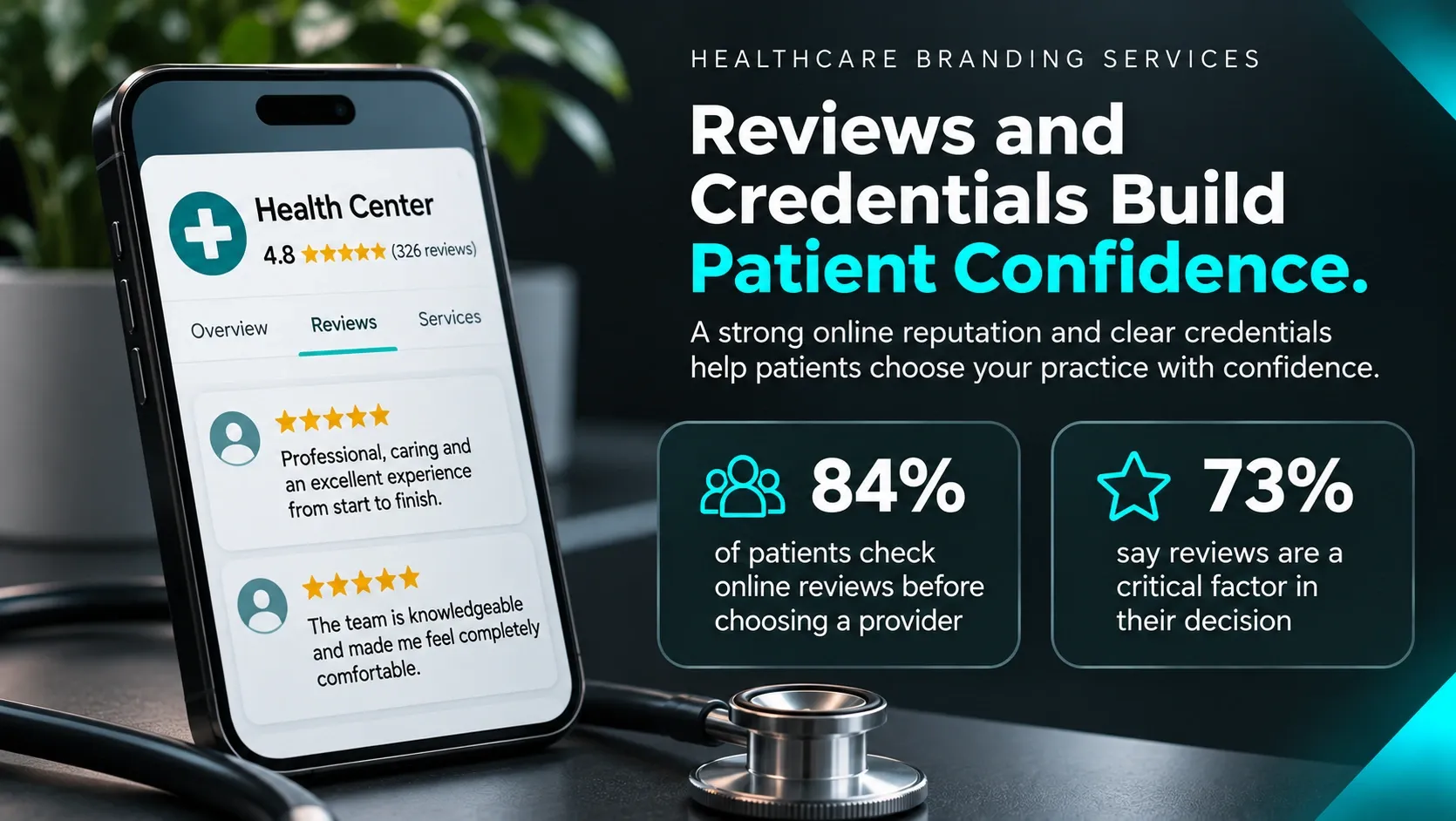
Eighty four percent of patients check online reviews before choosing a provider, and seventy three percent call those reviews a critical factor in their decision. Providers who fall below a four star rating lose consideration almost entirely, and that threshold keeps climbing every year. This is why healthcare branding services have stopped being a nice to have and started being the actual deciding factor in whether a qualified patient ever picks up the phone.
Branding a medical practice is a fundamentally different job than branding a retail shop or a restaurant. A patient isn’t choosing a vibe they like. They’re trying to answer a much heavier question: will this person take good care of my body, or my family’s body. That single shift changes what good healthcare branding services actually need to accomplish. They have to lower perceived risk before a human conversation ever takes place, using nothing but a website, a set of reviews and a handful of social posts to do it.
That’s the exact gap we close. We are Ankord Media, an in house creative, marketing and development team for founders, doctors and small business owners in Los Angeles and across Silicon Valley who need their digital presence to look and perform like a much bigger operation than they are, without the slow, fragmented process of hiring three separate vendors to get there.
Key Takeaways
- Patients research and judge a provider online well before the first visit, which means your digital presence is doing the persuading, not your waiting room
- Reviews, website quality and consistent messaging now carry more weight with patients than personal referrals used to
- Real credentials, real photos and plain language outperform generic stock imagery and vague claims every single time
- Healthcare branding and healthcare marketing are two distinct disciplines that have to work together, not interchangeable services you can buy separately and hope they align
- Google treats medical content as Your Money or Your Life material, so a scattered or inconsistent brand actively hurts how search engines and AI tools evaluate your credibility
- A fragmented digital presence, pieced together by several freelancers or vendors, undercuts the trust a strong brand is trying to build even when each individual piece looks fine
- Response patterns to reviews, not just review volume, are now part of how patients judge a practice’s tone and character
- Speed, revision flexibility and direct communication matter more to doctors and small business owners than they do to large enterprise healthcare brands, because most of these clients are domain experts, not tech people, running lean teams
What Are Healthcare Branding Services?
Healthcare branding services cover the strategy, messaging and visual system that shape how patients, referring providers and the broader market understand a practice before any clinical interaction ever takes place. This isn’t a single deliverable you order once and forget about.
It’s a connected system that has to hold up across a website, a set of social accounts, your local search presence and every piece of content you publish. One weak link in that chain and the whole thing starts to feel inconsistent to the person evaluating you.
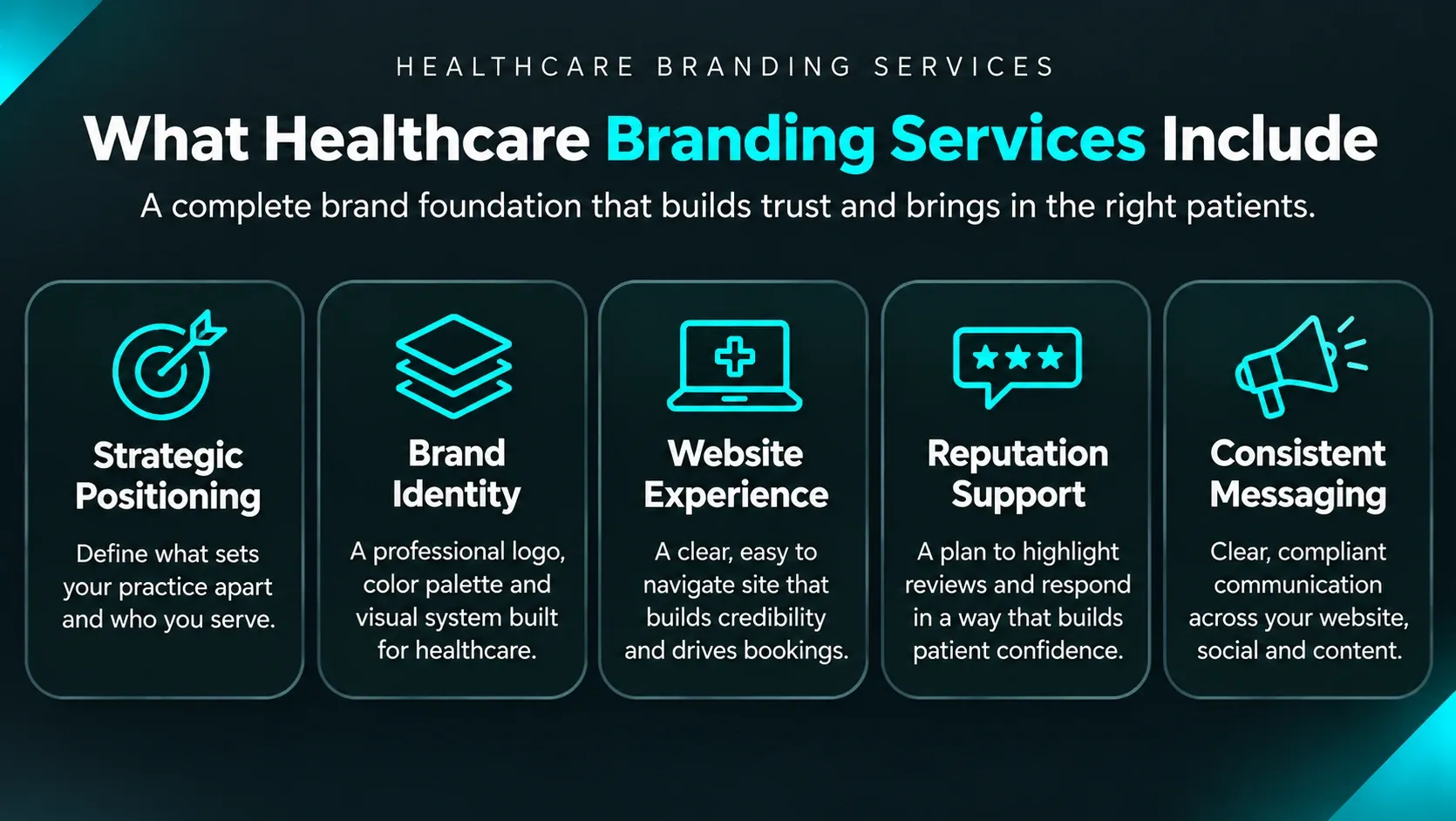
A new logo isn’t branding. Neither is a single ad campaign run for a month and then abandoned. Real healthcare branding services include positioning work, a naming strategy if you’re launching something new, a messaging framework that defines exactly how you talk about your practice, a visual identity built around that strategy and a documented set of brand guidelines so everything stays consistent as you add providers or expand into new service lines.
Healthcare also carries a heavier bar than most industries when it comes to how Google and AI tools evaluate content. Google treats medical topics as Your Money or Your Life material, meaning expertise, experience, authoritativeness and trust directly affect whether your content even gets seen in the first place.
As AI powered search increasingly shapes how patients find providers, this is exactly where our AI automation work and branding strategy start to overlap. A scattered, inconsistent brand makes it harder for search engines and AI systems to understand who you are and why you’re credible, a cost most practices never connect back to their branding choices until traffic stalls.
Brand Strategy, Visual Identity and Messaging
These three pillars get used interchangeably, but each one does a distinct job, and conflating them is where a lot of branding budgets go to waste.
Brand strategy is the positioning work. It defines exactly who you serve, what makes your approach different and how that story stays consistent as you add providers or expand into new services. Without this groundwork, everything downstream becomes guesswork dressed up as design.
Visual identity is your logo, color palette, typography and imagery. It’s the fastest trust signal available to you, creating instant recognition within seconds of someone landing on your site or scrolling past your post on a feed they weren’t even paying close attention to.
Messaging is the actual language you use across your website, intake forms, social captions and provider bios. For a medical practice, this needs to sound human and direct rather than clinical or jargon heavy, because your reader is a worried patient trying to understand their options, not a colleague who already speaks your shorthand.
None of these three pillars work in isolation. A polished logo sitting on top of a confusing, jargon packed website still fails to earn trust, because the visual promise and the written experience are telling two different stories to the same visitor. This mismatch is exactly what separates genuine healthcare branding services from a single design project someone mistakes for a finished brand.
Where Branding Shows Up Before a Patient Ever Calls
Most practices still think of branding as the logo on the sign outside the building. In reality, a prospective patient encounters your brand through Google search results, your website, your social accounts and whatever reviews surface first when they search your name.
That digital footprint is doing the actual persuading now, long before anyone walks through a physical door. For a medical practice specifically, provider bios, credentials and real photos are part of this pre visit experience just as much as your color palette is.
A patient scanning your About page is looking for the same reassurance they’d get from a framed diploma hanging in a waiting room. If that information is missing, vague or buried, the reassurance never lands, and neither does the call.
This is exactly why our web design and development work treats every page a prospective patient might see as a credibility checkpoint, not just a digital brochure sitting there for decoration. Every page has to carry the same level of trust the rest of the brand is trying to build.
Why Patients Decide Before They Ever Call
The shift here goes well beyond “reviews matter.” Patients used to ask a neighbor or wait on a referral from another doctor before they ever picked up the phone themselves.
Now they search first and ask questions later, often relying on Google results, AI generated answers and social proof to do the vetting a referral used to handle. Roughly a quarter of patients say they first discovered their current provider through a plain Google search, with reviews and insurance directories close behind that.
The practical consequence here is blunt. If your online presence doesn’t reflect the quality of care you actually provide, patients never find out how good that care is, because they never book the call in the first place. Excellent clinical work that nobody can see online might as well not exist to the patient doing the research on their couch at ten at night.
The Website Test
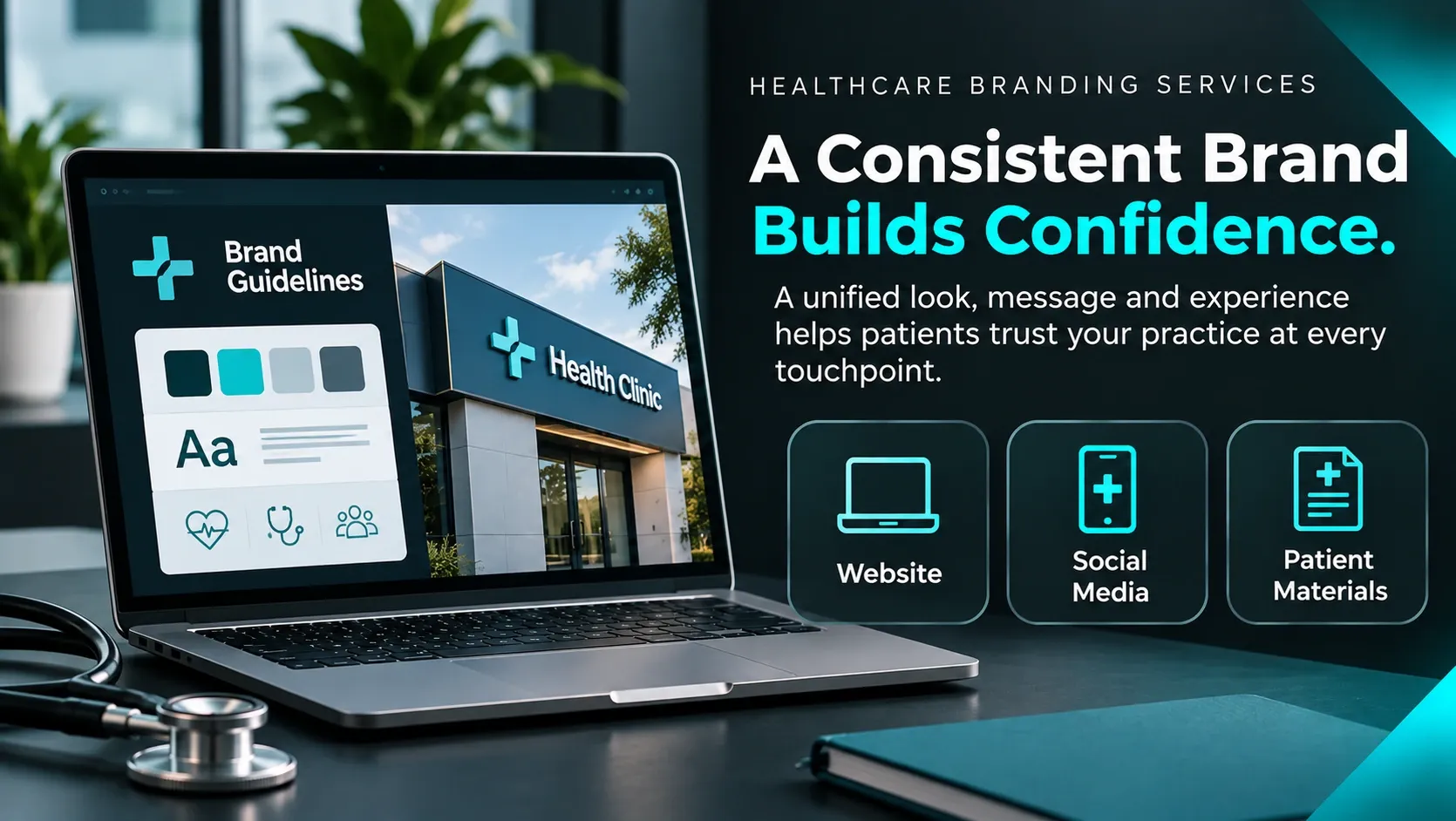
If reviews get a patient interested, your website is the final test before they decide to call. Patients are unconsciously scanning for fast load times, a mobile friendly layout, clear provider bios with real photos and credentials, transparent information about what you actually offer and an obvious, frictionless way to book.
A slow, cluttered or dated looking website damages trust even when the care behind it is genuinely excellent. Patients assume the website quality reflects the overall standard of the practice, fairly or not, because it’s the only piece of evidence they have in front of them.
This is one reason every site we build is held to a 90 plus PageSpeed score as a baseline, not an upsell someone pays extra for. A website that fails this test quietly costs you patients who never tell you why they decided not to call.
The Trust Signals That Earn a Booked Call
Understanding why patients decide early is only half the equation. The other half is building the specific, visible signals that actually earn that trust once someone is looking closely.
This comes down to three things working together: who you are, what others say about you and how consistent you are everywhere a patient might look you up.
Credentials and Expertise Patients Can See
Displaying your specialties, affiliations, board certifications and continuing education isn’t a formality. It’s active expertise signaling that both patients and search engines respond to directly.
Named provider bios with real photos, clearly stated years of experience and hospital affiliations do more trust building work than most practices realize, especially when that information isn’t buried three clicks deep in a PDF nobody opens. This groundwork is part of what solid healthcare branding services should always include from the very start of an engagement.
This matters even more for solo practitioners and smaller practices that don’t have a hospital system’s name recognition to lean on. Your personal credibility has to carry more of the weight on its own, with nothing larger standing behind it.
The same principle applies to startup founders and small business owners, where team expertise and founder credibility serve the exact same trust building function that credentials serve for a doctor. People are still asking the same underlying question: can I trust the person behind this.
Reviews as Social Proof and Active Reputation Management
Reviews now outweigh referrals in a way that surprises a lot of providers. A significant share of patients say they wouldn’t trust a friend’s recommendation if it conflicted with what they read online, which tells you reviews aren’t just one input anymore among many. They’re often the deciding one.
The behavioral details matter here too. More than half of patients read at least six reviews before making a decision, and recency carries real weight in that process. A profile full of five star reviews from three years ago with nothing since reads as stale, sometimes even concerning, to someone checking today and wondering why nobody’s left feedback lately.
Collecting reviews is only the starting point, though. Real reputation management means responding promptly and professionally, addressing negative feedback without getting defensive and making it genuinely easy for satisfied patients to leave feedback in the first place.
How a practice responds to criticism matters just as much as the praise it receives. A calm, professional reply to a negative review, without ever confirming a treatment relationship (which HIPAA restricts even in something as small as a thank you message), is itself a branding signal. Patients watch how you handle conflict just as closely as they watch how you handle compliments.
One Consistent Story Across Every Channel
A polished website sitting next to inactive social accounts and conflicting information scattered across the web undermines trust even when each individual piece looks fine on its own. Fragmentation reads as neglect, even when the actual quality of care hasn’t slipped at all.
Consistency, meaning the same voice, the same visuals and the same core message everywhere a patient looks, is what turns a one time visitor into a name a patient recognizes and trusts across multiple touchpoints.
This is the exact gap an integrated approach closes. When one team handles your brand, your website and your social media presence together, you avoid the patchwork feel that comes from several freelancers each interpreting your brand their own way and never quite agreeing on the details.
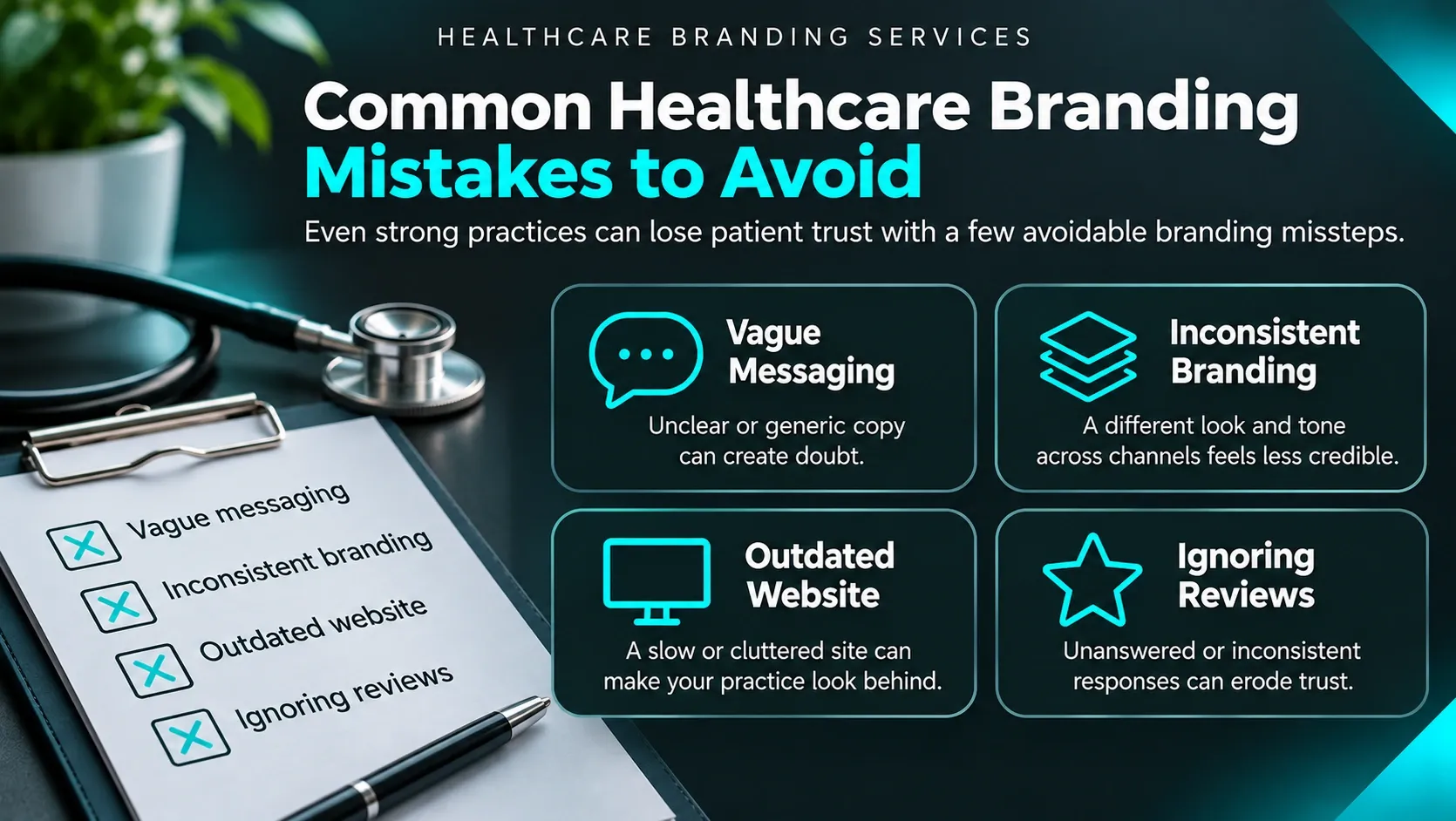
Common Healthcare Branding Mistakes That Cost Patient Trust
Some mistakes are obvious once someone points them out, but most practices never get that outside perspective until a prospective patient has already clicked away without a word.
Generic Stock Photos and Empty Jargon
Handshake photos, people pointing at whiteboards and vague phrases like “comprehensive care” or “patient centered approach” fail to build trust because patients have seen them on every competitor’s site already. They signal nothing specific about your actual practice or what makes it different.
Specificity wins instead. Real photos of your actual space and team, paired with plain language that explains exactly what sets your practice or business apart from the one down the street, do far more work than another stock image ever could.
This applies just as directly to startup founders and small business owners trying to look credible without sounding like a generic template that could belong to literally anyone in their category.
A Booking Process That Creates Friction
A confusing phone only booking process, a buried contact page or a form with too many steps can undo all the trust you just spent months building. Once a patient decides to trust you, every extra step between that decision and an actual booked appointment is another chance to lose them entirely.
Trust building content should always point toward an easy next step, not leave the reader to hunt for one on their own. That’s the whole idea behind shortening the path from search to call instead of search to education: build the trust, then make the next action obvious and immediate.
Healthcare Branding vs. Healthcare Marketing: What’s the Difference?
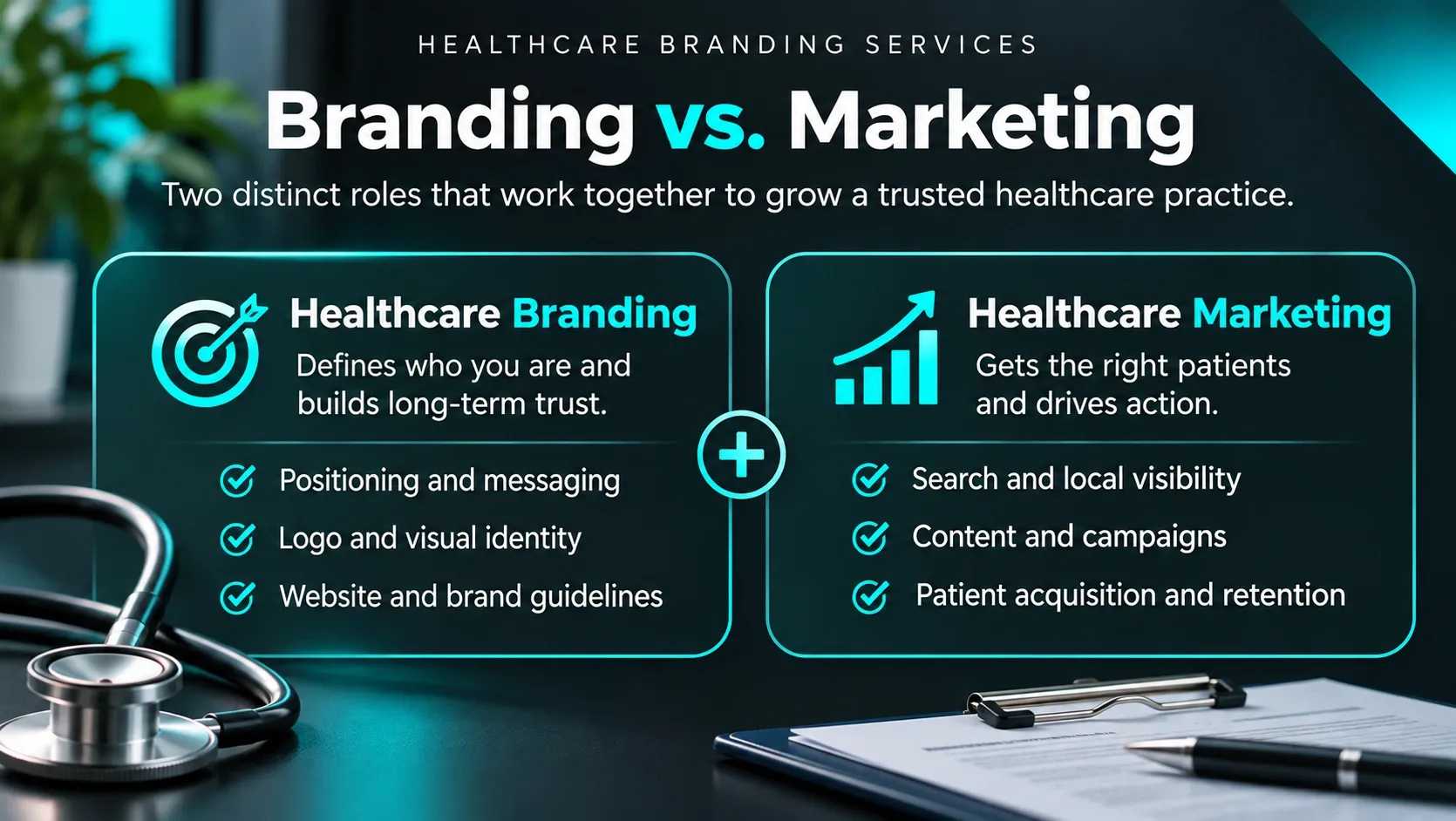
Branding defines who you are and how you should be understood. Marketing is how that identity actually gets put in front of the right people, through SEO, content, paid ads and social.
Plenty of practices invest in marketing tactics before the brand underneath is even clear, which wastes money because every campaign ends up with nothing consistent to point back to. The ads run, the clicks come in and the message still feels muddled once someone actually lands on the site.
These two disciplines need to work together rather than being treated as separate projects run by separate vendors who never talk to each other. A strong brand makes every marketing dollar work harder, and a strong marketing plan makes sure that brand actually gets seen by the people who need to see it.
This is exactly the fragmentation problem founders, doctors and small business owners run into when they hire a branding firm and a marketing firm separately and then have to translate between the two. An integrated approach, where brand creation and marketing execution come from the same team, avoids that disconnect entirely from day one.
What to Look for in a Healthcare Branding Partner
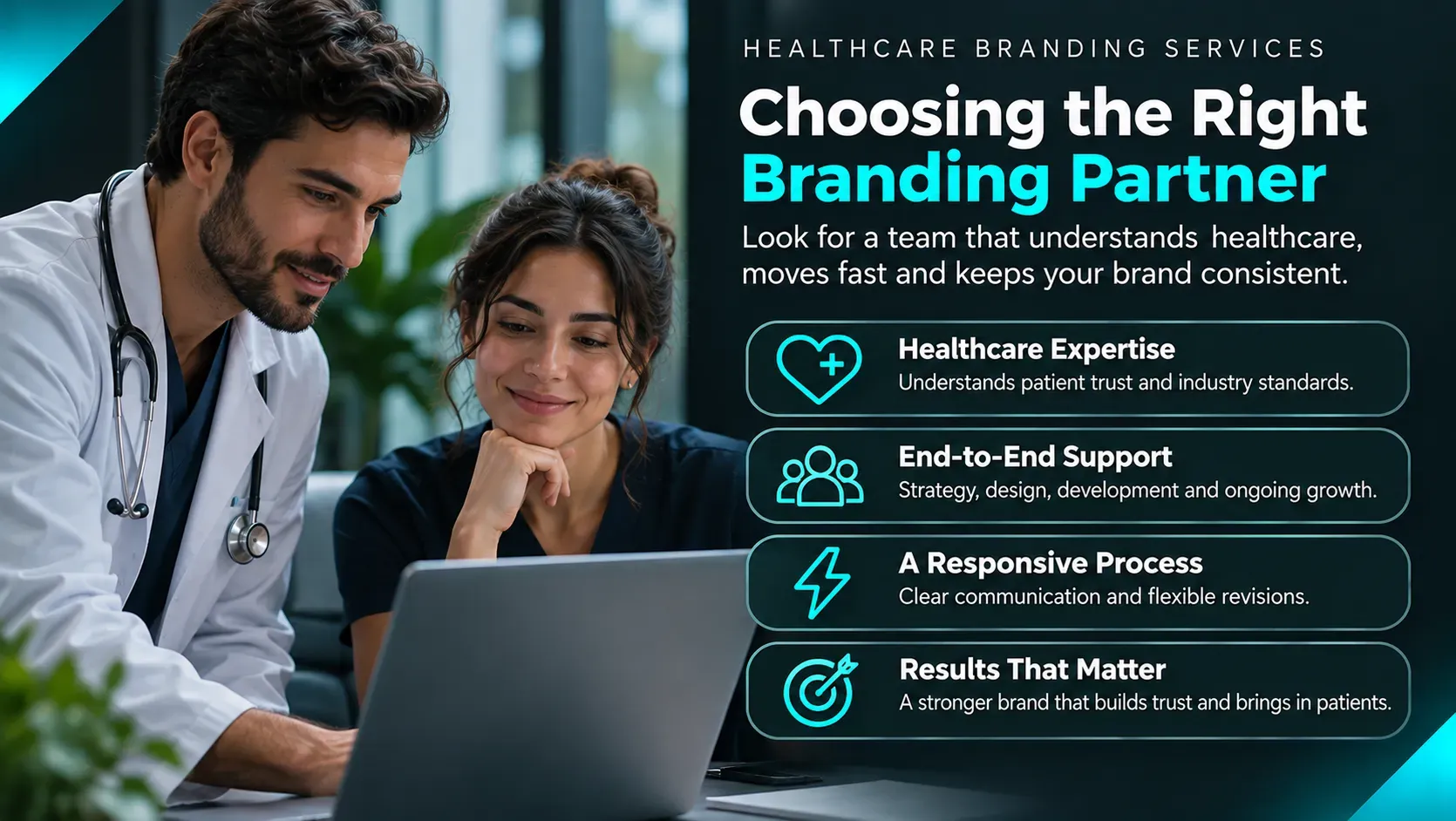
A few practical questions separate a genuinely useful partner from one that will slow you down for months. Does the partner understand healthcare specific compliance and privacy considerations, including the kind of accessibility and compliance standards a site should be built around from the start rather than bolted on later?
How fast can they actually turn work around, and do they offer ongoing support or just a one time deliverable that goes stale within a year of launch? Speed and revision flexibility matter more here than they do in large enterprise branding work, because doctors and small business owners usually need to move fast without an internal team managing the process for them.
Direct communication, a phone call or a quick text, tends to serve this audience far better than a heavy project management tool. Most clients in this position are domain experts, not tech people, and they don’t want to learn new software just to get their branding finished.
A transparent pricing structure and a visible track record, like an actual portfolio of real client work rather than a handful of mockups, also tell you a lot before you ever get on a call with anyone.
Healthcare Branding Services FAQ
What do healthcare branding services typically include?
Most healthcare branding services cover brand strategy and positioning, naming when needed, a messaging framework, visual identity and a set of brand guidelines, along with the website and digital content needed to carry that identity across every channel a patient might see.
How is healthcare branding different from healthcare marketing?
Branding defines who you are and how patients should understand you. Marketing is how that identity gets distributed and seen, through search, content, social and paid channels. You need both, but they answer genuinely different questions.
How long does a healthcare branding project take?
It depends on scope. A focused refresh can take a few weeks, while a full brand build paired with a new website often runs a couple of months. An integrated team working on brand and web together, rather than handing work between separate vendors, usually moves faster than a traditional agency model allows.
Do healthcare branding services help with patient reviews and reputation?
Yes, in the sense that a strong brand gives a practice a consistent voice to respond with. Reputation management itself, responding to reviews and encouraging new ones, works best when it reflects the same tone and standards the rest of your brand uses everywhere else.
[image]
Build a Healthcare Brand Patients Trust With Ankord Media
Everything covered here points to the same conclusion. Patients decide whether to trust you long before they call, and your brand is doing that work whether you’re actively managing it or not.
We are Ankord Media, and we build that trust on purpose, as one integrated team covering brand identity, website design, content and PR so founders, doctors and small business owners get agency level output without juggling three separate vendors.
We work fast, we offer unlimited revisions until you’re genuinely satisfied and every site we build is held to that 90 plus PageSpeed standard as a baseline, not an exception. If you’re ready to see what a brand patients actually trust looks like for your practice, book a call with us today.