



- Key Takeaways
- What Is a Pitch Deck Design Service?
- Why Your Pitch Deck’s Design Impacts Investor Confidence
- Portfolio and Industry Experience to Look For
- Storytelling and Narrative Structure Behind the Slides
- Collaboration, Feedback and Revision Policies That Matter
- Turnaround Time and Budget Fit for Your Raise
- Red Flags That Signal the Wrong Pitch Deck Design Service
- Pitch Deck Design Service FAQ
- Choose Ankord Media’s Pitch Deck Design Service for Your Next Raise
A pitch deck is the single document most likely to decide whether a fundraise moves forward or stalls out completely. Founders spend months, sometimes years, building the business behind it, then hand the one document that introduces that business to investors over to whoever happens to be available that week. That gap between effort and output is exactly why a professional pitch deck design service exists, and why choosing the right one matters more than most founders realize going in.
The agency behind the deck shapes how an investor reads the entire pitch before a single slide gets discussed out loud. Design quality, narrative structure and even the pacing of information all signal something about the company before the founder says a word. We are Ankord Media, a design and development agency built for startup founders raising from pre-seed through Series B, and we have watched a well-built deck change the tone of an investor meeting within the first sixty seconds.
If your pitch deck is not ready for the investors you are about to meet, connect with our team and we will walk you through what a stronger version looks like for your specific raise.
[image]
Key Takeaways
- A strong pitch deck design service handles both visual design and narrative structure together. Agencies that only offer one of the two leave founders with half a solution.
- Portfolio relevance matters more than portfolio polish. An agency with no experience at your funding stage or in your industry will learn on your timeline, which is a real cost during an active raise.
- Restructuring content (changing what is said and in what order) is a far more valuable skill than restyling it (making the same content look nicer). Most agencies only offer the second.
- Revision policy and turnaround time are frequently the deciding factors founders overlook until mid project, when a capped revision count or a six week timeline suddenly becomes a real problem.
- A clear, defined process with set checkpoints protects both the founder and the final product. Vague processes tend to produce vague decks.
- Unlimited revisions remove the pressure to settle for a deck that is merely acceptable instead of one that is genuinely ready.
- Red flags like template first design, no relevant portfolio examples and vague answers about process are easy to miss when a founder is under deadline pressure, which is exactly when they matter most.
What Is a Pitch Deck Design Service?
A pitch deck design service takes a founder’s raw material (a rough draft, scattered financial figures, half of a story) and turns it into a presentation an investor can actually follow in one sitting. This is a narrower and more specialized skill than general presentation design.
Pitch decks follow a specific internal logic that investors expect to see, built around a particular sequence of problem, market, solution and proof. Designers who do not work in this space regularly often miss that logic entirely, even when their visual work looks polished.
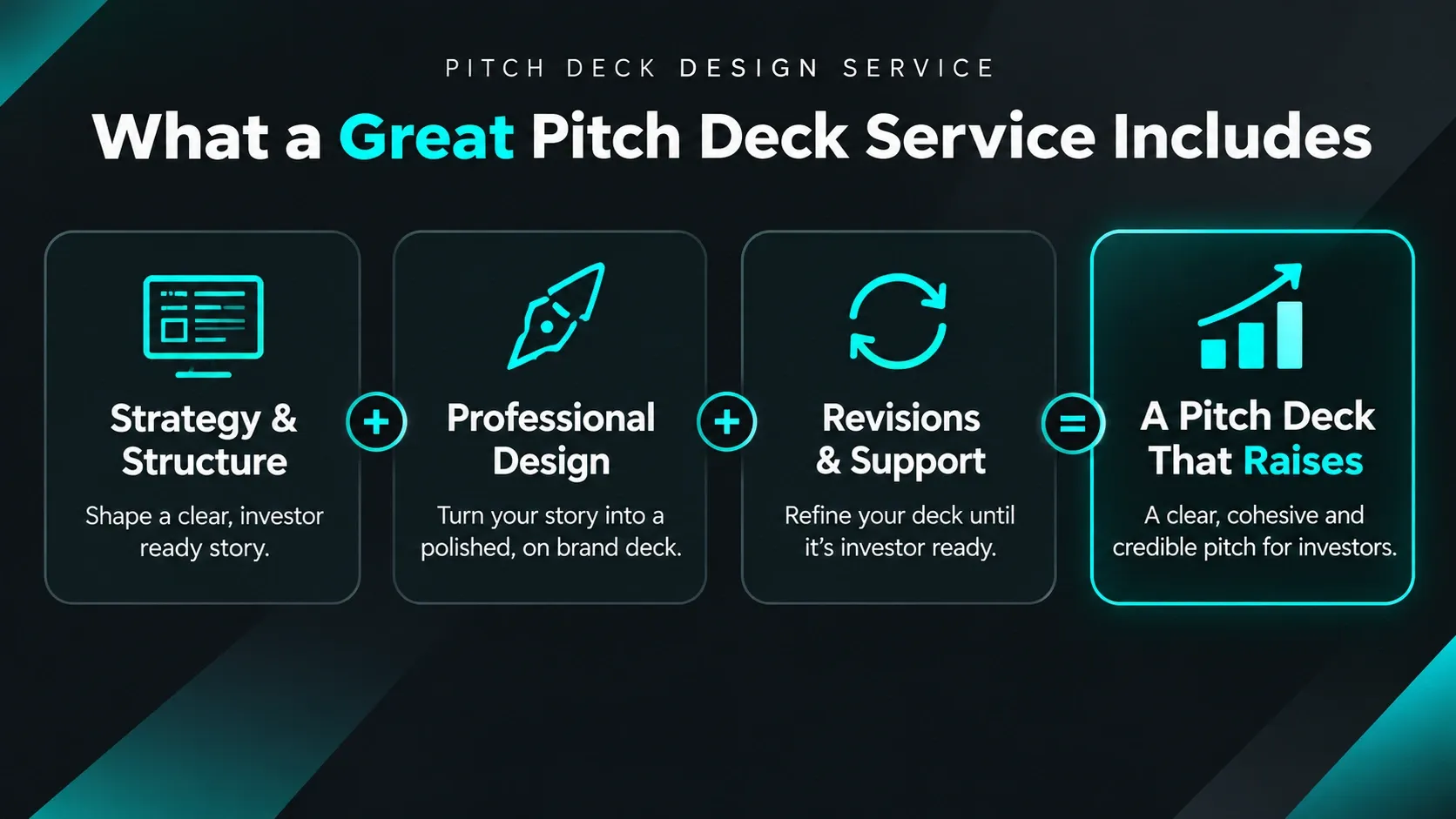
The strongest services combine two distinct skills under one roof: visual design and narrative strategy. Plenty of agencies only offer one of the two, and founders frequently do not find out which one until the deck is already finished and the raise is already underway.
Design Execution Versus Investor-Ready Storytelling
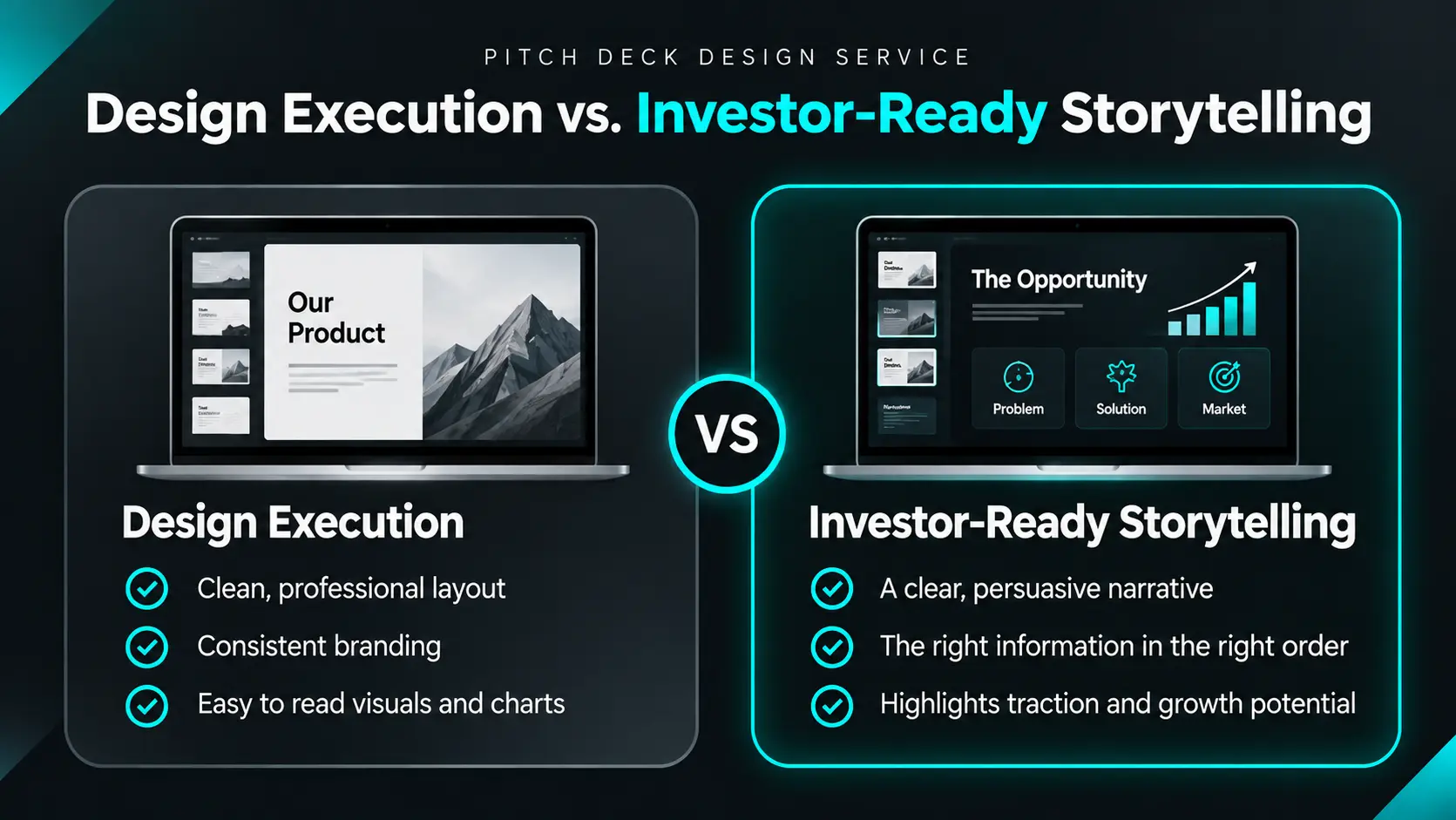
Design execution covers everything a founder expects to see on the surface: layout, typography, chart design and brand consistency carried across every slide. It is the part of the job that makes a deck look credible at a glance, and it is where most pitch deck agencies focus the bulk of their effort.
Narrative strategy is the harder, less visible half of the work. It determines what order the slides appear in, what gets emphasized, and what gets cut entirely because it weakens the argument instead of strengthening it. A gorgeous deck with a muddled story will lose an investor’s attention by slide four. A clear, sharp story presented with inconsistent formatting will lose credibility before the investor has even finished reading it.
Our own design and development work for founders is built around pairing these two things deliberately from the start, since one without the other rarely holds up once real investor scrutiny begins.
Why Your Pitch Deck’s Design Impacts Investor Confidence
Investors review dozens of decks in a given week, and that number climbs significantly during active fundraising seasons in spring and fall. They are pattern matching on competence long before they reach your financial slide.
A deck with inconsistent fonts, misaligned charts or a cluttered layout reads as a founder who moves fast and loose with details, even when that impression is completely unfair to how the business is actually run. Design quality often functions as the filter that decides whether your content gets a careful, attentive read at all, or gets skimmed and set aside.
Investors associate visual polish with operational maturity, whether that association is entirely rational or not. A founder who cannot be bothered to get the deck right raises a quiet, unspoken question about what else in the business might have been rushed. This is the same credibility signal we build into a founder’s broader digital presence through brand identity work, because the pitch deck is rarely the only thing an investor looks at before deciding whether to take a meeting or write a check.
Portfolio and Industry Experience to Look For
A good looking portfolio on its own tells a founder almost nothing. What actually matters is whether the agency has designed decks for companies at a similar funding stage and in a similar industry.
A studio known for sleek consumer brand work might produce something visually beautiful and still have no idea how to structure a dense SaaS metrics slide or a biotech data set that needs to survive technical scrutiny. Ask directly to see examples from your stage and sector before signing anything. When you review examples, look closely at our own portfolio for a sense of what relevant, stage appropriate work should actually look like.
An agency with no relevant reference point for your specific situation will inevitably learn on your timeline instead of bringing that knowledge in on day one. During an active fundraise, that education period is time most founders simply do not have to spare.
Decks Built for Stage, Sector and What Comes After the Deck
Pre-seed decks lean heavily on vision, team and market size, since there is little traction yet to point to. Series A and B decks need to carry real, defensible traction and financial depth, because investors at that stage check every number against their own internal models before a partner meeting even happens.
A doctor presenting to a lending partner or a potential practice investor needs an entirely different narrative than a tech founder pitching a venture fund, and a one size fits all template fails both of them equally. We work across founders raising from pre-seed through Series B, doctors and medical practices and small business owners, which means this kind of stage specific and sector specific judgment is built directly into how every deck gets approached rather than treated as an afterthought.
It is also worth noting that many founders, doctors and small business owners who come to us initially for a deck end up needing the same credibility carried across other channels once the raise or the launch is underway. That is often where social media management and PR support come into play, keeping the same tone and visual consistency that made the deck work in the first place.
Examples That Show Restructuring, Not Just Restyling
Ask to see a genuine before and after, not just a finished, polished product. Restyling means the same content gets a nicer font and better spacing. It is common, and it is relatively easy for any competent designer to deliver.
Restructuring means the agency actually changed what was said and in what order, which is a rarer and far more valuable skill to find. A direct question works best here: can you show me a deck where you changed the story itself, not just the slides? If the answer is vague, or the examples only show surface level visual improvements, that agency is most likely offering design alone. We have broken down several real before and after examples like this on our blog for founders who want to see the difference in practice before hiring anyone.
Storytelling and Narrative Structure Behind the Slides
A strong pitch narrative moves through problem, market, solution, traction, team and ask in a sequence that builds one single, cohesive argument rather than listing a series of disconnected facts.
The most common failure in pitch decks is not bad design. It is padding. Too many slides try to cover every possible angle instead of making one sharp, confident case for why this specific company, and why right now. The best agencies will actually push back when a founder insists on keeping a slide that weakens the overall story, even when it is a slide the founder feels personally attached to.
That kind of honest, direct pushback is rare, and it is worth asking about openly during an initial sales call. Our own content philosophy favors a clear point of view over a generic, everything included approach, and that same thinking applies directly to how we help structure a founder’s pitch from the first draft onward.
Collaboration, Feedback and Revision Policies That Matter
A pitch deck is never a one and done deliverable. Founders adjust messaging after nearly every investor meeting, after practicing the pitch out loud for the first time, and after feedback from an advisor who caught something nobody else on the team had noticed.
A service built around a rigid send your content, get a deck back process cannot keep pace with how fundraising actually moves in real time. Good collaboration means clear check-ins, a defined number of revision rounds stated up front before any work begins, and a real point of contact rather than a support ticket queue that takes two business days to respond.
What a Clear Process Looks Like
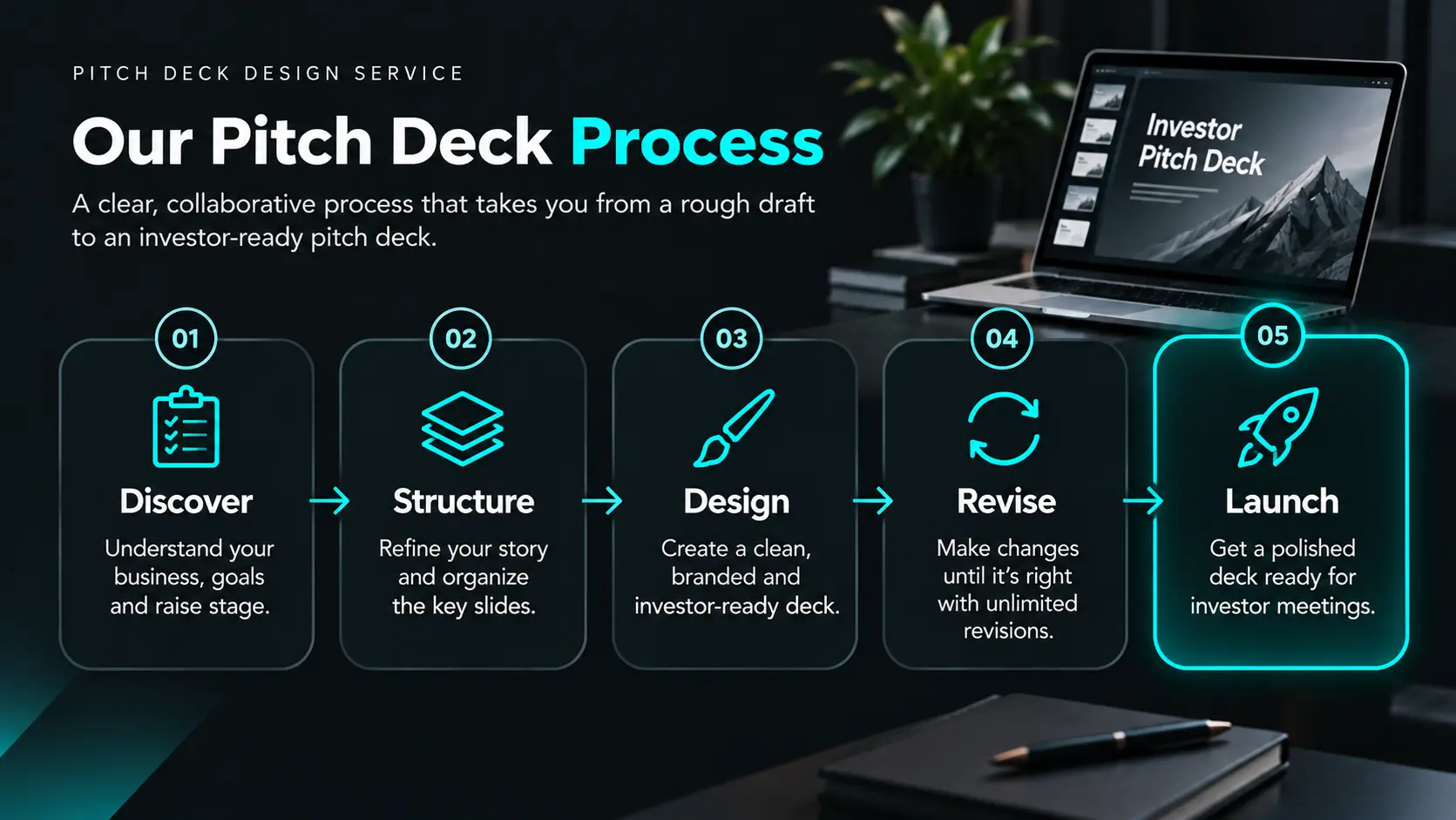
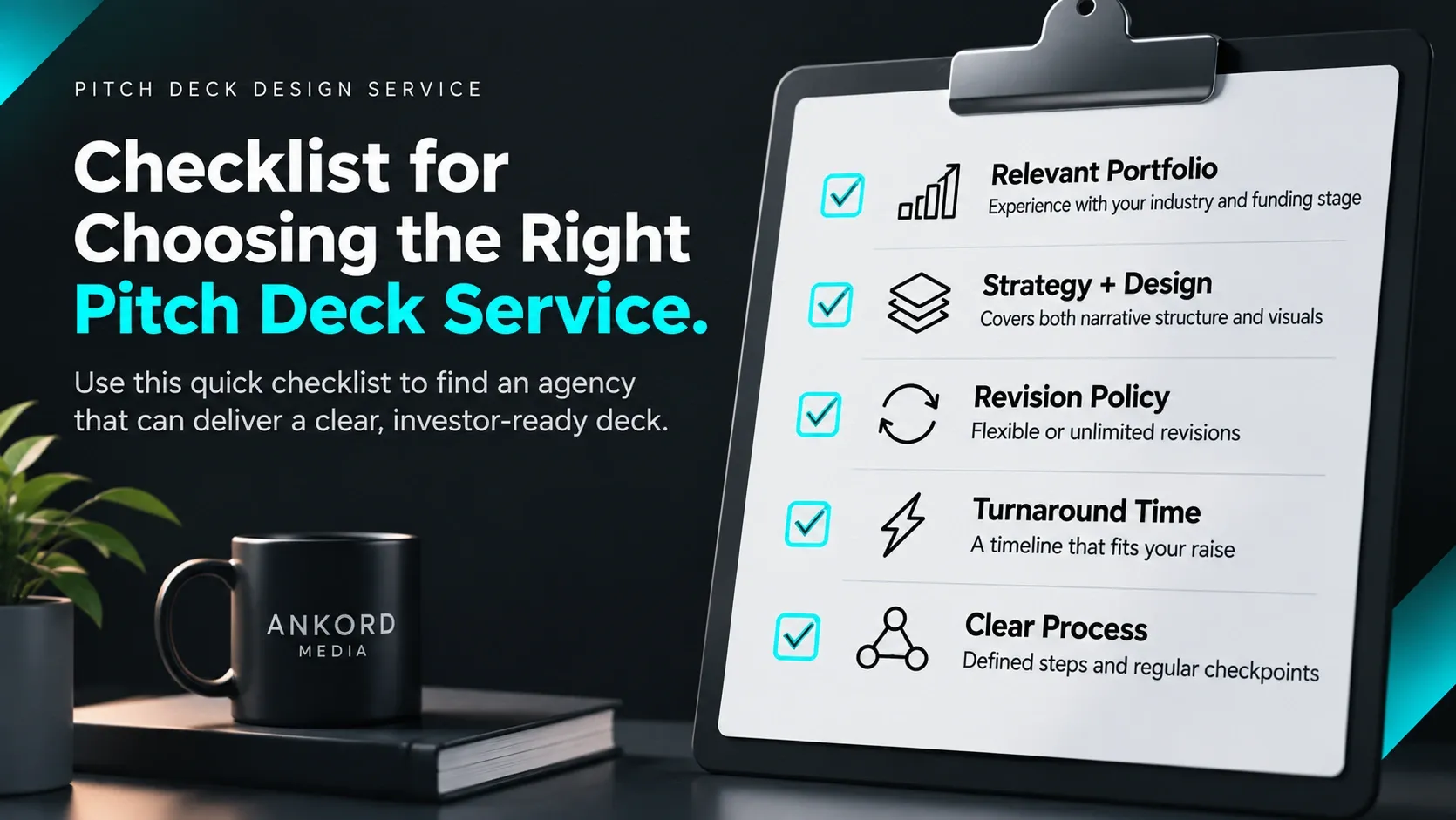
A transparent process typically runs through an intake call, a content draft stage, a design concept stage and clearly defined feedback checkpoints at each step along the way. Before signing anything, ask exactly how revisions are handled and how many rounds are included in the quoted price.
Vague revision terms are where scope creep and surprise invoices tend to show up later, almost always right when a founder has the least amount of time left to deal with it. Many agencies, including our own, now use AI automation to speed up early draft turnaround without sacrificing the human judgment needed to catch a weak argument before it ever reaches a slide.
Why Unlimited Revisions Change the Outcome
Capped revision rounds create quiet pressure to settle for a deck that is close enough, especially when a founder is still actively refining messaging right up until the week of the pitch itself. Unlimited revisions remove that tradeoff entirely.
A founder is no longer forced to choose between getting the deck genuinely right and staying inside a fixed, pre-negotiated scope. Every engagement we run includes unlimited revisions until the client is fully satisfied, specifically because fundraising timelines rarely move in one clean, predictable line from start to finish.
Turnaround Time and Budget Fit for Your Raise
Turnaround time is frequently the deciding factor founders underweight early on, because fundraising runs entirely on investor calendars rather than on a design studio’s internal production schedule. A six week delivery timeline becomes close to worthless if a raise is set to close in three.
Budget fit matters just as much, though a lower price does not automatically mean lower quality, and a higher price does not automatically guarantee a better outcome either. What matters more is understanding exactly what is included at each price point. Research, copywriting and design are sometimes bundled together into one fee and sometimes billed as three entirely separate line items.
Check a pricing page closely before comparing quotes across different agencies, since the headline number rarely tells the full story of what a founder is actually buying. Fast turnaround paired with direct, phone and messaging based communication, rather than a rigid project management workflow, tends to serve founders best during an active raise. That is exactly how we have built our own process for founders in Los Angeles and the Bay Area and beyond.
Red Flags That Signal the Wrong Pitch Deck Design Service
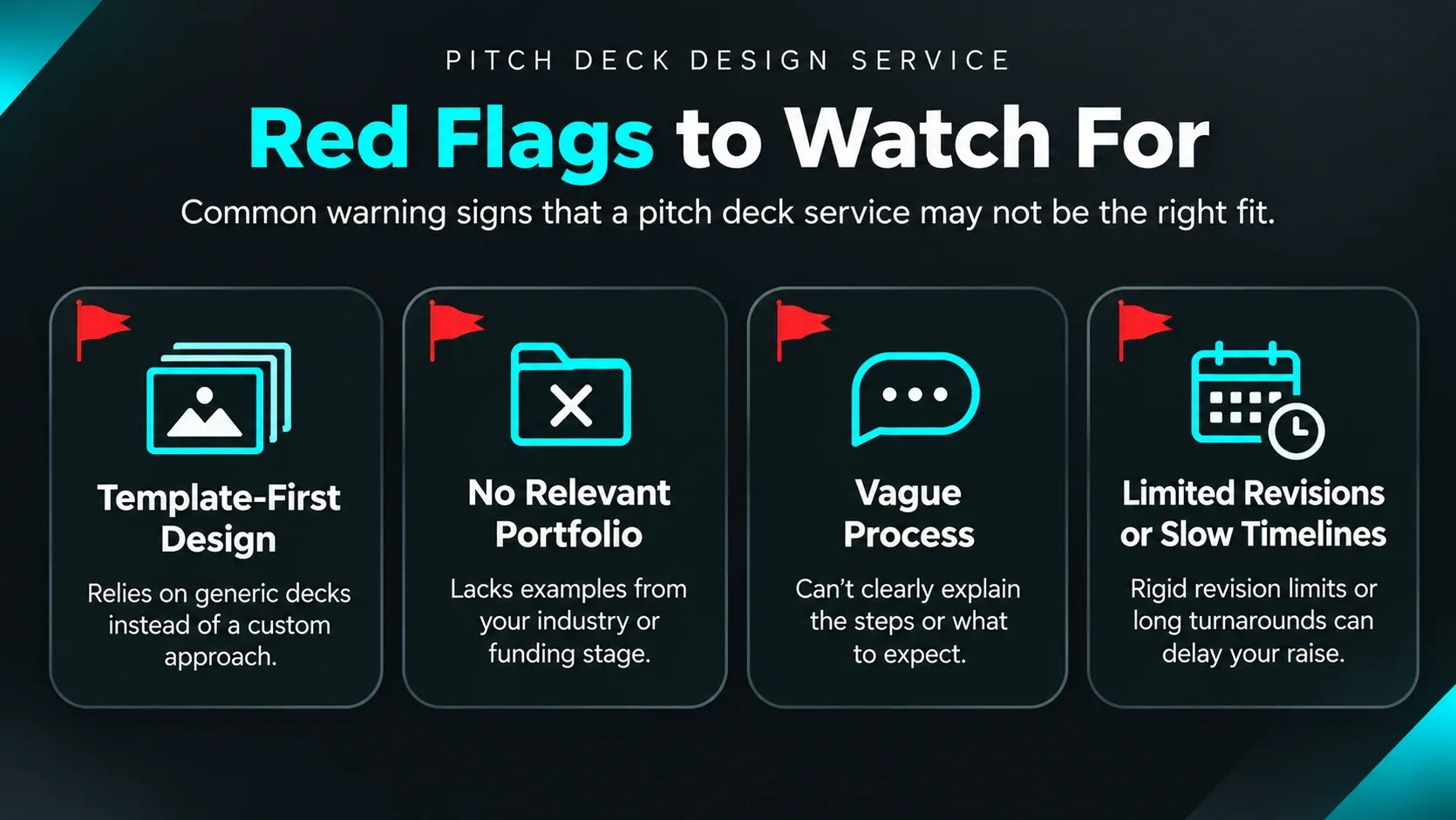
A few warning signs are consistently worth watching for before signing any agreement. Template first decks with little real customization are an immediate flag, since experienced investors see this exact pattern constantly and recognize it almost instantly.
A portfolio with no relevant industry or stage examples is another clear sign, along with vague or capped revision policies buried somewhere in the fine print. Agencies that only ever talk about visual design, with no mention of narrative or story structure, are telling a founder exactly what they will get and exactly what they will not.
If an agency cannot clearly explain its own process when asked directly, including how it handles accessibility and basic compliance in client facing materials, that gap is usually a preview of the client experience still to come. We treat those standards seriously enough to outline our own approach on our compliance page, and we would expect any agency a founder is vetting to be just as transparent about it.
Pitch Deck Design Service FAQ
What does a pitch deck design service typically include?
Most pitch deck design services include a discovery call, content or story development and final visual design, though exact scope varies widely between agencies, so confirming this upfront matters.
How long does it take to get a pitch deck designed?
Turnaround ranges from a few days for a simple redesign to several weeks for a full strategy and design engagement, depending on the agency and how complex the raise is.
How much does a professional pitch deck cost?
Pricing commonly falls between a few hundred dollars for a basic redesign and several thousand dollars for a full strategy, writing and design package, so always clarify what is actually bundled into that number before comparing agencies.
Is it worth hiring an agency instead of using a template?
Templates can work for early, informal conversations, but for an investor meeting with real money on the table, a pitch deck design service built around a founder’s specific stage and story consistently outperforms a generic template.
Choose Ankord Media’s Pitch Deck Design Service for Your Next Raise
The best pitch deck design service treats design and narrative as equally important, never one at the expense of the other. That is the standard we hold ourselves to, backed by unlimited revisions, fast turnaround and a team that stays reachable throughout an active raise. If your deck is not ready for the investors you are about to meet, reach out to Ankord Media today and let’s get it there.