


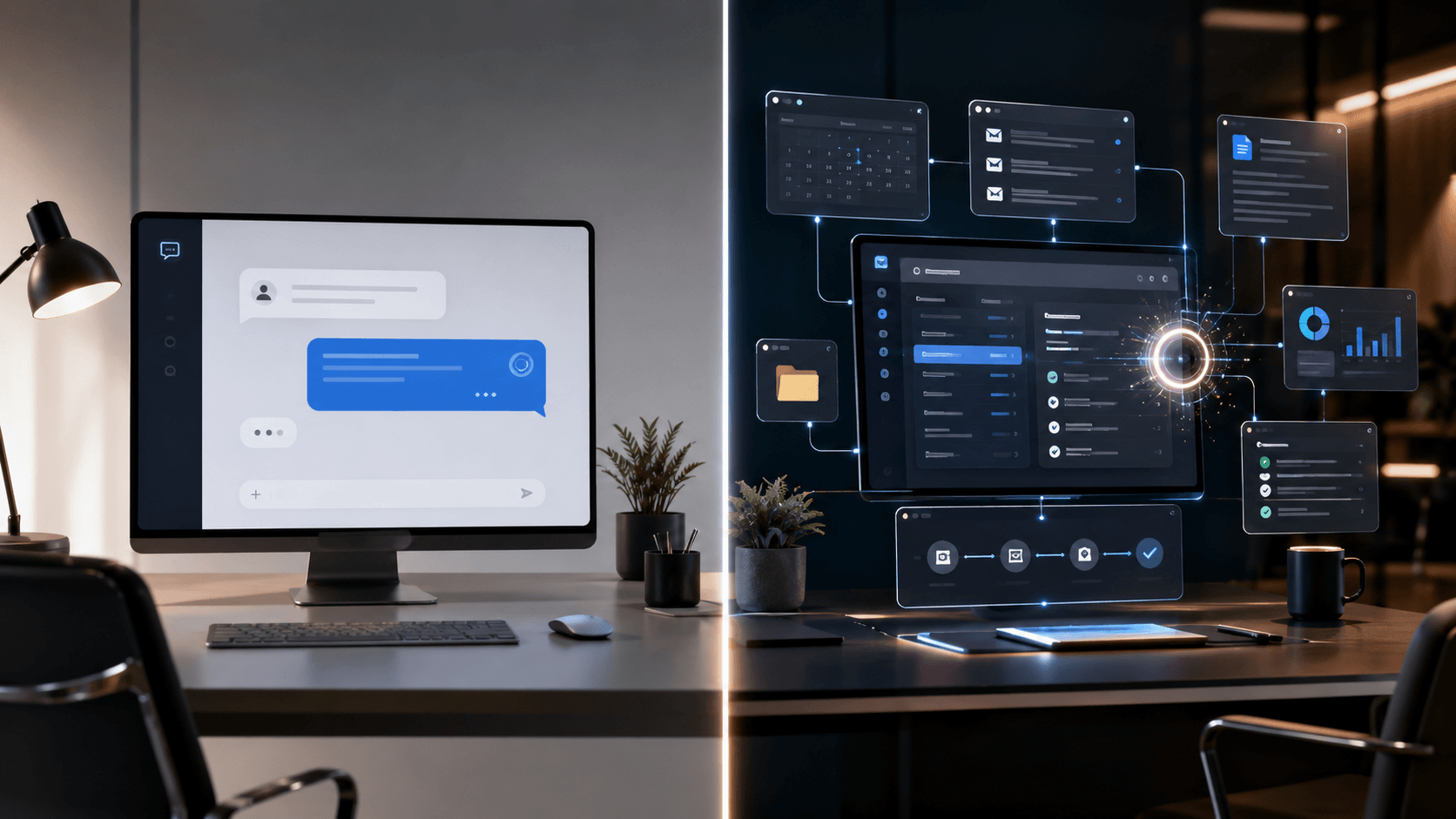
The confusion between AI agents and chatbots runs deeper than most business leaders realize. While both use artificial intelligence, they operate on fundamentally different architectures and serve entirely different purposes in your business ecosystem. Understanding this distinction becomes critical when you're deciding which technology will actually solve your operational challenges and drive measurable outcomes.
Most people encounter chatbots daily through customer service interfaces or virtual assistants that answer questions and provide information. These systems excel at conversation but remain limited to reactive responses within predefined boundaries. Milan Kordestani and the Ankord Media team approach this differently, building AI agents that don't just respond to requests but actively monitor, analyze, and execute complex business processes without human intervention.
The gap between these technologies determines whether you're adding a digital conversation partner or deploying an intelligent workforce that transforms how your business operates. When our team evaluates your infrastructure needs, we're not just implementing another chatbot - we're architecting systems that integrate with your existing workflows, make autonomous decisions, and deliver concrete business outcomes while you focus on strategic growth.
Understanding AI Agents: Autonomous Intelligence That Takes Action
An AI agent represents a sophisticated system designed to perceive its environment, process complex information, and take autonomous actions to achieve specific objectives. Unlike conversational tools, these agents operate continuously in the background, monitoring data streams, analyzing patterns, and executing tasks based on real-time conditions. The development team at Ankord Media builds agents that integrate directly with your business infrastructure, accessing databases, APIs, and workflows to make intelligent decisions without requiring human oversight for routine operations.
The architecture behind our agents involves multiple interconnected components that work together to create genuine business intelligence. Each agent maintains awareness of its operational environment through data connectors that feed information from your existing systems into processing layers that analyze, categorize, and prioritize incoming information. Milan Kordestani's approach focuses on building agents that understand context, remember previous interactions and outcomes, and adapt their decision-making based on changing business conditions and performance metrics.
What makes our AI agents particularly powerful is their ability to execute multi-step workflows that span different systems and departments. Rather than simply providing answers or recommendations, these agents actually perform the work - updating records, sending communications, scheduling resources, processing transactions, and coordinating between different business functions. When our infrastructure is properly deployed, your agents operate as autonomous team members that handle routine tasks with consistency and accuracy while escalating complex situations that require human judgment.
The core capabilities that define effective AI agent deployment include:
- Environmental Perception: Continuous monitoring of data sources, system states, and business conditions to maintain real-time awareness of operational context and trigger appropriate responses
- Autonomous Decision Making: Logic frameworks that evaluate situations against predefined criteria and business rules to make independent choices without requiring human approval for routine operations
- Action Execution: Direct integration with business systems that allows agents to perform actual work like updating databases, sending communications, processing transactions, and coordinating workflows
- Learning and Adaptation: Feedback mechanisms that allow agents to improve their performance over time by analyzing outcomes and adjusting their decision-making processes based on results
The infrastructure requirements for deploying effective AI agents extend far beyond simple software installation. Our approach involves comprehensive integration with your existing technology stack, including customer relationship management systems, enterprise resource planning platforms, communication tools, and data warehouses. This integration creates the foundation for agents to access the information they need and execute the actions that drive business outcomes.
Milan Kordestani and the team handle the complex technical architecture that makes this possible, including secure data connections, processing workflows, decision trees, and feedback loops that ensure your agents operate reliably and deliver consistent results. The deployment process involves understanding your specific business processes, identifying optimization opportunities, and building custom logic that aligns with your operational objectives and compliance requirements.
Chatbots: Conversational Interfaces with Limited Scope
Chatbots operate as conversational interfaces designed to simulate human dialogue through text or voice interactions. These systems excel at understanding natural language inputs, processing questions, and providing relevant responses based on predefined knowledge bases or training data. Our experience shows that chatbots work best for customer service scenarios, frequently asked questions, initial lead qualification, and situations where the primary goal is information exchange rather than task execution.
The technical architecture of chatbots focuses on natural language processing, intent recognition, and response generation rather than autonomous action-taking. When Ankord Media's development team builds chatbot solutions, we create systems that can understand conversational context, maintain dialogue flow, and access specific information databases to provide accurate answers. However, these systems remain fundamentally reactive - they respond to user inputs rather than proactively monitoring and acting on business conditions.
Most chatbots operate within constrained parameters, following scripted conversation paths or drawing from knowledge bases to answer specific questions. While advanced chatbots can handle complex conversations and even perform simple tasks like booking appointments or updating contact information, they typically require human oversight or approval for significant actions. The value proposition centers on improving customer experience, reducing response times, and handling routine inquiries that would otherwise require human staff time.
Key characteristics that define chatbot functionality include:
- Conversational Processing: Natural language understanding that interprets user inputs, identifies intent, and formulates appropriate responses within the context of ongoing dialogue
- Knowledge Base Access: Integration with information repositories that allows chatbots to retrieve and present relevant data, answers, and resources based on user queries and conversation flow
- Dialogue Management: Systems that maintain conversation context, track user preferences, and guide interactions toward helpful outcomes while staying within defined operational boundaries
- Response Generation: Capabilities that create natural, contextually appropriate responses using predefined templates, dynamic content assembly, or generative language models trained on specific datasets
The deployment process for chatbots typically involves less complex integration than AI agents because these systems primarily need access to information rather than the ability to modify business data or execute workflows. Our team handles the technical setup including natural language processing configuration, knowledge base optimization, conversation flow design, and integration with communication platforms where your customers will interact with the system.
However, the limitations become apparent when businesses need solutions that go beyond conversation and information sharing. Chatbots excel at answering questions about product specifications, company policies, or account status, but they cannot autonomously analyze sales data to identify optimization opportunities, automatically adjust marketing campaigns based on performance metrics, or coordinate complex workflows that involve multiple systems and decision points.
The Critical Differences: Why Your Choice Determines Business Outcomes
The fundamental distinction between AI agents and chatbots lies in their operational scope and business impact potential. While chatbots enhance communication and information accessibility, AI agents transform operational workflows by taking autonomous action based on real-time analysis and predefined business logic. Milan Kordestani's experience deploying these systems reveals that the choice between agents and chatbots determines whether you're optimizing customer interactions or fundamentally transforming business operations.
Chatbots require human users to initiate interactions and guide conversations toward desired outcomes, making them reactive tools that depend on external input to function. Our agents operate continuously, monitoring business conditions and taking proactive action when specific criteria are met, regardless of whether humans are actively managing or directing their activities. This distinction becomes critical when evaluating which technology will deliver measurable business improvements versus incremental customer service enhancements.
The integration complexity and infrastructure requirements differ dramatically between these approaches. Chatbots typically connect to information databases and communication platforms, requiring relatively straightforward technical setup and maintenance. AI agents require deep integration with operational systems, including the ability to read data, analyze conditions, make decisions, and execute actions across multiple platforms simultaneously, demanding more sophisticated architecture and ongoing technical management.
The operational differences that impact your business outcomes include:
- Scope of Operation: Chatbots handle individual conversations and information requests, while agents manage entire business processes and workflows across multiple systems and time periods
- Initiative and Autonomy: Chatbots respond to user inputs and cannot operate without human interaction, while agents proactively monitor conditions and take action based on predefined criteria without human involvement
- Integration Requirements: Chatbots need access to information and communication platforms, while agents require comprehensive integration with operational systems including the ability to modify data and execute business processes
- Outcome Generation: Chatbots improve communication efficiency and information accessibility, while agents deliver measurable business outcomes through automated workflow optimization and intelligent decision-making
When our infrastructure is properly deployed, the results speak for themselves through quantifiable improvements in operational efficiency, cost reduction, and business growth metrics. Clients who implement AI agents typically see significant decreases in manual processing time, improved accuracy in routine operations, and the ability to scale business processes without proportionally increasing staff requirements. These outcomes reflect the fundamental difference between tools that enhance communication and systems that transform operations.
The decision between deploying AI agents or chatbots should align with your specific business objectives and operational challenges. If your primary goal is improving customer service interactions, providing faster access to information, or handling routine inquiries more efficiently, chatbots offer an appropriate solution with relatively simple implementation requirements. However, if you need to optimize complex workflows, automate decision-making processes, or scale operations without expanding overhead costs, our AI agents provide the autonomous intelligence and action-taking capabilities that drive transformational business outcomes.