


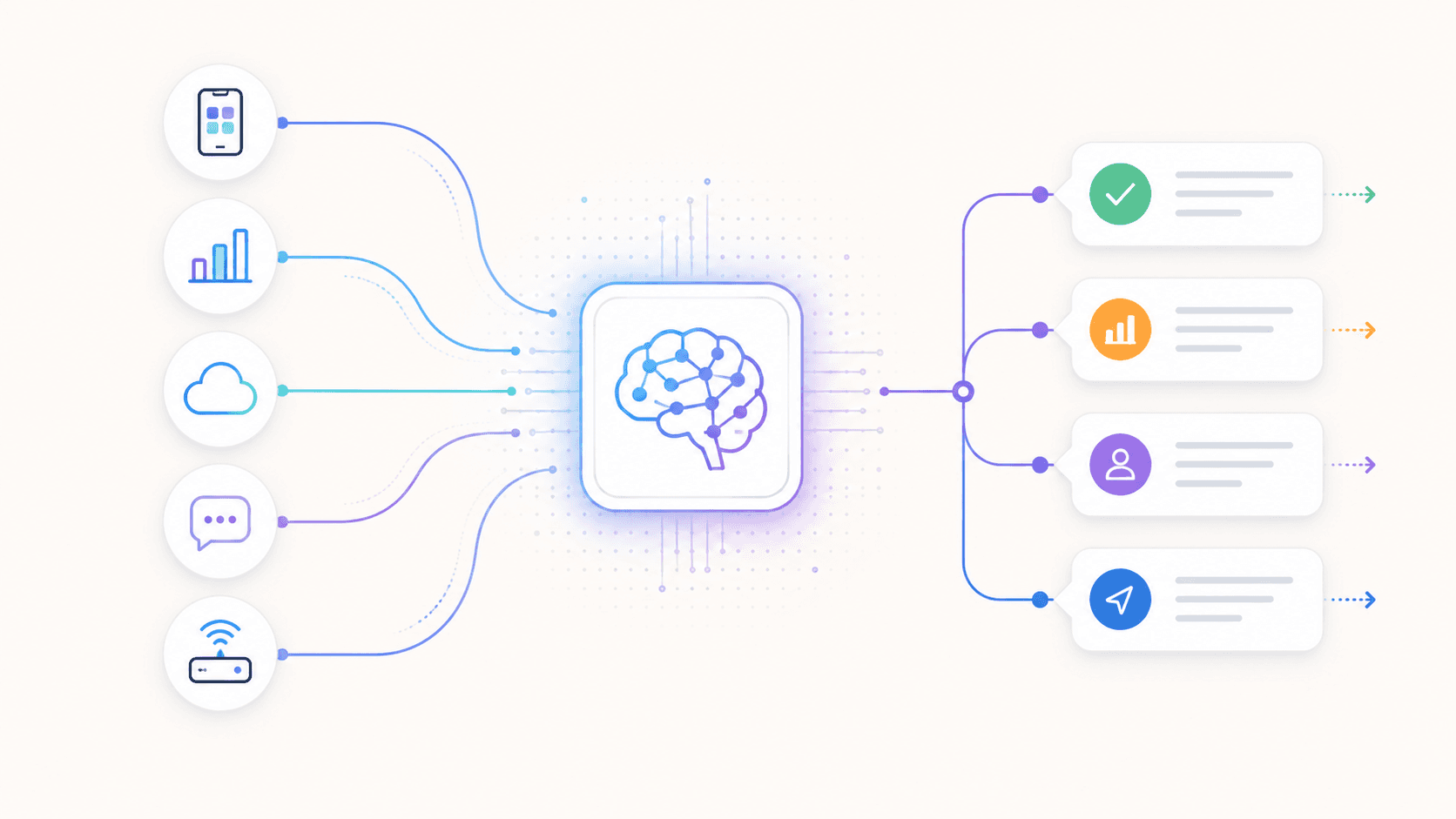
Modern businesses generate data continuously across dozens of channels. Customer interactions flow through chat systems, sales data updates in real time, inventory levels fluctuate by the minute, and market conditions shift throughout the day. The question isn't whether this data exists, but whether your systems can process and respond to it fast enough to matter.
AI agents represent a fundamental shift in how we handle this challenge. Unlike traditional systems that batch process data or require manual intervention, properly deployed AI agents consume multiple data streams simultaneously and make decisions in milliseconds. Milan Kordestani and the development team at Ankord Media have built agent architectures that don't just monitor these streams but actively orchestrate responses across your entire business infrastructure.
The key insight our team has discovered is that real-time data handling isn't just about speed. It's about creating intelligent systems that understand context, prioritize actions, and maintain consistency across multiple data sources. When we deploy these agents for clients, they're not just getting faster data processing. They're getting systems that think and respond like experienced operators who never sleep.
The Architecture Behind Multi-Stream Data Processing
Real-time data stream processing requires a fundamentally different architecture than traditional database systems. Our agents operate on what Milan calls "streaming consciousness" - the ability to maintain awareness of multiple data flows while building contextual understanding over time. This isn't about storing everything and querying later. It's about making intelligent decisions as data flows through the system.
The foundation starts with event-driven architecture. Every piece of incoming data becomes an event that can trigger immediate actions or update the agent's understanding of current conditions. Our infrastructure processes these events through multiple layers of intelligence, from basic filtering and validation to complex pattern recognition and predictive analysis. The development team at Ankord Media has optimized this pipeline to handle thousands of events per second while maintaining sub-100-millisecond response times.
Stream correlation represents the most sophisticated aspect of this processing. Individual data points mean little without context. When a customer sends a support message, that event needs correlation with their purchase history, current service status, previous interactions, and real-time system performance data. Our agents build these correlations instantly, creating a complete picture that enables intelligent responses rather than generic reactions.
The technical components that enable this processing include:
- Event Stream Processors: High-throughput systems that ingest, filter, and route data from multiple sources simultaneously
- Contextual Memory Systems: Distributed storage that maintains relevant historical context while prioritizing recent patterns and trends
- Real-time Decision Engines: AI models specifically trained to make decisions under time constraints with incomplete information
- Action Orchestration Layers: Systems that coordinate responses across multiple channels and platforms based on agent decisions
Data consistency across streams presents unique challenges that traditional systems weren't designed to handle. When multiple sources provide conflicting information or data arrives out of sequence, our agents use probabilistic reasoning to maintain coherent understanding. This approach acknowledges that perfect information rarely exists in real-time scenarios, but decisions still need to happen.
The outcome for clients is transformative. Instead of discovering problems hours or days after they occur, issues get identified and addressed within minutes of emerging patterns. Customer service agents receive relevant context before customers finish explaining their problems. Inventory systems automatically adjust purchasing and allocation based on real-time demand signals. Sales teams get notified of qualified leads the moment prospect behavior indicates buying intent.
Stream Integration and Data Orchestration
Integrating multiple data streams goes far beyond technical connectivity. Each data source operates on different schedules, formats, and reliability patterns. Social media APIs might deliver bursts of activity followed by quiet periods. Payment processors send transaction data immediately but batch settlement information. IoT sensors stream continuously but occasionally go offline. Our approach handles this complexity through intelligent orchestration rather than forcing uniformity.
Ankord Media founder Milan Kordestani's team has developed adaptive ingestion protocols that adjust to each source's characteristics while maintaining overall system coherence. Fast, reliable streams get processed with minimal buffering for immediate response. Intermittent or unreliable sources get monitored with backup polling and gap detection. High-volume streams get filtered and sampled intelligently to extract signal from noise without overwhelming downstream processing.
Data transformation happens in real time as information flows through the system. Rather than storing raw data and transforming later, our agents normalize, enrich, and contextualize information immediately upon ingestion. A customer service chat message gets enriched with account details, recent purchase history, and current service issues before it reaches the response generation system. This preprocessing enables faster, more accurate responses while reducing storage and computational overhead.
Key orchestration capabilities we deploy include:
- Adaptive Rate Limiting: Dynamic throttling that prevents any single stream from overwhelming the system while maintaining responsiveness
- Cross-Stream Validation: Real-time verification that detects inconsistencies between related data sources and flags potential issues
- Temporal Synchronization: Systems that align data from sources with different timing characteristics to enable accurate correlation
- Failover Management: Automatic switching to backup sources or degraded operation modes when primary streams become unavailable
The intelligence layer that sits above raw integration makes the real difference. Our agents don't just combine data streams; they understand which combinations matter for specific business contexts. During normal operations, they might monitor dozens of streams at low intensity while focusing processing power on key performance indicators. When anomalies emerge, they automatically shift attention and resources to investigate relevant data sources more intensively.
Business rules and priorities get embedded directly into the orchestration layer. Not all data streams carry equal importance, and priorities shift based on business context. During peak sales periods, transaction and inventory streams get elevated priority. During service outages, system performance and customer communication channels take precedence. The Ankord Media team configures these priorities during deployment, but the agents learn and adapt based on observed business patterns.
Decision-Making and Response Automation
The culmination of real-time stream processing is intelligent decision-making that leads to immediate action. This is where most traditional systems fail. They can ingest and store streaming data effectively, but they lack the intelligence to make good decisions quickly or the integration to act on those decisions automatically. Our agents close this loop by combining real-time analysis with automated response capabilities.
Decision-making under time pressure requires different AI models than batch processing systems. Milan Kordestani and the development team at Ankord Media train specialized models that optimize for speed and reasonable accuracy rather than perfect analysis. These models learn to make decisions with incomplete information, update their reasoning as new data arrives, and escalate complex situations to human operators when appropriate. The key insight is that making a good decision quickly often produces better outcomes than making a perfect decision too late.
Response automation extends across all integrated business systems. When the agent identifies a customer at risk of churning based on usage patterns and support interactions, it doesn't just flag the account. It automatically updates the customer's priority status, notifies the account manager, prepares relevant retention offers, and adjusts future communication strategies. This orchestrated response happens within minutes of pattern detection, while the situation is still addressable.
The automated actions our agents coordinate include:
- Dynamic Resource Allocation: Automatically scaling system resources, staff assignments, or inventory distribution based on real-time demand patterns
- Personalized Communication Triggers: Sending targeted messages, offers, or support outreach based on individual behavior and context
- Process Optimization: Adjusting workflows, routing rules, or operational parameters based on current performance data and conditions
- Preventive Interventions: Taking proactive action to prevent issues based on predictive patterns rather than waiting for problems to manifest
Confidence levels and escalation protocols ensure that automated decisions remain appropriate and accountable. Our agents calculate confidence scores for every decision based on data quality, pattern strength, and historical accuracy. High-confidence routine decisions proceed automatically. Medium-confidence decisions get executed with human notification. Low-confidence or high-impact decisions get escalated for human review before action. This graduated approach maximizes automation benefits while maintaining oversight.
The learning loop that emerges from this automated response system creates continuous improvement. Every action the agent takes generates new data about outcomes and effectiveness. This feedback gets incorporated into future decision-making, creating agents that become more accurate and effective over time. Our infrastructure tracks these performance metrics and provides clients with clear visibility into how agent decisions impact business outcomes.