


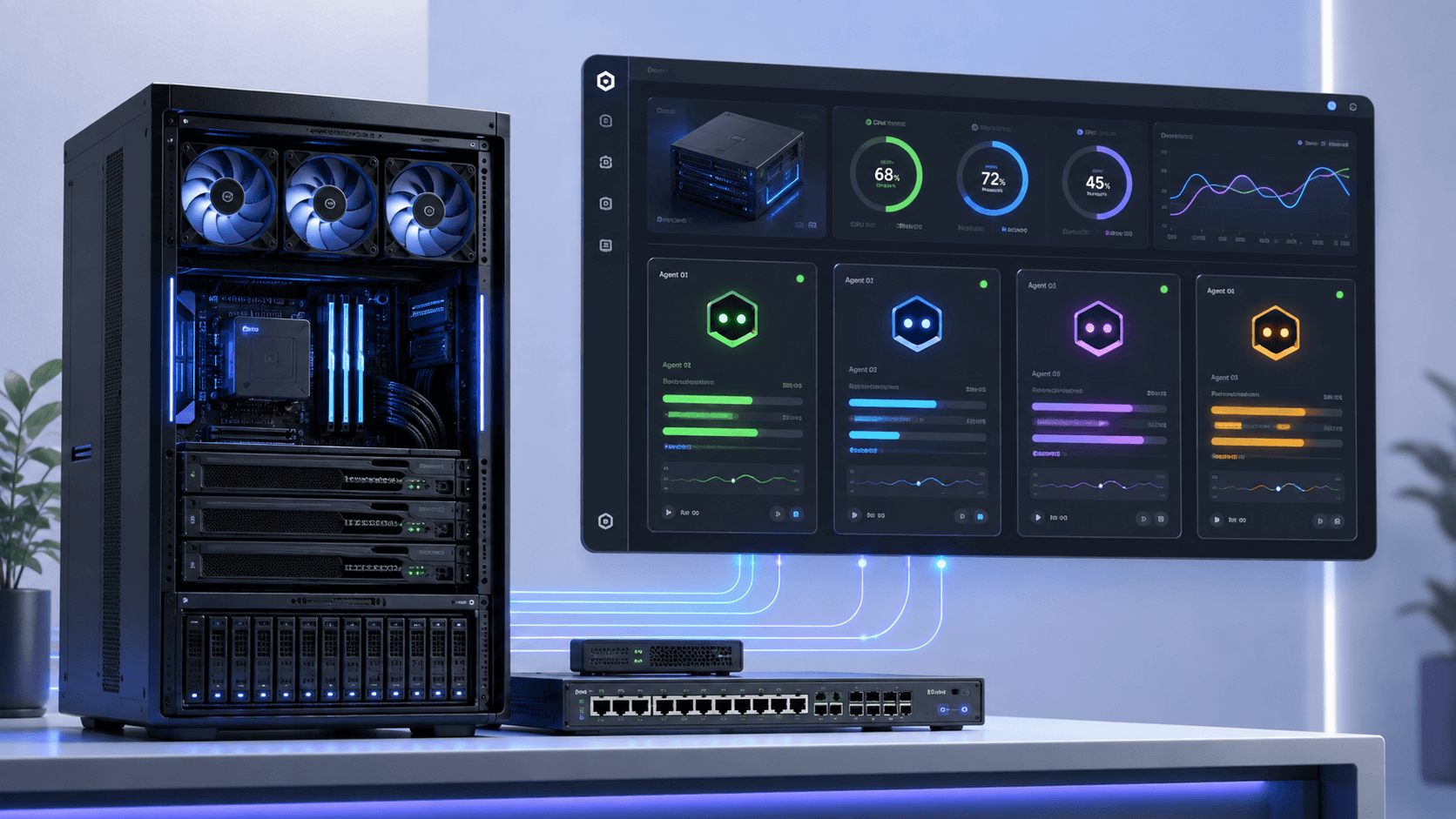
When businesses decide to deploy multiple AI agents, the hardware infrastructure becomes the foundation that determines success or failure. Most companies underestimate the complexity of running several autonomous agents simultaneously, each requiring dedicated resources while maintaining coordination. Milan Kordestani has observed that the difference between a smooth deployment and a system that crashes under load often comes down to proper hardware architecture from day one.
The challenge isn't just about having powerful hardware - it's about designing an infrastructure that can handle dynamic workloads, isolate agent processes, and scale resources based on real-time demands. Our agents don't operate in isolation; they communicate, share data, and coordinate actions across your business processes. This means the hardware setup must account for both individual agent requirements and the collective system overhead that emerges when multiple AI processes run concurrently.
What many businesses discover too late is that running multiple AI agents is fundamentally different from running traditional software applications. The Ankord Media team has learned that agent workloads are unpredictable, memory-intensive, and highly dependent on real-time data processing. When we deploy these systems for clients, the hardware configuration reflects months of testing and optimization to ensure reliable performance under varying business conditions.
Core Hardware Architecture for Multi-Agent Systems
The foundation of any multi-agent AI system starts with understanding how computational resources get allocated across different agent types. Milan Kordestani and the Ankord Media team have found that the biggest mistake companies make is treating all AI agents equally when designing hardware infrastructure. Different agents have vastly different resource requirements - a data analysis agent needs substantial RAM and processing power, while a scheduling agent operates efficiently with minimal resources.
Memory architecture becomes critical when multiple agents share the same hardware environment. Our system design ensures that each agent has dedicated memory space while maintaining shared memory pools for inter-agent communication. This prevents memory conflicts that can cause system instability and ensures that one agent's heavy processing doesn't impact another agent's performance.
The processor configuration must balance single-core performance with multi-core scaling capabilities. Modern AI agents benefit from high-frequency cores for real-time decision making, but they also need multiple cores for parallel processing of complex tasks. The development team at Ankord Media configures systems with a mix of high-performance cores for critical agent functions and efficient cores for background processes and system overhead.
Storage architecture requires careful consideration of both speed and capacity requirements:
- NVMe SSD Arrays: Primary storage for active agent data and real-time processing with sub-millisecond access times
- High-Capacity SATA Storage: Secondary storage for historical data, training datasets, and backup agent states
- Network-Attached Storage: Shared storage pools for inter-agent data exchange and collaborative processing tasks
- Memory-Mapped Storage: Hybrid storage solutions that blur the line between RAM and persistent storage for frequently accessed data
Network infrastructure design becomes increasingly important as the number of agents grows. Our approach involves creating dedicated network segments for different types of agent communication - high-speed internal networks for real-time coordination and standard networks for external API calls and data synchronization. This segmentation prevents network congestion from affecting critical agent communications.
The physical hardware configuration must account for thermal management and power distribution across multiple high-performance components. When Milan Kordestani deploys multi-agent systems, the server configurations include redundant cooling systems and power supplies to prevent hardware failures that could disrupt entire agent workflows.
Resource Management and Orchestration Systems
Container orchestration becomes essential when managing multiple AI agents across distributed hardware resources. The Ankord Media team uses sophisticated container management systems that can dynamically allocate resources based on real-time agent demands. This approach allows agents to scale up during intensive tasks and scale down during idle periods, maximizing hardware utilization efficiency.
Load balancing across multiple agents requires intelligent resource allocation algorithms that understand each agent's current workload and priority level. Our infrastructure monitors agent performance in real-time and automatically redistributes computational resources to prevent bottlenecks. This dynamic allocation ensures that critical business processes receive priority access to hardware resources when needed.
Fault tolerance and redundancy planning are crucial for business-critical agent deployments. Our agents are designed with failover capabilities that automatically migrate agent processes to healthy hardware when system issues are detected. This redundancy extends beyond simple backups to include real-time state synchronization and seamless process migration.
The orchestration system includes several key components for optimal performance:
- Resource Monitoring Dashboards: Real-time visibility into CPU, memory, and network utilization across all agent processes
- Automatic Scaling Triggers: Predefined thresholds that automatically provision additional resources during peak demand periods
- Health Check Systems: Continuous monitoring of agent processes with automatic restart capabilities for failed or unresponsive agents
- Performance Optimization Algorithms: Machine learning-based resource allocation that improves efficiency based on historical usage patterns
Database and data storage orchestration requires special attention when multiple agents access shared data sources. Milan Kordestani's approach involves implementing database connection pooling, query optimization, and caching layers that prevent database bottlenecks from impacting agent performance. The system includes read replicas and write optimization to handle concurrent data access efficiently.
Security isolation between different agent processes protects sensitive business data while maintaining necessary inter-agent communication channels. The development team at Ankord Media implements network segmentation, process isolation, and encrypted communication protocols that ensure each agent operates within defined security boundaries while maintaining system functionality.
Deployment Strategy and Performance Optimization
The deployment process for multi-agent hardware systems requires careful staging and testing to ensure optimal performance before going live. Our infrastructure deployment follows a structured approach that validates each component's performance under realistic business workloads. This testing phase identifies potential bottlenecks and configuration issues before they impact production operations.
Performance tuning involves optimizing both individual agent configurations and system-wide resource allocation policies. The Ankord Media team monitors agent behavior patterns during initial deployment phases and adjusts hardware configurations based on actual usage data rather than theoretical requirements. This data-driven optimization approach ensures that the hardware setup matches real business needs.
Monitoring and maintenance systems provide ongoing visibility into agent performance and hardware utilization trends. Our approach includes automated alerts for performance degradation, capacity planning based on growth trends, and predictive maintenance scheduling to prevent hardware failures. These systems enable proactive management rather than reactive problem-solving.
The optimization strategy encompasses multiple performance dimensions:
- Latency Optimization: Tuning network configurations, storage access patterns, and inter-agent communication protocols for minimal response delays
- Throughput Maximization: Configuring parallel processing capabilities and batch operation optimization for maximum data processing capacity
- Resource Efficiency: Implementing smart scheduling algorithms that minimize idle resources while maintaining performance standards
- Scalability Planning: Designing expansion pathways that accommodate business growth without requiring complete system redesigns
Long-term maintenance planning includes hardware refresh cycles, capacity expansion strategies, and technology upgrade paths that keep the multi-agent system current with evolving business requirements. Milan Kordestani and the team design these systems with future growth in mind, ensuring that initial hardware investments continue providing value as business needs evolve.
The deployment process includes comprehensive documentation and knowledge transfer to ensure that businesses understand their new infrastructure capabilities. Our agents come with detailed performance baselines, troubleshooting guides, and optimization recommendations that enable businesses to maximize their return on hardware investment while maintaining system reliability and performance.