


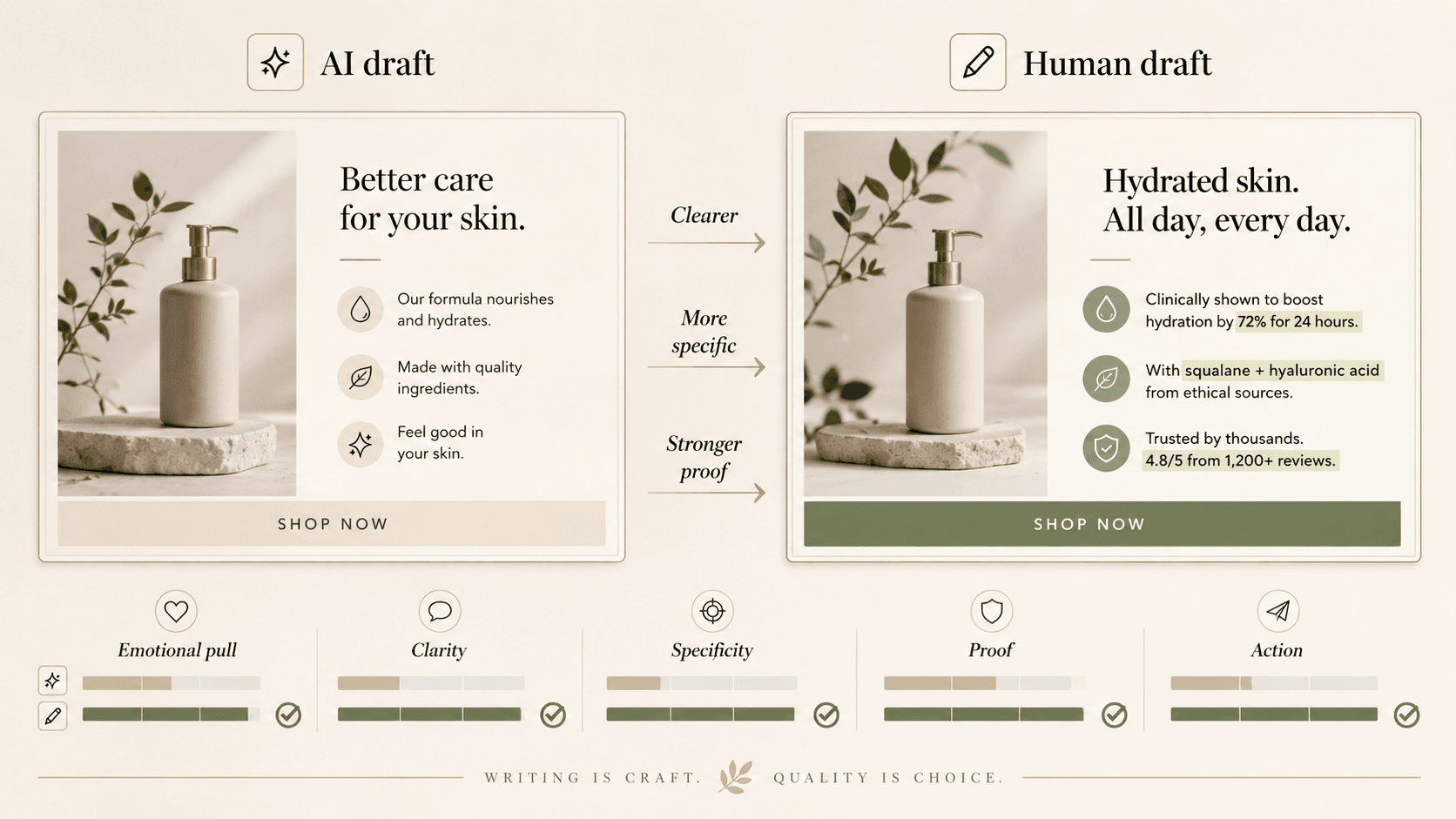
The question isn't whether AI agents can write better copy than human copywriters - it's when and how they outperform humans in specific contexts. After deploying hundreds of AI copywriting systems, Milan Kordestani has observed that the answer depends entirely on your definition of "better" and the specific use case you're optimizing for. The most successful implementations combine AI efficiency with human oversight in carefully architected workflows.
Traditional comparisons between AI and human copywriters miss the fundamental shift happening in content production. The development team at Ankord Media has found that AI agents don't replace human creativity - they amplify it by handling data-intensive, repetitive, and scale-dependent tasks that humans struggle with. When we deploy these systems correctly, clients see improvements in both output volume and conversion performance because each component handles what it does best.
The real breakthrough comes from understanding that AI agents and human copywriters operate on different performance curves. Our agents excel in scenarios requiring rapid iteration, data synthesis, and personalization at scale, while humans dominate in brand voice development, emotional storytelling, and strategic messaging. Milan Kordestani and the Ankord Media team have developed deployment frameworks that leverage these complementary strengths rather than forcing direct competition.
Where AI Agents Outperform Human Copywriters
AI agents demonstrate clear superiority in data-driven copywriting scenarios where speed, consistency, and personalization intersect. Our infrastructure processes customer data, behavioral patterns, and conversion metrics in real-time to generate copy variations that human writers couldn't produce at comparable speed or scale. The Ankord Media team has deployed systems that analyze thousands of data points per customer to create personalized email sequences, product descriptions, and ad variations that consistently outperform human-written alternatives in A/B tests.
The mathematical advantage becomes obvious when you consider that our agents can test hundreds of copy variations simultaneously while learning from each interaction. Milan Kordestani's approach involves feeding conversion data, customer feedback, and engagement metrics back into the AI system continuously, creating a learning loop that improves performance over time. Human copywriters, constrained by time and cognitive bandwidth, typically test 2-3 variations before moving to the next project, missing optimization opportunities that AI agents capture automatically.
Performance data from our deployments shows AI agents excel particularly in contexts where copy needs frequent updates based on changing variables. E-commerce product descriptions that must reflect inventory levels, seasonal trends, and customer preferences benefit enormously from AI automation. The development team at Ankord Media has built systems that update copy across thousands of product pages based on real-time data inputs, maintaining relevance and accuracy at a scale impossible for human teams.
The specific scenarios where our agents consistently outperform humans include:
- High-volume personalization: Creating thousands of unique email variations based on customer segments, purchase history, and behavioral data that converts better than generic human-written campaigns
- Data-driven optimization: Continuously testing and refining copy elements like headlines, calls-to-action, and value propositions based on real-time performance metrics and user feedback
- Multilingual adaptation: Translating and culturally adapting copy across multiple markets while maintaining brand consistency and local relevance at speeds human teams cannot match
- Dynamic content updates: Automatically refreshing copy based on inventory changes, pricing updates, seasonal factors, and trending topics without human intervention or delays
However, this performance advantage comes with important infrastructure requirements that Milan Kordestani and the team address during deployment. Our agents need clean, structured data feeds to function optimally, which often requires rebuilding how clients collect and organize customer information. We handle the technical architecture that connects your existing systems to our AI infrastructure, ensuring data flows seamlessly between platforms without disrupting current operations.
The transformation clients experience goes beyond just better copy - it's a fundamental shift in how content production scales with business growth. When we deploy these systems, marketing teams move from creating individual pieces to managing automated workflows that produce hundreds of optimized variations. This operational change requires training and process adjustment, but the results speak for themselves in improved conversion rates and reduced content production costs.
Where Human Copywriters Still Reign Supreme
Despite AI advancement, human copywriters maintain decisive advantages in areas requiring emotional intelligence, brand intuition, and strategic thinking. The Ankord Media team has observed that our most successful deployments preserve human control over brand voice development, narrative strategy, and complex emotional messaging that drives long-term customer relationships. AI agents can optimize for immediate conversions, but humans excel at building the brand equity and emotional connections that create lasting customer value.
Creative breakthrough moments - the insights that reframe entire markets or create new product categories - remain fundamentally human territory. Milan Kordestani has found that while our agents excel at iterating within established parameters, humans drive the strategic pivots and creative leaps that transform businesses. The most impactful copy often challenges assumptions, introduces new frameworks, or connects seemingly unrelated concepts in ways that current AI systems cannot replicate reliably.
Cultural sensitivity and contextual nuance represent another domain where human expertise proves irreplaceable. Our infrastructure can process demographic data and cultural indicators, but humans understand the subtle implications of word choice, cultural references, and timing that determine whether messaging resonates or alienates. The development team at Ankord Media often deploys hybrid systems where AI generates initial drafts and humans refine them for cultural appropriateness and emotional impact.
The scenarios where human copywriters consistently outperform our agents include:
- Brand voice development: Establishing the foundational tone, personality, and messaging framework that defines how a company communicates across all channels and touchpoints
- Crisis communication: Navigating sensitive situations requiring empathy, strategic messaging, and real-time adaptation to changing circumstances and stakeholder concerns
- Thought leadership content: Creating insights, perspectives, and strategic frameworks that position executives and companies as industry authorities and intellectual leaders
- Complex B2B sales cycles: Developing nuanced messaging that addresses multiple stakeholders, lengthy decision processes, and relationship-building requirements in enterprise sales contexts
The infrastructure Milan Kordestani and the Ankord Media team deploy accounts for these human strengths by creating workflows where AI handles production tasks while humans focus on strategy and oversight. This division of labor requires careful system design to ensure human input reaches AI outputs effectively, which we accomplish through approval workflows, feedback loops, and iterative refinement processes built into our deployment architecture.
What changes for clients when we implement these hybrid systems is a shift from choosing between AI and human capability to orchestrating both optimally. Marketing teams report that they spend more time on strategic thinking and less time on production tasks, leading to both better creative outcomes and improved operational efficiency. The key is designing workflows that enhance rather than replace human judgment while leveraging AI capabilities where they provide clear advantages.
The Future of AI-Human Copywriting Collaboration
The trajectory Milan Kordestani observes in AI copywriting development points toward increasingly sophisticated collaboration rather than replacement of human creativity. Our agents are evolving to handle more complex reasoning tasks while humans focus on strategic direction and quality oversight. The development team at Ankord Media is building systems that understand context, maintain brand consistency across channels, and adapt messaging based on customer journey stages in ways that complement rather than compete with human insight.
Advanced deployment architectures now enable real-time collaboration between AI systems and human copywriters within the same projects. Our infrastructure allows humans to set strategic parameters, approve AI-generated variations, and provide feedback that improves system performance continuously. Milan Kordestani has found that this collaborative approach produces better results than either AI or human work in isolation, combining the scale and data processing capabilities of AI with human creativity and strategic thinking.
The emerging paradigm shifts focus from "AI versus human" to "AI amplifying human capability" in ways that transform both copy quality and production efficiency. When we deploy these collaborative systems, clients experience improvements in both creative output and operational metrics because each component operates within its zone of optimal performance. The Ankord Media team designs these workflows to feel natural for human users while maximizing AI capability behind the scenes.
The collaborative advantages that our infrastructure enables include:
- Intelligent draft generation: AI creates multiple copy variations based on strategic briefs, allowing humans to select and refine the most promising approaches rather than starting from blank pages
- Real-time optimization feedback: Systems that monitor copy performance and suggest improvements to human writers based on data patterns and conversion analytics unavailable to individual copywriters
- Contextual research synthesis: AI agents that process market research, competitor analysis, and customer feedback to provide writers with comprehensive briefs and data-driven insights for strategic content development
- Cross-channel consistency management: Automated systems that ensure messaging alignment across multiple platforms while allowing human creativity within brand guidelines and strategic frameworks
The technical infrastructure required for these collaborative workflows involves sophisticated data integration, workflow automation, and feedback processing that Milan Kordestani and the team handle during deployment. Our systems need to understand your brand guidelines, customer data, and business objectives well enough to provide useful assistance without constraining creative freedom. This balance requires careful calibration of AI parameters and human oversight processes.
Looking ahead, the most successful organizations will be those that deploy AI copywriting systems strategically rather than reactively. The Ankord Media team is developing predictive frameworks that help clients identify which content types, channels, and customer segments benefit most from AI automation versus human creativity. This strategic approach ensures that technology investments amplify rather than replace human capability while delivering measurable improvements in both content quality and business outcomes.