


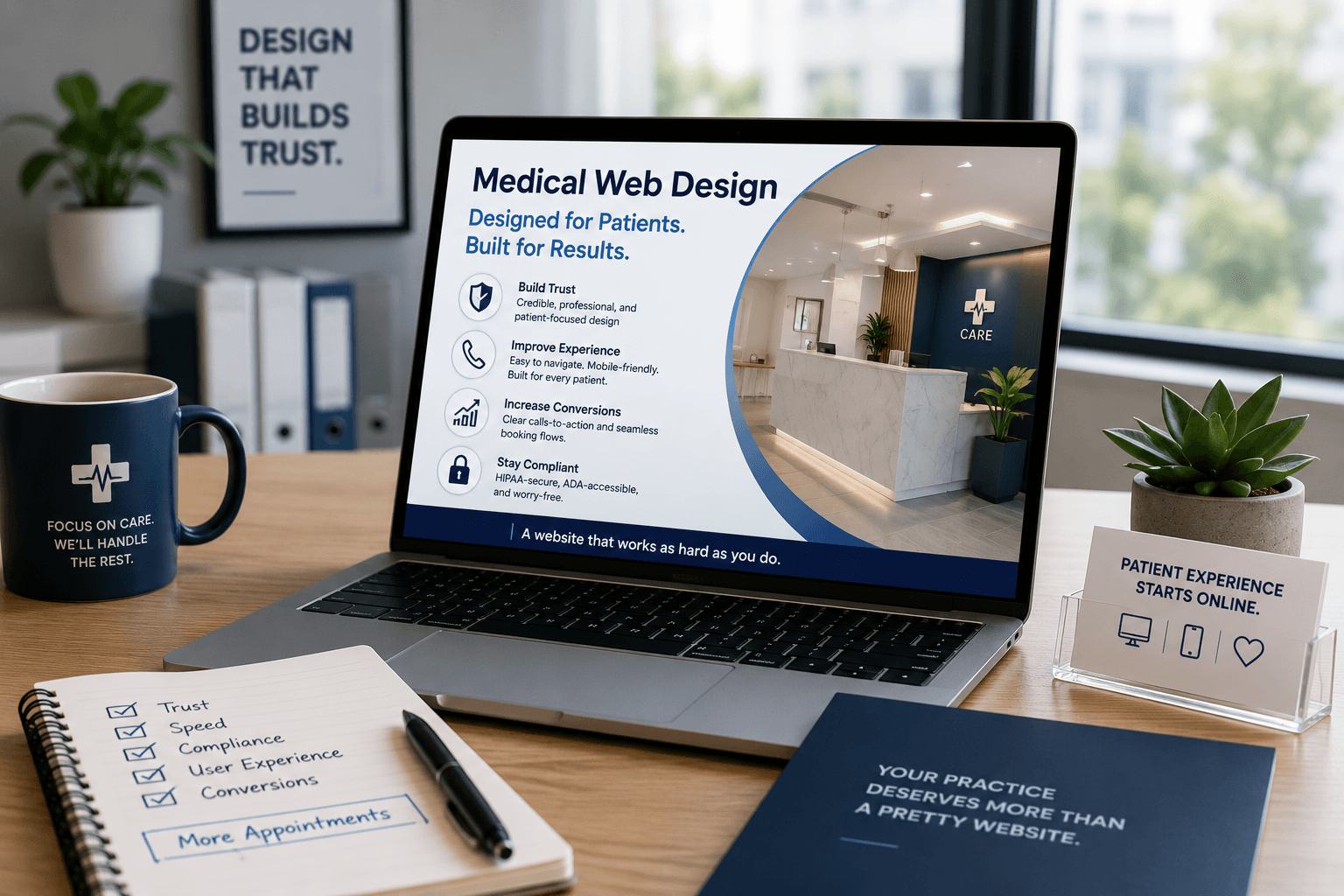
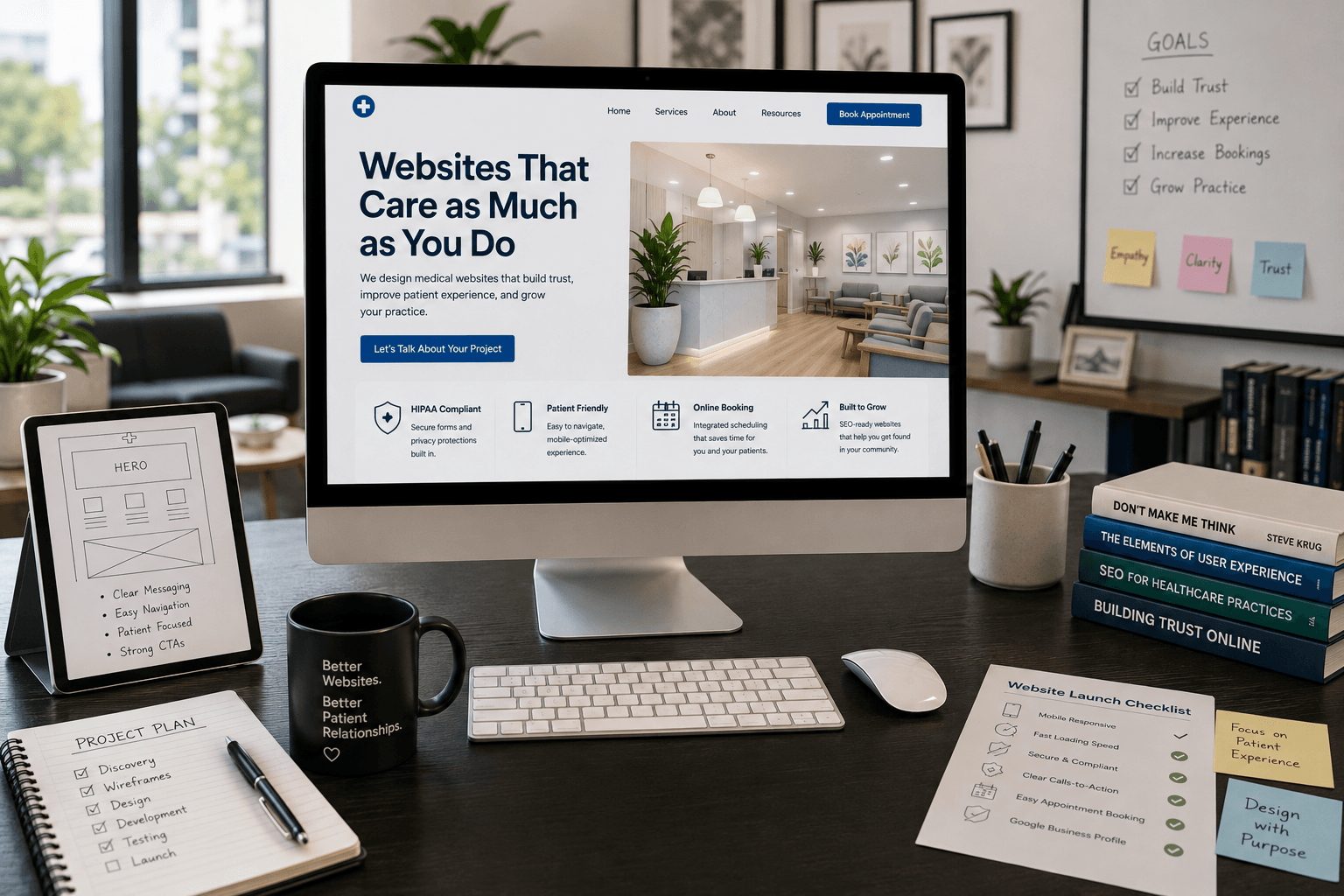
A polished homepage means nothing if the phone still isn't ringing. Plenty of practices spend real money on a beautiful site and still watch patients bounce before they ever fill out a contact form.
The problem usually isn't the color palette or the font choice. It's everything underneath the surface that a patient and Google actually judge a practice by. Good medical web design blends compliance, speed and trust into something that functions as well as it looks, and that combination is where most sites quietly fall apart. We built Ankord Media around solving exactly this gap for doctors who need a digital presence that works as hard as their practice does. If you want to see what that looks like in practice, book a call with our team once you've read through what actually matters below.
What Medical Web Design Actually Means for a Growing Practice
Medical web design carries a different weight than a typical small business site. A restaurant website that loads slowly is annoying. A medical website that loads slowly, buries its HIPAA disclosures or fails an accessibility check is a liability.
Patients are also searching with more urgency and more anxiety than the average shopper, so every design decision needs to account for someone who might be stressed, in pain or comparing three practices in the same ten minutes.
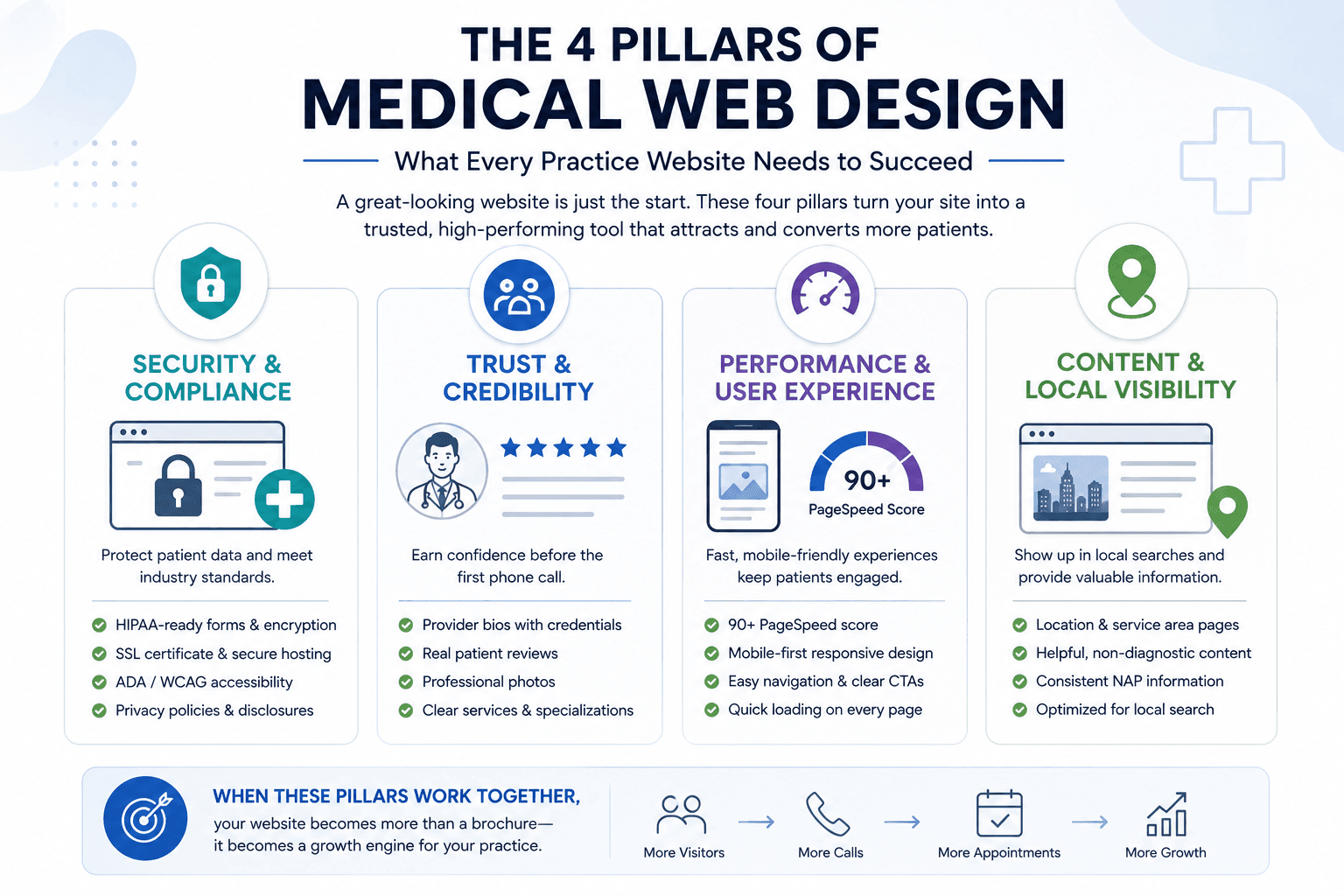
Think of the website as the patient's first clinical impression rather than a marketing brochure. That reframe changes what good design even means. It's not just about visual appeal. It's about whether the site protects patient data properly, earns trust before the first phone call, loads fast enough to keep someone from leaving and provides content that's genuinely useful without overstepping into medical advice. Those four pillars are what separate a nice looking site from one that actually converts, and we'll walk through each one below.
Compliance Doctors Can't Ignore: HIPAA and ADA Standards
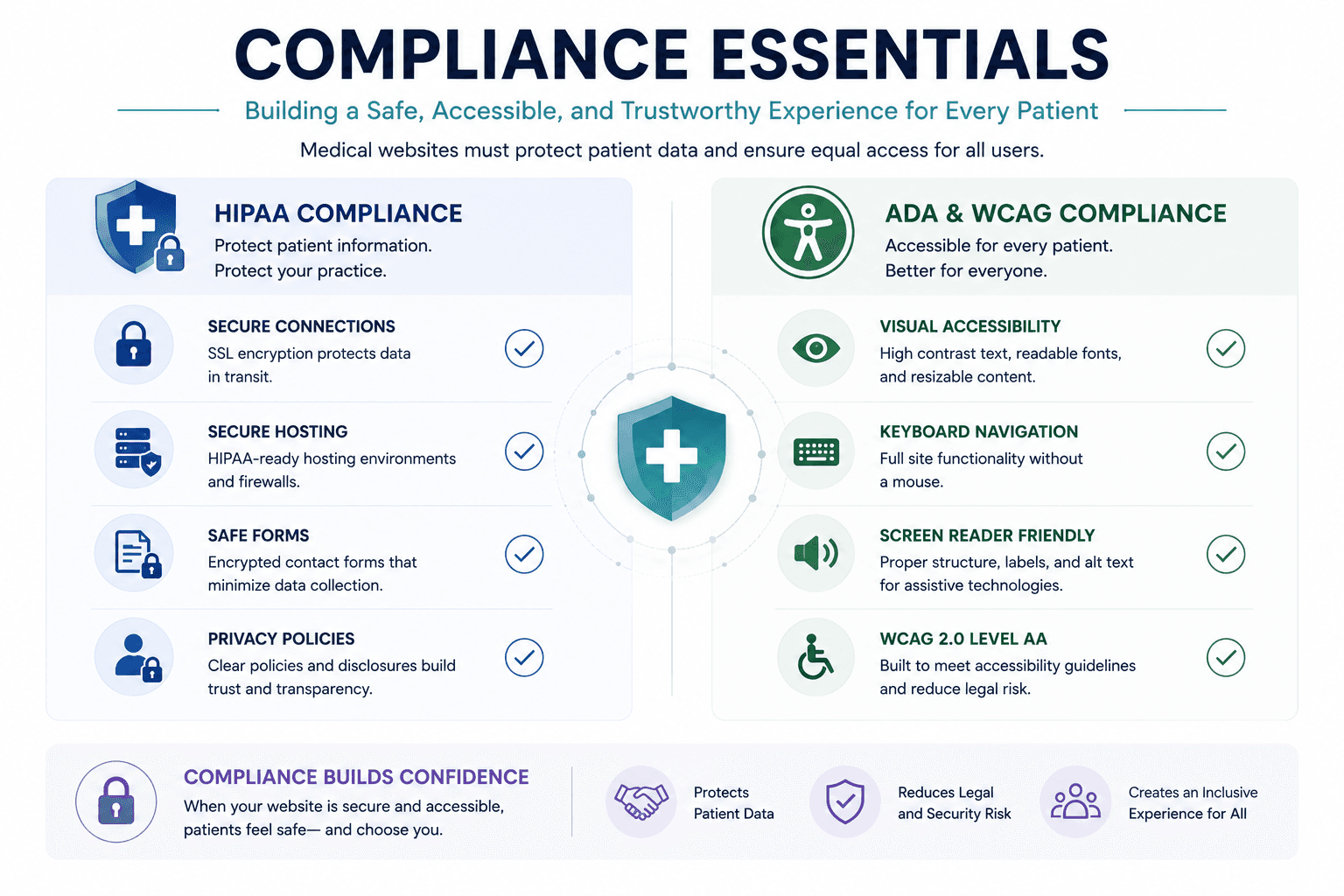
Compliance is the one area where good enough isn't actually good enough. A medical website that collects any patient information, even something as simple as a contact form asking for a name and reason for visit, takes on a level of responsibility a typical small business site never has to think about.
Skipping this isn't just risky from a legal standpoint. It also tells a patient, often without them consciously noticing, that the practice doesn't take their privacy seriously.
Protecting Patient Data With HIPAA-Ready Forms
Every form on a medical website should be built with encryption in mind, not bolted on afterward. That means secure hosting, encrypted data transfer and ideally routing anything sensitive to a proper patient portal rather than an open contact form.
An SSL certificate is the baseline here, not a differentiator. If a practice's site doesn't show the padlock icon in the address bar, that's a problem to fix today, not next quarter. Our design and development team builds these protections into a site from the start rather than treating them as an afterthought.
Meeting ADA and WCAG Accessibility Requirements
Accessibility gets talked about less than HIPAA but matters just as much. WCAG 2.0 Level AA is the standard worth building toward, and in practical terms that means solid color contrast, full keyboard navigation and screen reader compatibility across every page.
Accessibility gaps hide in plain sight. Missing alt text on a provider headshot or a portfolio image feels minor until a patient using a screen reader can't figure out who they're even looking at. This is exactly the kind of gap our ADA compliance work is built to catch before it becomes a bigger issue, and it's a core part of doing medical web design correctly rather than as an afterthought.
Building Trust With Patients Before They Ever Call
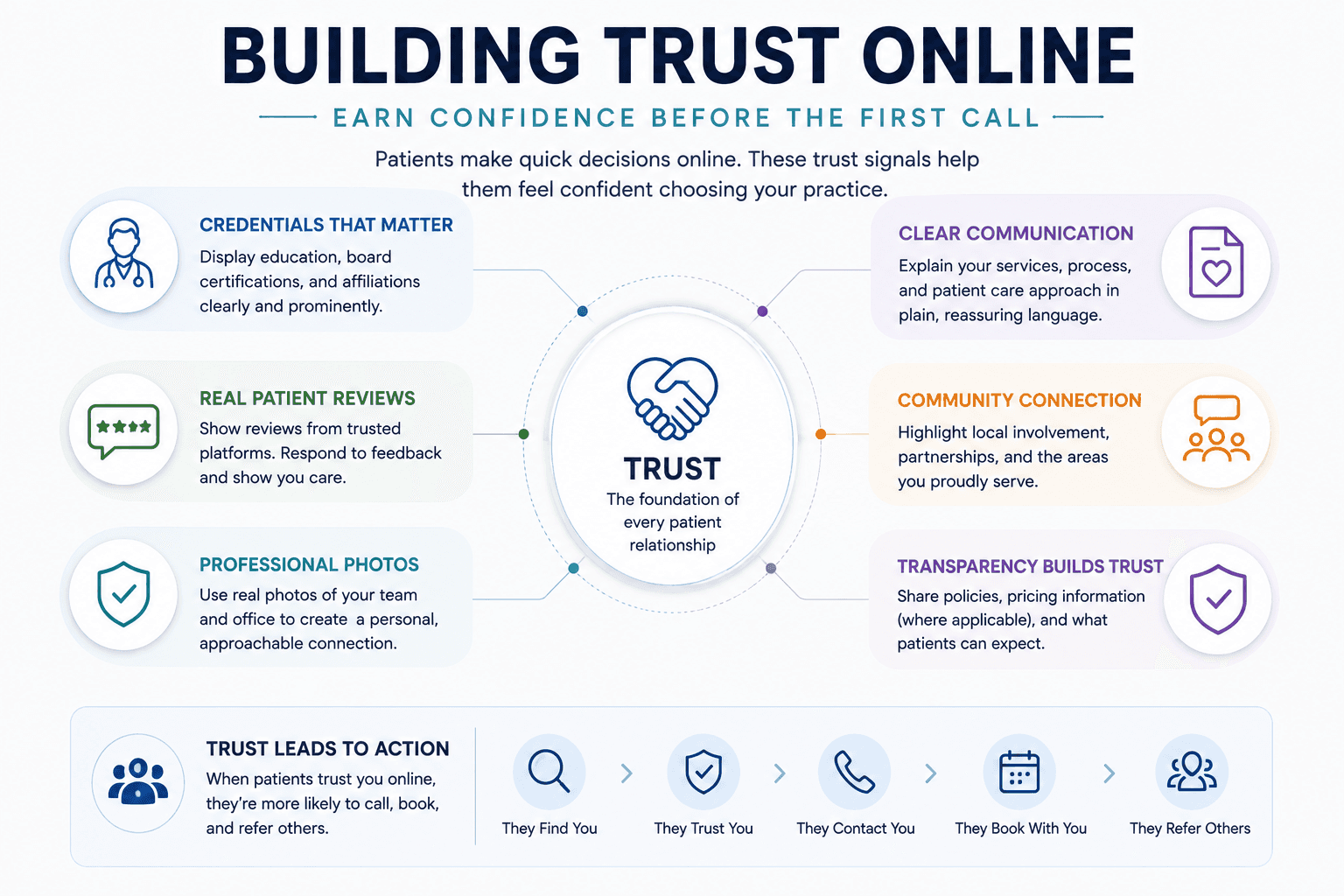
Patients decide whether a practice feels credible long before they pick up the phone. That decision happens in the ten or so seconds it takes to scroll a homepage, so the site has to earn that trust fast and keep earning it on every page after.
A strong provider bio does more than list a name and specialty. Education, board certifications, professional affiliations and a real photo, placed prominently rather than buried three clicks deep in an About page, tell a patient this person is qualified before they ever ask a question out loud. This matters for more than first impressions too. Search engines evaluate medical content partly on whether the person behind it has real, visible credentials, so a strong bio does double duty as both a trust signal and an SEO asset.
Reviews carry a similar weight. Pull them from Google or another verified platform rather than only hand picking the glowing ones. A mix of ratings, including a few that aren't perfect five stars, reads as more honest than an unbroken wall of praise. Responding to reviews, even the less flattering ones, actually builds more credibility than ignoring them since it shows a practice that listens.
Real proof of past work matters here too, which is part of why we treat our portfolio as one of the strongest trust builders on a client's site rather than an afterthought page.
Site Speed and Mobile Experience Patients Actually Notice
Speed matters everywhere, but it matters more in healthcare specifically. A patient searching for urgent care or a same week appointment has almost no patience for a slow loading page or a booking form that breaks on their phone.
A one second delay can be the difference between a booked appointment and a visitor who taps back to Google and clicks a competitor instead. This isn't a minor technical detail. It's a direct patient acquisition problem.
Every site we build is held to a 90+ PageSpeed standard as a baseline, not an upsell, because a fast mobile experience is table stakes for medical web design that actually converts visitors into booked patients rather than just impressed ones.
Content That Builds Credibility Without Crossing Into Medical Advice
There's a real line doctors need to walk with website content. Good content builds authority and helps search engines trust the site. Bad content crosses into medical advice territory and creates liability the practice never intended to take on.
The safest and most effective approach is writing service and condition overviews in plain language, attributing content to a named credentialed provider and answering the questions patients actually search for without ever diagnosing anyone through a screen.
Consistent, well credentialed content also plays directly into how search engines evaluate medical sites for trustworthiness, so this isn't just about sounding smart. It's about being found in the first place. A regularly updated blog is one of the most effective ways to build this kind of authority over time, and it's part of what we help clients maintain long after a new site launches.
Booking Flow and Patient Portal Integration That Reduce Friction
A booking flow with too many fields loses patients before they finish filling it out. Keep the form short, make it work cleanly on a phone and give the patient a clear next step the moment they hit submit, whether that's a confirmation screen or an immediate email.
Patient portal integration is an expectation now rather than a nice feature to add later, and the link to it needs to be easy to find, not hidden in a footer menu.
We handle this kind of integration through a concierge process, meaning clients never have to learn a new project management tool or chase down a developer to get functional booking features live. Some clients also lean on our AI automation work to handle scheduling reminders and intake more smoothly, which cuts down on staff time spent on the phone.
Local Visibility for Doctors Competing in a Specific City or Neighborhood
Local visibility works differently for a practice without a storefront to anchor a map listing around. Service area content and consistent business information do the heavy lifting instead.
Naming specific neighborhoods and cities directly in the site copy, rather than relying only on a generic location page, helps a practice show up when someone searches for care nearby. We've built this kind of local relevance for practices in Los Angeles and across other markets, and the pattern holds regardless of city. Consistency across every page beats a single well optimized location page every time.
Why Doctors Choose Ankord Media for Medical Web Design That Works as Hard as They Do
Compliance, trust, speed and content all have to work together, not as separate boxes to check with separate vendors. We handle all of it as one team, with a concierge model that means phone calls and WhatsApp messages instead of a project management tool, unlimited revisions until a client is satisfied and fast turnarounds that respect a busy practice's time.
Our pricing reflects that full scope rather than charging piecemeal for design, development and content separately. If your current site is falling short on any of what we covered here, book a call with us today.