



- What Does a Startup UX Design Agency Actually Do?
- Why Early UX Decisions Matter More Than Most Founders Expect
- The Startup UX Decisions That Have the Biggest Long-Term Impact
- UX Debt: How Fast MVP Decisions Create Bigger Problems Later
- Why Prototyping Makes Expensive UX Mistakes Cheaper to Find
- When to Hire a Startup UX Design Agency and What to Look For
- Build Your Product on Better UX Decisions With Ankord Media
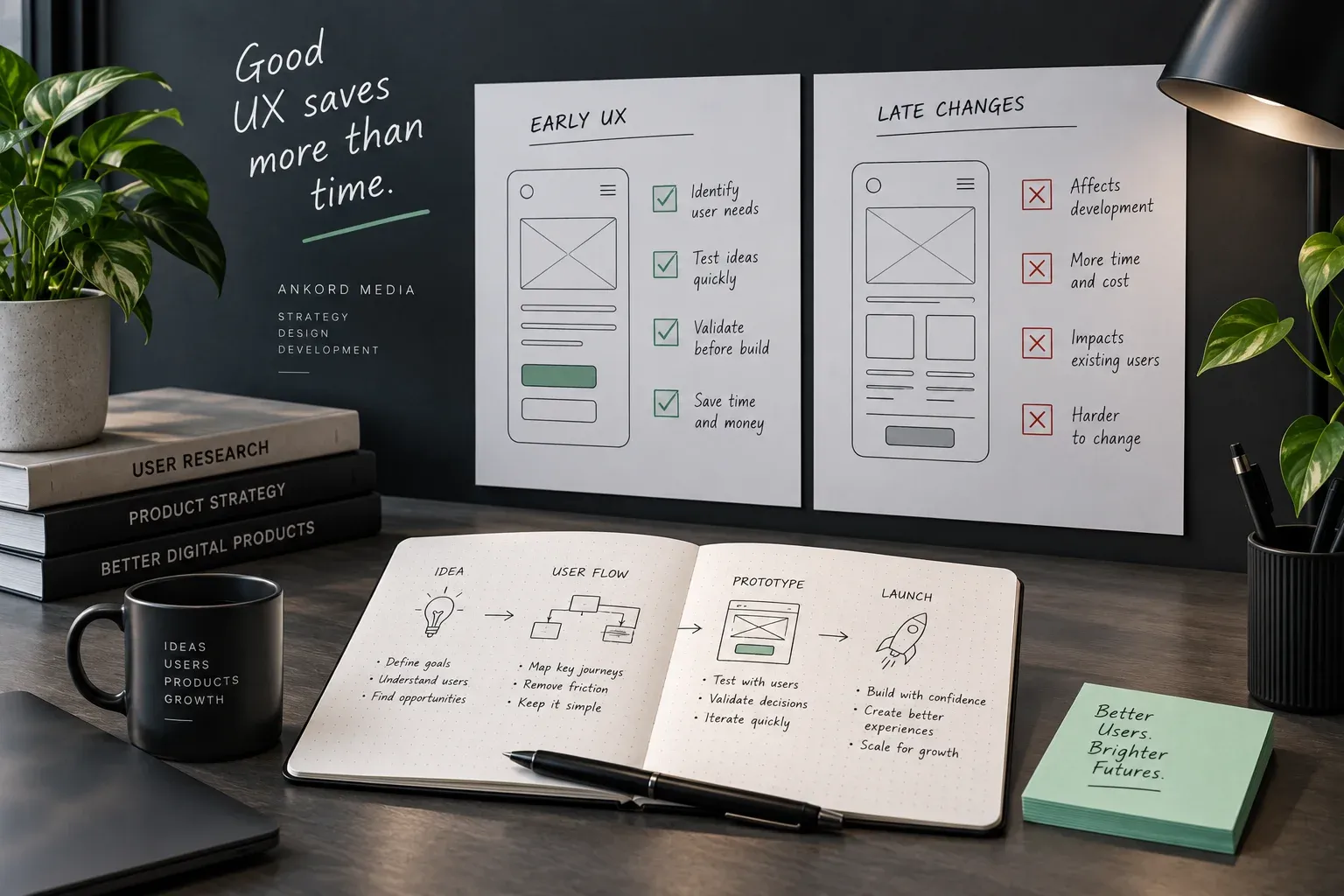
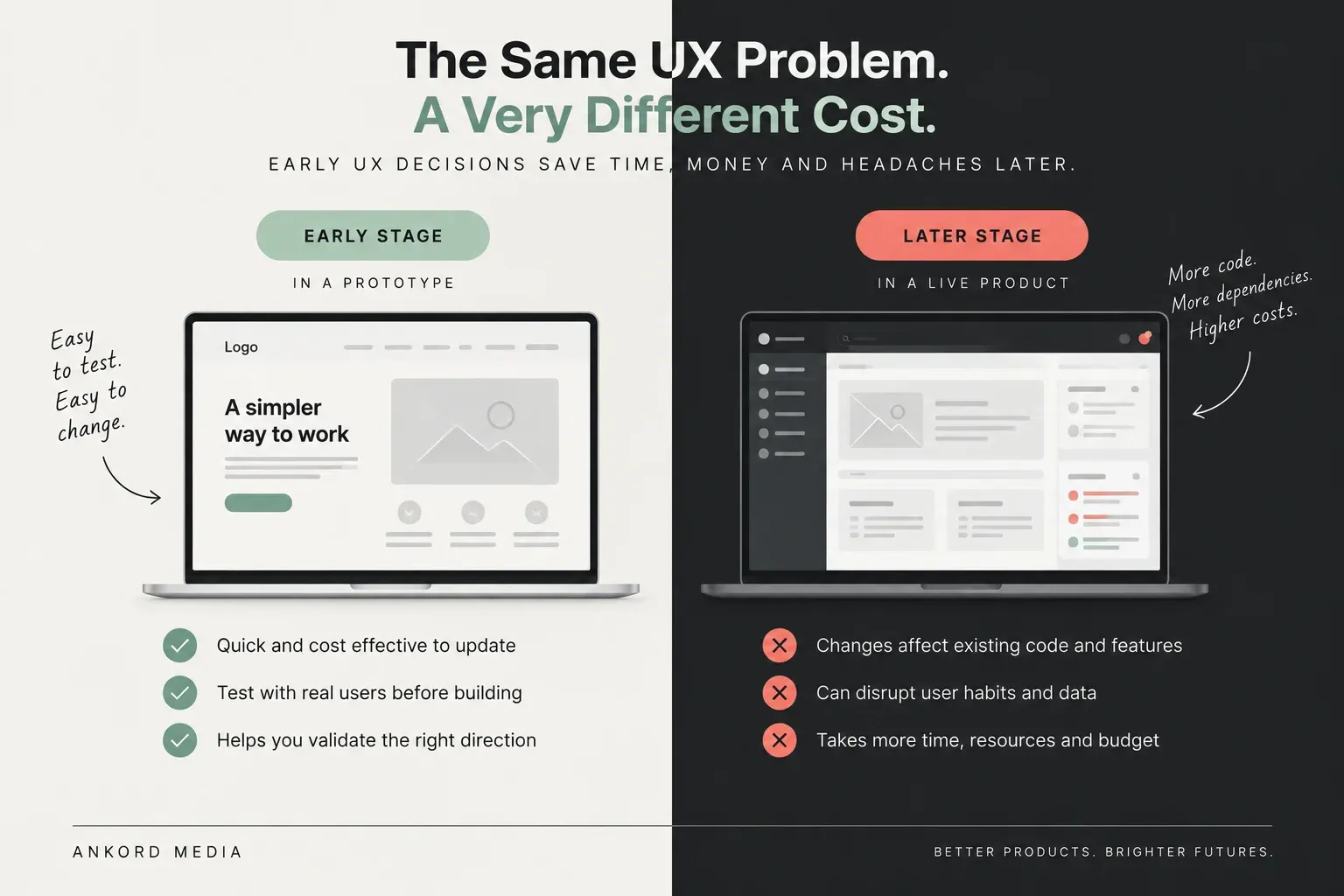
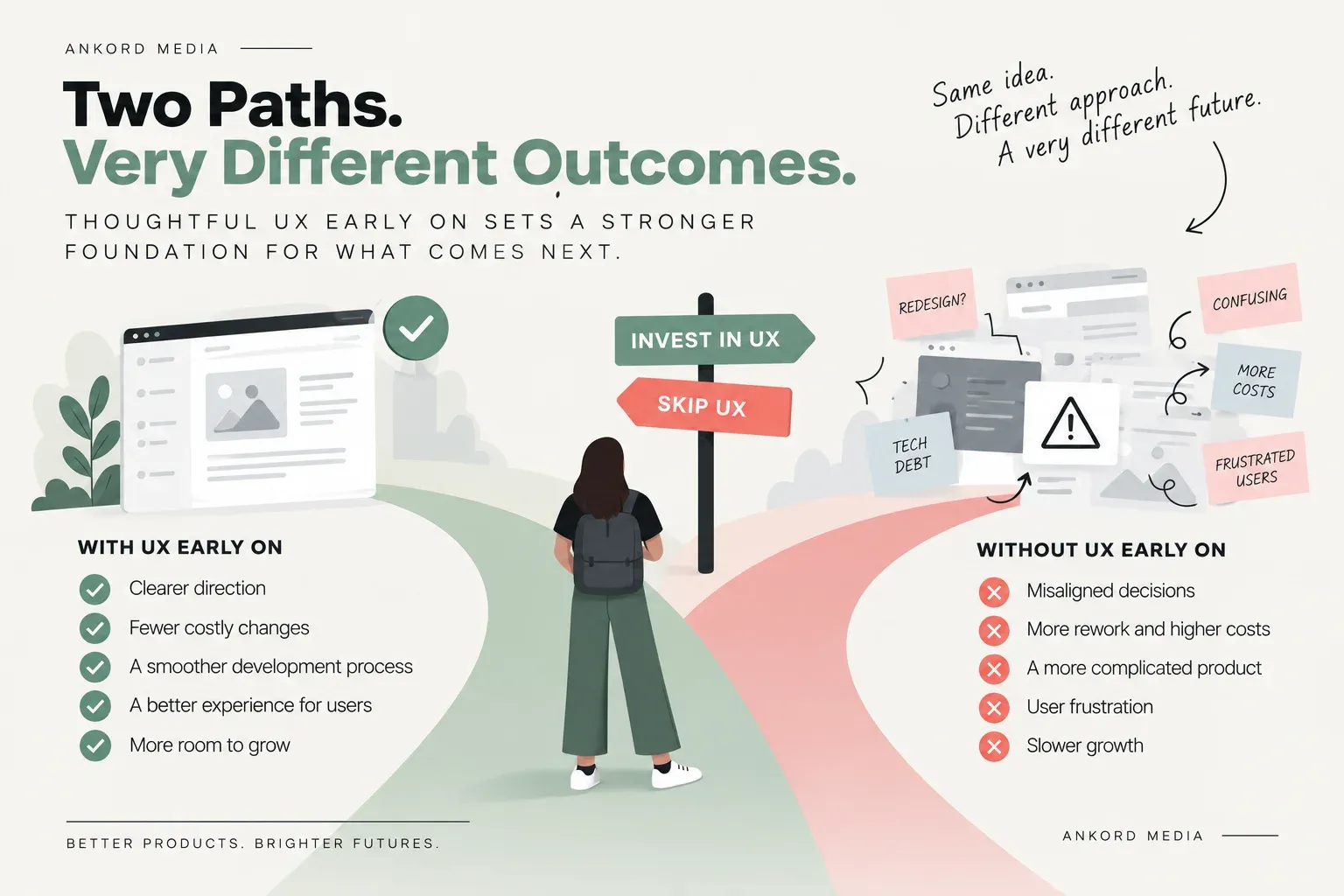
A bad UX decision is cheap to fix in a prototype. Six months later, that same decision could sit underneath code, integrations, new features and user habits that make changing it far more complicated.
That is why choosing a startup UX design agency early is not about making an MVP look polished. It is about identifying which product decisions need careful thought before the rest of the product depends on them.
Startups still need to move fast. Good UX supports that speed by testing important assumptions early, simplifying what gets built and preventing avoidable rework.
At Ankord Media, we bring product design and development together so founders do not have to coordinate disconnected teams as an idea moves from concept to launch. If you are planning an MVP, redesigning an existing product or preparing for your next stage of growth, book a call with us to talk through what you are building.
What Does a Startup UX Design Agency Actually Do?
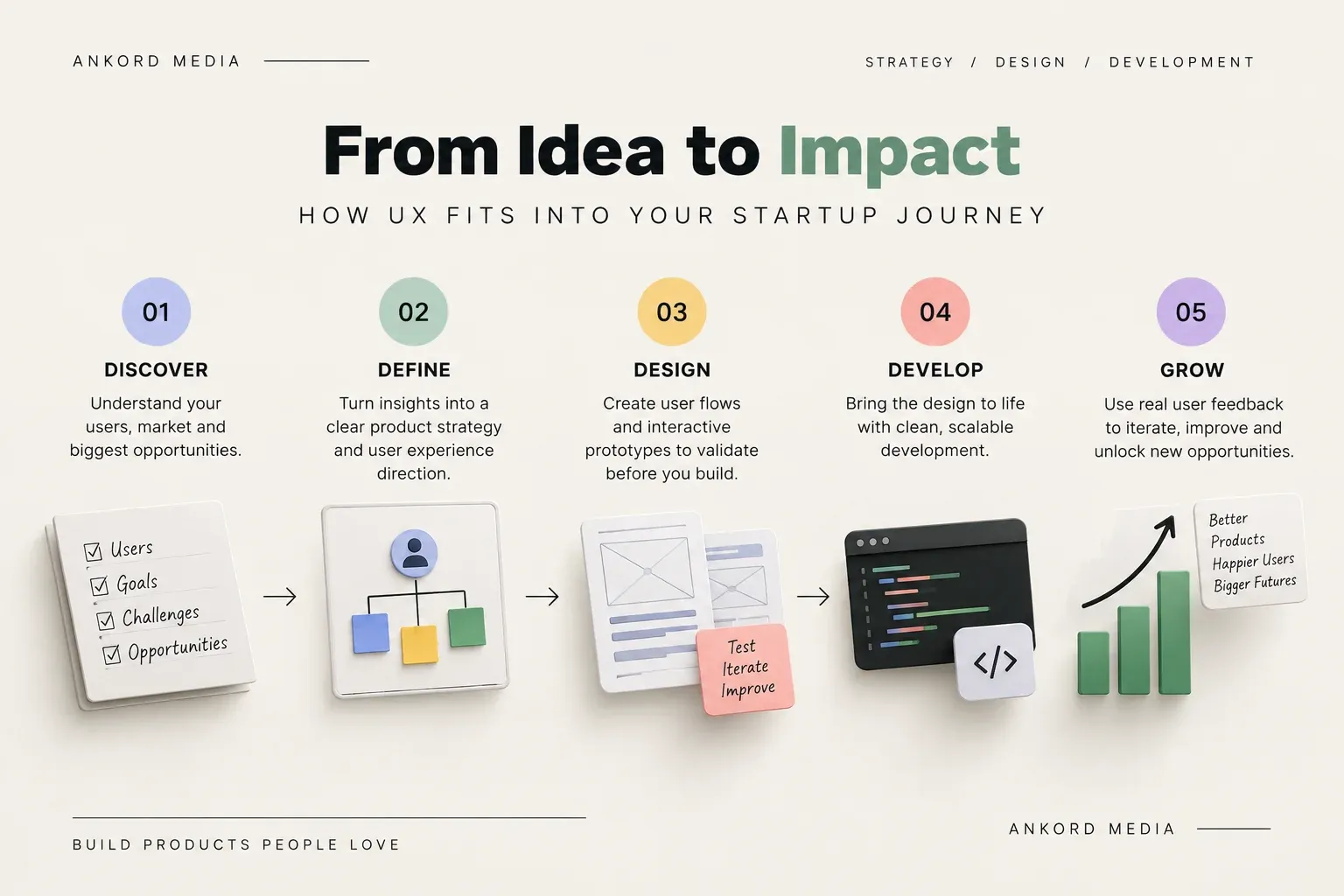
A startup UX design agency turns business requirements and user needs into a product people can understand and use. UX focuses on how the experience works, including where users go, what actions they take and how easily they can accomplish their goals. UI focuses more closely on how those interactions are presented visually.
Startup UX comes with an additional challenge: the product, audience and business model may still be evolving. Strong UX work identifies which assumptions need validation now and which decisions can remain flexible until the company has better evidence.
User Research and Product Discovery
Discovery establishes who the product serves, what those users are trying to accomplish and what currently makes that difficult.
Research can include user interviews, competitor analysis, existing product data and usability testing. The goal is not research for its own sake. It is to find assumptions that could send development in the wrong direction if they turn out to be false.
Early-stage research should also match the maturity of the startup. A pre-seed founder does not necessarily need months of discovery. The highest-risk assumptions should be investigated first.
User Flows, Prototypes and Developer Handoff
User flows map the steps someone takes to complete an important action, such as creating an account, setting up a workspace or completing a purchase. Wireframes establish the structure of those experiences before visual details take over.
Interactive prototypes then let teams test the experience before committing engineering resources. This is particularly valuable for UX design for startups because a confusing flow discovered in a prototype can usually be changed much faster than one discovered after launch.
Once those decisions are validated, they need to translate cleanly into development. Our design and development services keep product thinking, UI and implementation connected rather than treating each stage as a separate handoff.
Why Early UX Decisions Matter More Than Most Founders Expect
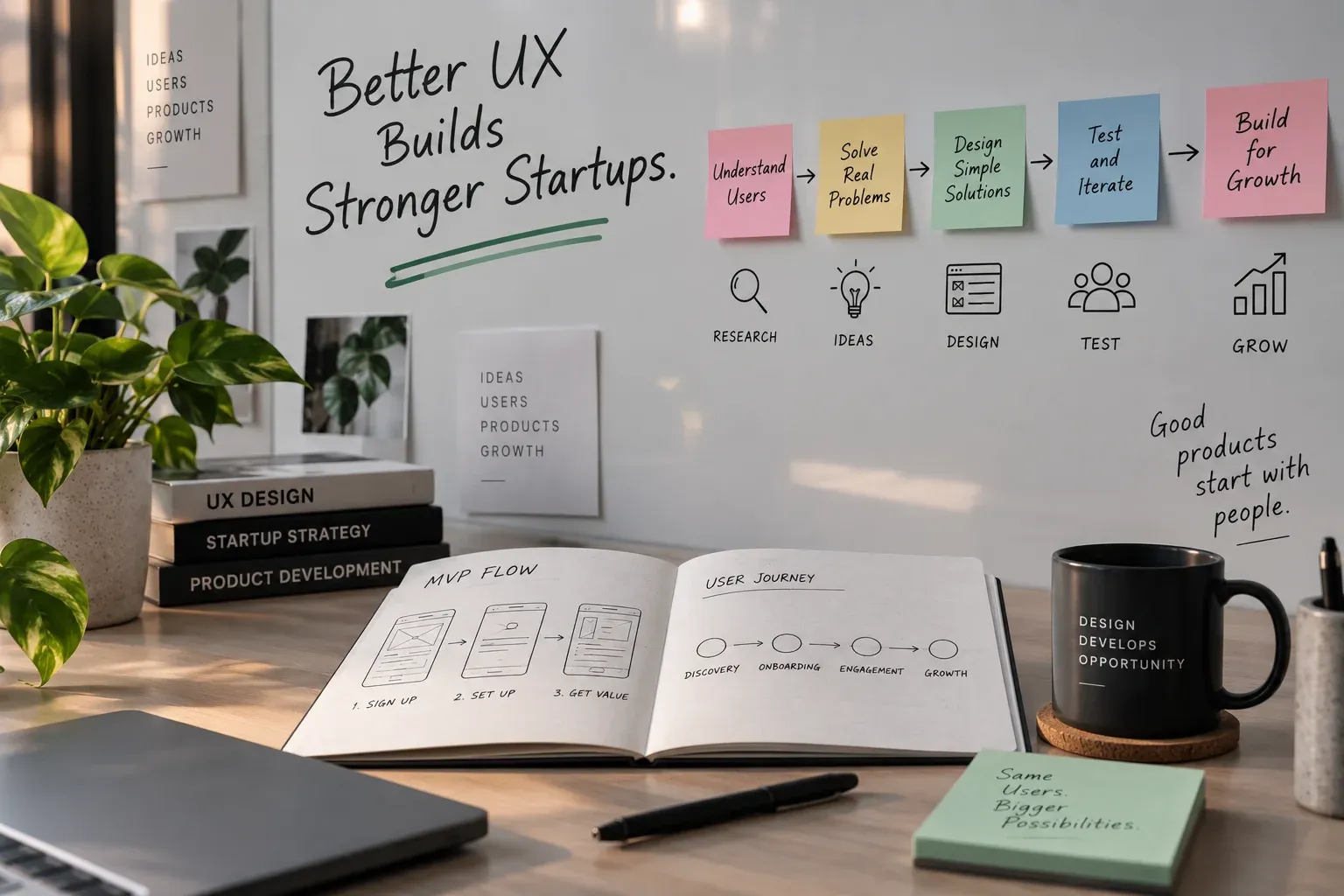
Early UX decisions compound.
One choice affects a screen. That screen affects development. New features are built around that development. Customers learn how those features work. Eventually, changing the original decision means changing far more than the original screen.
The goal is not to overthink every detail before launch. Founders should concentrate on structural choices that other parts of the product are likely to inherit.
Small Decisions Can Shape the Entire Product
Consider a SaaS platform organized around accounts, workspaces, projects and users.
How those elements relate can eventually affect navigation, permissions, dashboards, billing and onboarding. A decision that appears simple during the MVP can become part of the product's underlying logic.
Changing a visual treatment later is relatively easy. Reworking how users, accounts and permissions interact may affect large parts of the product.
A strong startup UX agency helps identify that difference early so time is spent on decisions with real downstream consequences.
The Cost of Changing UX Rises Over Time
The progression often looks like this:
UX decision → interface → development → user behavior → additional features → more dependencies
A workflow might take a few minutes to rearrange in a sketch or prototype. After launch, changing that same workflow could affect front-end code, backend logic, analytics and third-party integrations.
Customers add another complication. Users develop mental models around where features live and how common tasks work, so a major change can create a learning cost alongside the technical work.
Thoughtful early UX does not mean predicting every future feature. It means building a sensible foundation without unnecessarily limiting where the product can go next.
The Startup UX Decisions That Have the Biggest Long-Term Impact
Not every design choice deserves equal attention. The highest-priority decisions are usually the ones that determine how users understand the product, complete its core actions and navigate future functionality.
Information Architecture, Navigation and Design Systems
Information architecture determines how features, content and actions are organized.
Navigation should make sense for the product users have today while leaving reasonable room for growth. Designing an elaborate structure around 100 hypothetical features creates unnecessary complexity. Building navigation that only works for the five features currently in an MVP creates the opposite problem.
Terminology matters too. Users should not need to understand your company's internal language to understand the product.
Basic design systems can reinforce that structure. Consistent buttons, forms, cards and interaction patterns give users familiar behavior while giving designers and developers reusable components as new features are introduced.
Onboarding and Core User Flows
Good onboarding moves users toward meaningful value without placing unnecessary steps in their way.
Shorter is not automatically better. Some products genuinely require account configuration, permissions or setup. Each step should still have a clear reason for being there.
Start with the flows closest to the product's primary purpose. If the core value is collaborative project management, for example, getting a user to create a project and start collaborating deserves more attention than polishing a settings screen they may not visit for weeks.
This also gives teams a useful way to prioritize limited UX resources: improve the experiences that determine whether users actually reach value first.
UX Debt: How Fast MVP Decisions Create Bigger Problems Later
UX debt is the accumulation of usability, structural and consistency problems created when short-term solutions continue without being revisited.
Some shortcuts are necessary. Startups have deadlines, limited resources and changing priorities. Problems start when nobody remembers which compromises were supposed to be temporary.
What UX Debt Looks Like in an Early-Stage Product
UX debt can appear as inconsistent terminology, duplicated workflows, confusing navigation, different behavior for similar buttons or repeated pop-ups used to patch missing functionality.
Individually, these issues may seem harmless. Together, they make the product harder to learn and maintain. They also make new features harder to introduce because the team no longer has one clear pattern to follow.
The temporary MVP can also survive much longer than expected. Once customers, features and engineering dependencies surround an old workaround, fixing it becomes increasingly disruptive.
Known compromises should therefore be documented. A startup can consciously accept a shortcut today without allowing it to quietly become tomorrow's standard.
How to Move Fast Without Creating Unnecessary Design Debt
Treat reversible and structural decisions differently.
Validate assumptions that affect core workflows. Keep repeated interactions consistent. Postpone lower-impact visual polish when time is limited.
The goal is not zero UX debt. That is unrealistic for most startups. The goal is avoiding unnecessary debt that makes future product development slower, less consistent and more expensive.
Why Prototyping Makes Expensive UX Mistakes Cheaper to Find
A prototype is one of the cheapest places to discover that an idea does not work.
Finding a problem during testing is useful. Building the wrong experience and discovering that problem only after engineering has implemented it is the more expensive outcome.
Testing Assumptions and Finding Friction Before Development
Clickable prototypes can reveal whether users understand navigation, terminology and important actions without requiring a fully functioning application.
They also expose the difference between expected behavior and actual behavior. A flow that feels obvious to the people who have spent months discussing the product may confuse someone encountering it for the first time.
One confused tester does not automatically mean a workflow needs to change. Patterns are more valuable. If several representative users hesitate at the same onboarding question or cannot find the primary action, investigate that friction before launch.
Testing should focus first on high-value flows such as signup, account setup, checkout and the action that delivers the product's central value.
Using Feedback to Decide What Belongs in the MVP
Testing can reveal something even more valuable than how to improve a feature: the feature may not need to be built yet.
Removing unnecessary scope saves design and engineering time. It also keeps the MVP focused on testing the product's central value instead of becoming a collection of unproven assumptions.
Moving quickly is not only about building faster. Sometimes the fastest product decision is deciding what does not need to be built.
When to Hire a Startup UX Design Agency and What to Look For
Not every idea needs an agency immediately. A simple concept that has not validated demand may benefit more from proving its business case before investing heavily in UX.
Professional support becomes more valuable as product complexity increases and development becomes more expensive. At that point, preventing the wrong structural decision can be considerably more valuable than simply producing another polished screen.
When Professional UX Support Starts Paying Off
A startup UI/UX design agency can be particularly useful before building a complex MVP, during a significant redesign or when an early product is becoming a larger platform.
Multiple user types, permission levels, integrations and complex dashboards are also signs that product decisions are becoming increasingly interconnected.
Major launches and fundraising milestones can raise the stakes further. Prospective customers, partners and investors may all encounter the product, making clarity and credibility increasingly important.
Look for Product Thinking, Not Just Polished Screens
A strong portfolio is useful proof, but finished interfaces only tell part of the story.
Ask what happened before those screens were designed. A good UX partner should understand users, business goals, product assumptions and technical constraints before deciding what the interface needs.
They should also be willing to challenge unnecessary features. Turning every founder request into another screen is not good product thinking.
Choose a Team That Connects UX With Development
UX decisions eventually have to work in code.
When strategy, UX, UI and development operate as disconnected handoffs, important context can get lost between teams. Technical constraints can also surface too late, forcing approved designs to be reconsidered after work has already been completed.
We work as an integrated creative and development team at Ankord Media, connecting product thinking with implementation while keeping the process fast enough for startups that cannot afford months of agency back-and-forth.
Build Your Product on Better UX Decisions With Ankord Media
Startups do not need perfect UX from day one, but the decisions that future design and development depend on should be intentional.
We help founders connect UX, product design and development without assembling separate agencies for every stage. Explore Ankord Media or book a call with us to build a stronger foundation for what comes next.