



- Key Takeaways
- What AI Automation Services Actually Mean for a Small Business
- Signs Your Business Is Actually Ready for Automation
- Signs You Should Wait
- Where Startup Founders See the Fastest Returns
- Where Medical Practices Can Benefit Without Crossing a Compliance Line
- Where Small Business Owners Save the Most Hours
- What Works and What Doesn’t in AI Automation Services
- FAQ: Common Questions About AI Automation Services
- Do small businesses actually need AI automation services?
- How much do AI automation services typically cost?
- How long does it take to see a return on AI automation services?
- Can a small business with no technical staff use AI automation services safely?
- Partner With Ankord Media for AI Automation Services Built Around Your Business
Most of the content telling you to buy AI automation right now was written by someone who sells AI automation. That’s worth sitting with before you spend a single dollar on it.
The real risk here isn’t missing out on a trend. It’s paying to automate a process that never needed it. Worse, it’s automating a process that was already broken, which just makes the broken process fail faster and louder.
The honest answer to whether a small business needs AI automation services has almost nothing to do with how big the business is. It has everything to do with whether one specific process is frequent enough, consistent enough and expensive enough in lost time to justify the build.
We have spent years building exactly this kind of work for founders, doctors and small business owners at Ankord Media. The pattern holds across every client type we work with: the real question is never “do I need AI.” It’s “which process in my business actually qualifies for it.” If you already suspect you know the answer, our team is happy to talk it through on a call rather than make you read the entire decision tree first.
Key Takeaways
- AI automation services fall into three distinct categories, and most business owners shopping for one don’t know which category actually fits their problem until they’ve been pitched all three.
- A process needs to run frequently and consistently before automation pays off. Infrequent or constantly shifting processes are usually poor candidates, no matter how much time they eat up when they do happen.
- Startup founders, medical practices and small business owners each get value from automation in different ways. A generic “AI for every business” pitch rarely fits any of them well, which is why so much AI marketing feels hollow.
- The gap between businesses that have “tried AI” and businesses that have actually automated something is wide. Plenty of owners have used a chatbot once. Far fewer have a system running unattended today.
- The biggest failure pattern in automation projects isn’t picking the wrong software. It’s automating a workflow nobody documented first, which locks in bad habits instead of fixing them.
- Cost scales with complexity, not with business size. A five-person company with one high-volume process can justify a larger build than a fifty-person company with no repetitive bottlenecks.
- The businesses that benefit fastest treat automation as one piece of a bigger operational and marketing picture, not a standalone purchase bolted onto everything else they already do.
What AI Automation Services Actually Mean for a Small Business
The phrase AI automation services gets used so loosely in marketing that it is worth pinning down before going any further.
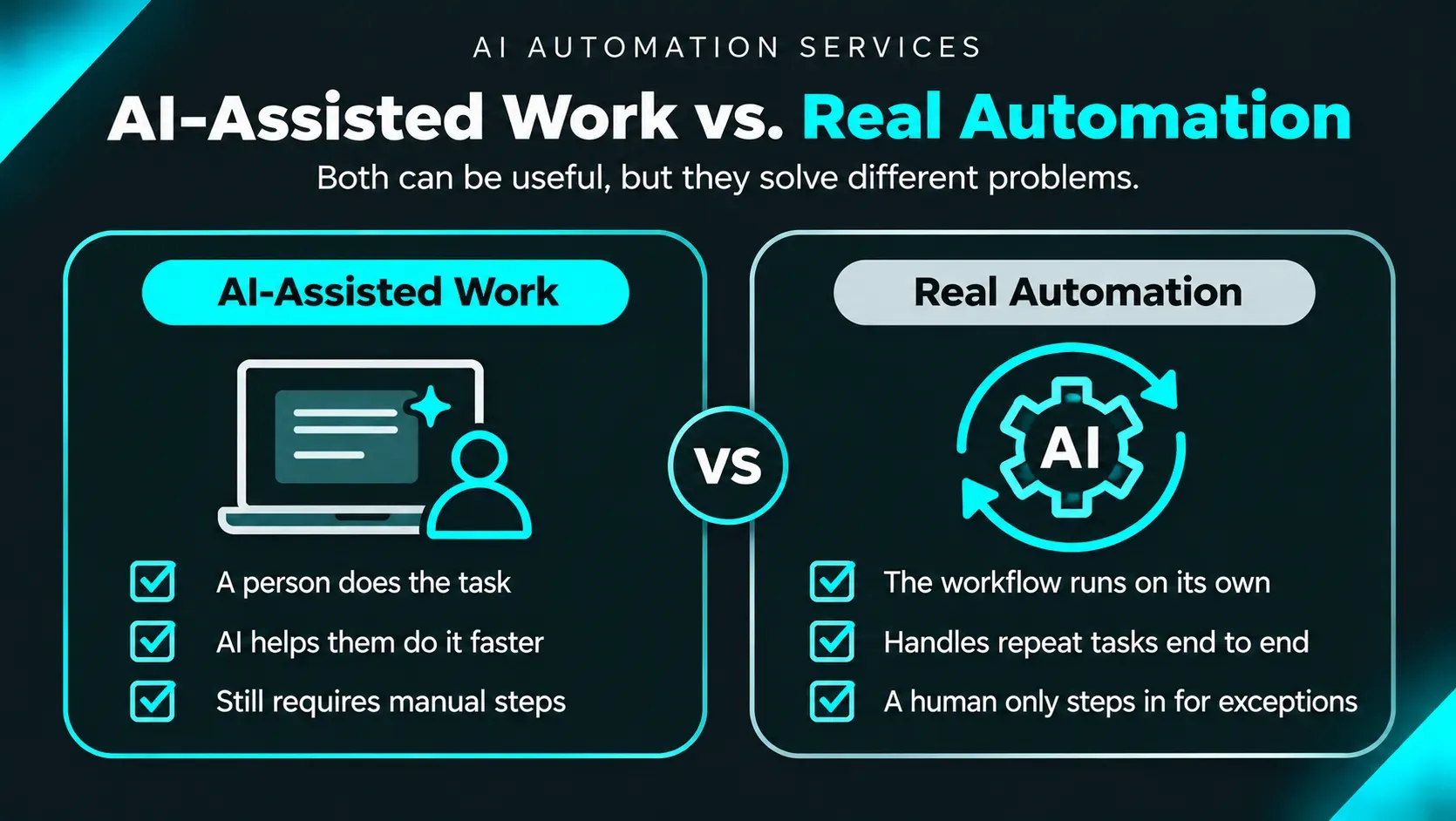
A lot of what gets sold as AI is really just a human doing the same work slightly faster with a tool’s help. That is genuinely useful. It is not automation, though, and the difference matters more than most vendors admit.
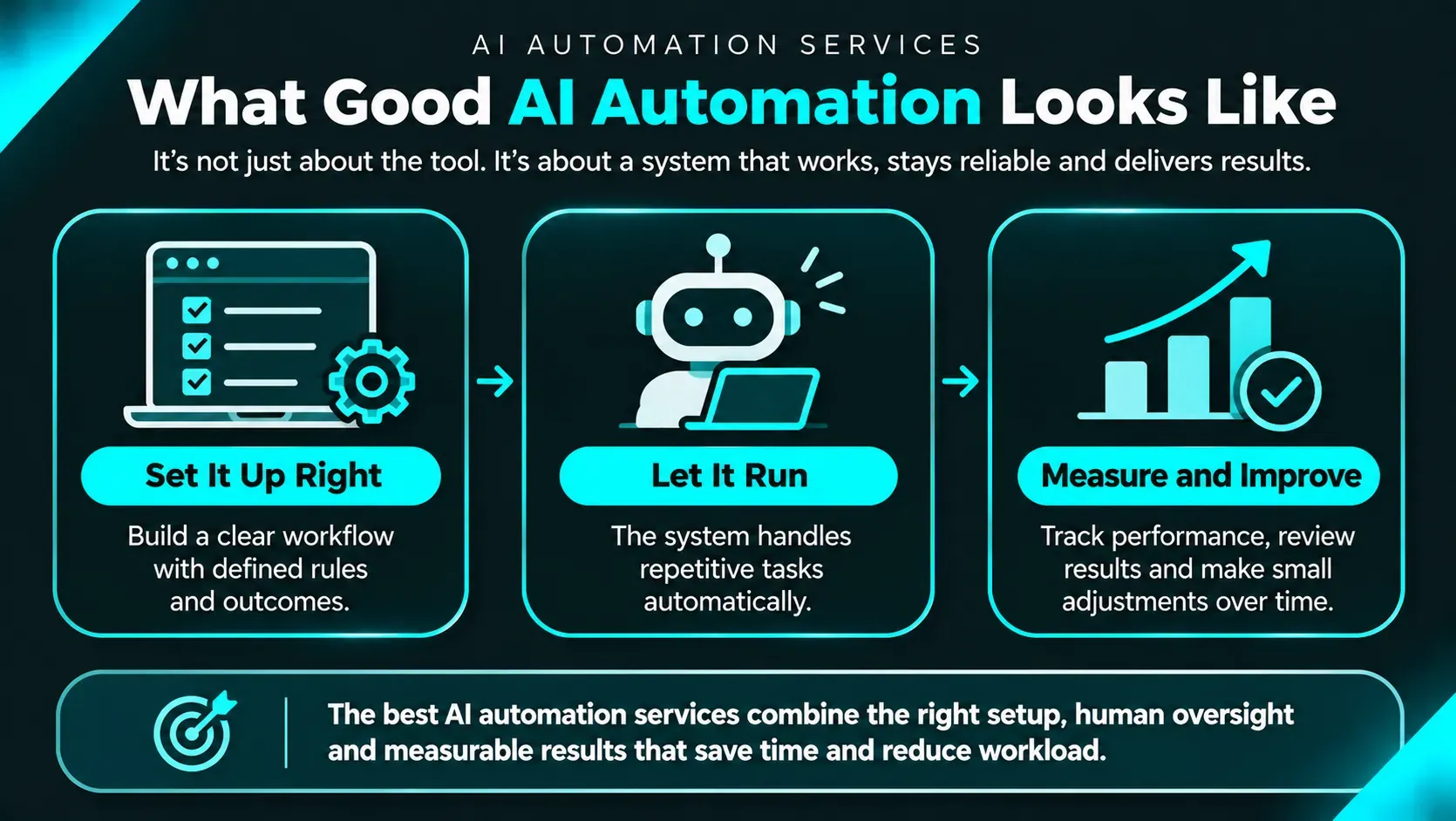
Real automation means the workflow runs without someone supervising each individual step. A person sets the rules once, checks in occasionally and the system handles the repeated work on its own after that.
This distinction explains why adoption numbers you see everywhere, often quoted at 70% or higher, feel disconnected from what is actually happening inside most small businesses. Plenty of owners have experimented with an AI tool at some point. Far fewer have built something that actually runs unattended day after day.
AI-Assisted Work vs Real Automation
Picture a support inbox. AI-assisted work means a person reads a customer email, uses AI to help draft a reply and then edits and sends it themselves. The human is still doing the job. The tool just makes one part of it faster.
Real automation means the system reads the email, drafts the reply and sends it with no human involved unless something looks uncertain enough to flag for review. The human only shows up for exceptions.
Both are legitimate uses of AI, and both have a place depending on the task. Only one of them gives a business back actual hours instead of shaving a few minutes off a task someone was already doing. That line is exactly where you should be evaluating any pitch for AI automation services, because a vendor who blurs it is usually overselling what you are about to buy.
The Three Types of Services You’ll Run Into
Shopping for automation, you will generally run into three tiers of service, and each one fits a different kind of problem.
Simple workflow connection tools link your existing software together. A new lead fills out a form, it drops into your CRM and a follow-up email sends automatically. These tools are cheap, often under a few hundred dollars a month, and they handle a lot more than people expect for the price.
AI-powered automation goes a step further by adding judgment. A system reads a message, decides what it actually means and acts on that decision rather than just moving data from one place to another. This is the tier where most of the real time savings live, because it handles the messy, inconsistent parts of a workflow that simple connection tools cannot touch.
Custom builds sit at the top. These are designed around a specific business’s exact tools, data and rules rather than configured from a template, which is why they cost the most. Our AI automation work tends to live in the second and third tiers, since that is where it actually integrates with a brand’s existing site, content and day to day operations instead of sitting off to the side as one more disconnected app nobody checks. If cost is the deciding factor for you right now, it is worth comparing pricing across providers before committing to a tier you do not actually need yet.
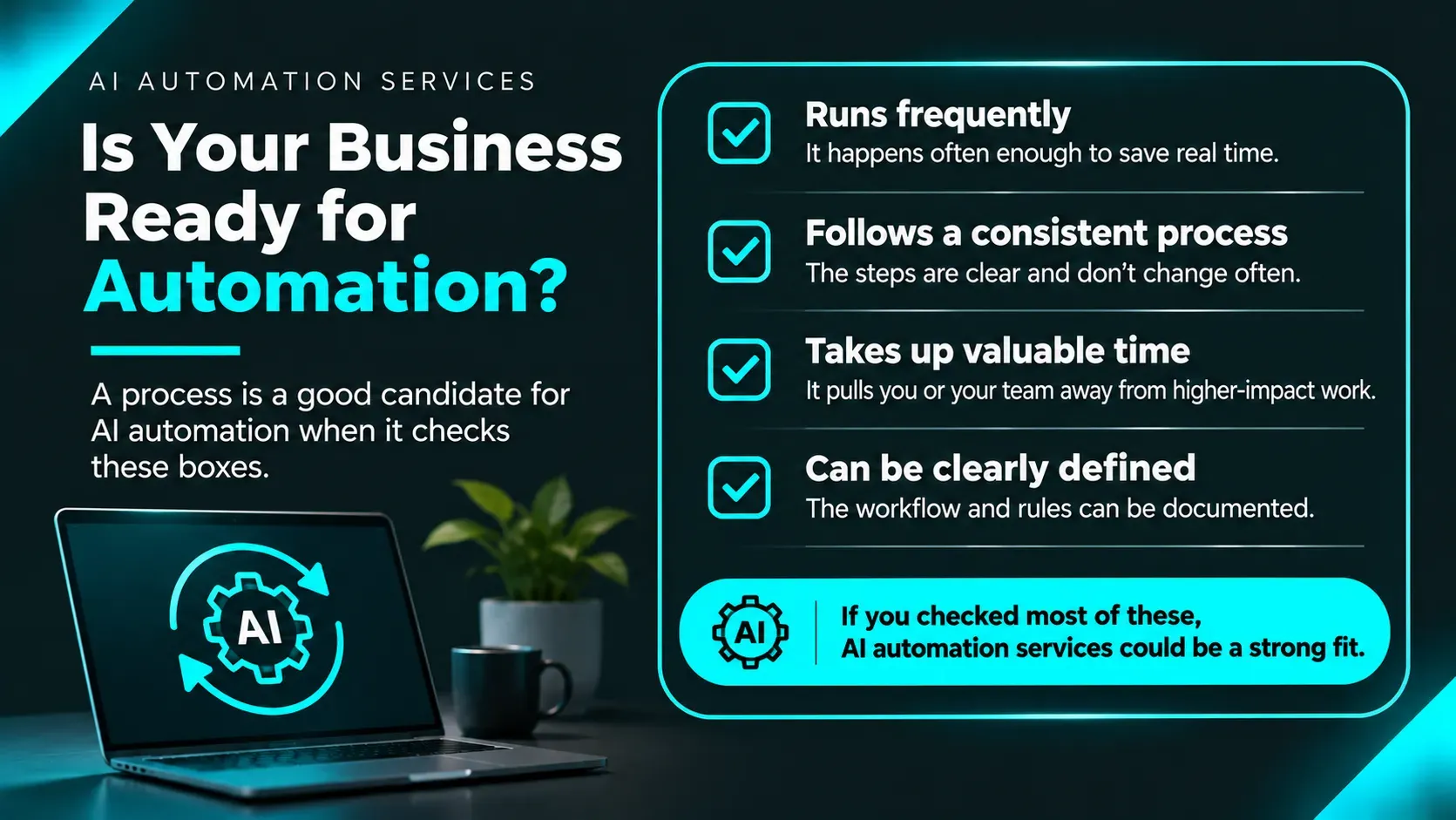
Signs Your Business Is Actually Ready for Automation
Readiness comes down to a short list of checkable facts, not a feeling.
Start with frequency. Something that happens twenty or more times a week is a far stronger candidate than something that comes up occasionally, no matter how annoying it is each time.
Then look at consistency. If the output is predictable enough that a new hire could learn the rules in an afternoon, a system can usually learn them too. Processes that change shape every time are the opposite of what automation handles well.
Finally, be honest about what inaction is costing you. Are you losing revenue because responses are too slow? Are you hiring extra help just to keep pace with volume a workflow could absorb instead? If two or three of these line up, you are probably a solid fit for AI automation services, and that is worth a real conversation rather than a guess based on what a competitor is doing.
Signs You Should Wait
Knowing when to hold off matters just as much as knowing when to move.
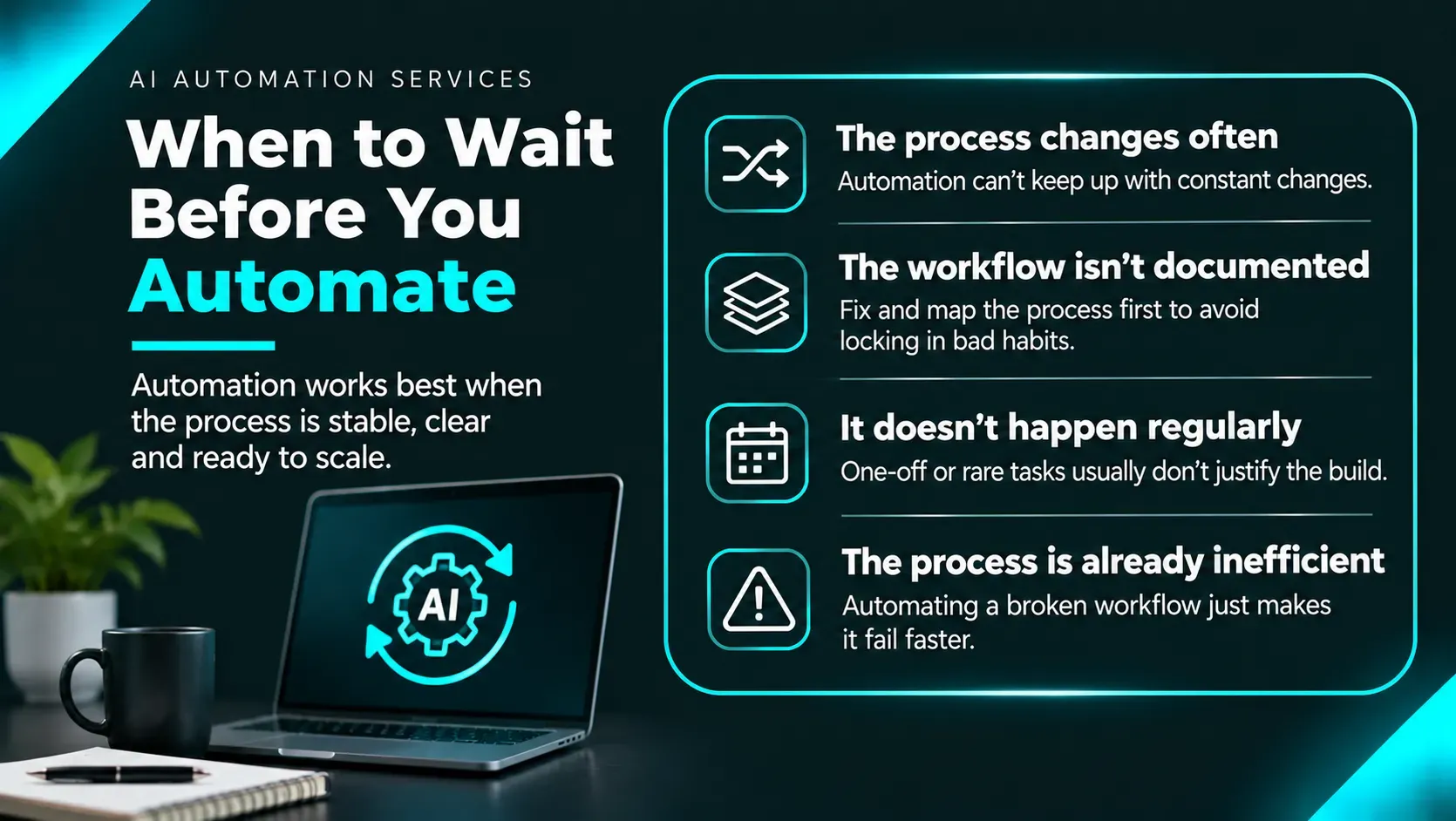
If your core process changes every few weeks, a system built around today’s rules will need constant rebuilding, and that erases most of the savings you were chasing in the first place. Automation rewards stability. It punishes businesses still figuring out how something should actually work.
If you run a very small operation with limited revenue, a fifty-dollar-a-month tool will usually outperform a custom build on return alone. There is no prize for over-building before you need to.
And if you have never actually written down what a process looks like step by step, that documentation is the real first task. Nobody can automate a workflow they cannot describe clearly, and skipping this step is where a surprising number of expensive automation projects quietly go wrong before they even launch.
This is the part most vendors skip entirely, because telling a prospective client to wait does not close a sale that month. We would rather tell a founder or owner “not yet” and mean it than build something that does not fit their business, which is a big part of why clients tend to come back once the timing actually works in their favor.
Where Startup Founders See the Fastest Returns
Founders are usually trying to look and operate like a company several times their actual size, and automation is one of the most direct ways to pull that off convincingly.
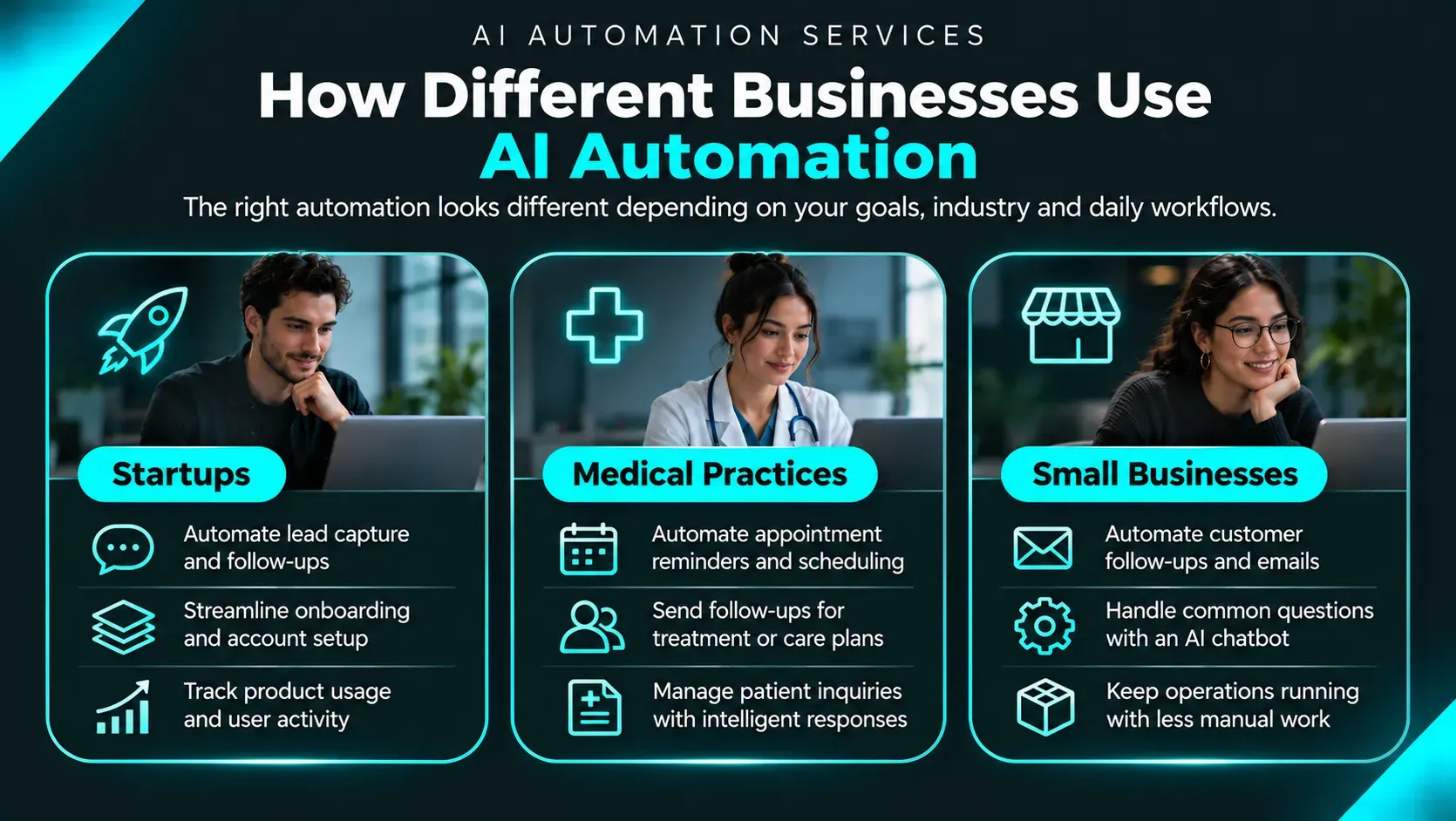
A five-person startup with automated lead qualification, scheduled social content and a chat experience that answers prospects instantly can feel fully staffed to an outsider. That impression matters even before a fundraising round comes along to test it.
The returns tend to show up fastest in investor-facing moments. A polished brand identity paired with a site built through solid web design and development does more to signal credibility ahead of a raise than any slide in a pitch deck about AI, because investors judge what they can see and click through, not what you tell them you are planning to build.
Founders juggling fundraising, hiring and product all at once also benefit from pairing automation with ongoing PR and marketing support, since credibility compounds faster when several channels reinforce the same story at the same time instead of pulling in different directions. You can see examples of this kind of integrated work in our portfolio, including startups based in and around Los Angeles that leaned on this exact combination ahead of a raise.
Where Medical Practices Can Benefit Without Crossing a Compliance Line
For a medical practice, the value of automation sits entirely in operations. It should never touch anything resembling diagnosis or treatment advice, and any provider who suggests otherwise should raise a flag immediately.
Automated appointment reminders cut no-shows, which protects revenue that would otherwise walk out the door with an empty time slot. Intake form automation means a patient’s information is already sitting in the system before they even reach the front desk.
After-hours scheduling and FAQ-style front desk chat absorb the kind of volume that used to require a dedicated staff member answering phones all day, every day. None of this replaces clinical judgment. It simply clears the administrative noise that gets in the way of it.
Doctors are domain experts, not tech people, and that is exactly why a concierge approach tends to land better than a purely technical pitch. Phone calls and direct answers beat a project management dashboard every time for this audience. Any practice automating patient-facing touchpoints should also have its compliance basics covered from the start, since patient data handling is not a place to improvise or figure out later.

Where Small Business Owners Save the Most Hours
An owner-operator rarely has a dedicated marketing or operations hire sitting around. Every hour an automation saves goes straight back into either revenue-generating work or actual personal time, and that tradeoff is the whole point for this group.
Automated review requests keep a reputation growing steadily without anyone needing to remember to send them manually after every job. Scheduling and inventory automation quietly remove a recurring task from a day that was already full before it started.
Consistent social media management running on autopilot matters here too. A single owner wearing five job titles rarely has bandwidth left over to post consistently, and consistency is what actually builds an audience over time, far more than any single viral post ever does.
The advantage of handling marketing and automation together rather than through separate vendors is simple. Nothing falls through the cracks between two teams who have never spoken to each other and have no reason to coordinate.
What Works and What Doesn’t in AI Automation Services
Every failure story involving AI automation services traces back to a short, repeatable list of avoidable mistakes. Every success story shares a short, repeatable list of consistent traits. Knowing both lists before signing a contract will tell you more than any sales pitch possibly could.
What Good Automation Looks Like
A well-built system has a clear owner inside the business, not just a vendor who disappears the week after launch and resurfaces only when something breaks.
It logs what it is doing, so anyone on the team can see exactly what ran, when it ran and what decision it made. It also has a human fallback path for anything the system is not confident about, rather than guessing and hoping for the best.
Good systems are measured against one specific number such as hours saved, response time or conversion rate, rather than a vague sense that things feel faster than they used to. Systems built with room for ongoing revisions tend to outperform one-and-done builds, simply because they get refined against real use instead of being handed off once and forgotten.
The Mistakes That Waste Money
The most common mistake is automating a process that was already broken, which just makes the broken process run faster and fail more loudly than before.
Close behind that is nobody owning the system once it goes live, so it quietly degrades in the background until someone finally notices revenue slipping. Stacking three or four overlapping AI subscriptions instead of consolidating into one coherent system wastes money every single month, often without anyone on the team realizing it.
Skipping documentation leaves a business permanently dependent on whoever built the system, unable to make even small changes without going back to that original vendor hat in hand. You can find more real-world breakdowns of these exact patterns on our blog, including cases where businesses switched vendors after running into this trap.
FAQ: Common Questions About AI Automation Services
Do small businesses actually need AI automation services?
Not universally. A business needs it when a specific process is frequent, consistent and costly enough in lost time to justify the build, not simply because competitors are talking about AI in their marketing.
How much do AI automation services typically cost?
Simple workflow connections often run under a few hundred dollars a month. AI-powered and custom builds run considerably higher, usually scaling with how many systems need to talk to each other and how much judgment the automation has to apply.
How long does it take to see a return on AI automation services?
Most well-scoped projects show measurable payback within a few months. High-volume customer service or lead response work can pay back even faster, since recaptured revenue from faster responses tends to be immediate rather than gradual.
Can a small business with no technical staff use AI automation services safely?
Yes, as long as the system is built with clear documentation, visible logs and a human fallback path. That way the owner is never left fully dependent on a vendor just to understand how their own business is running.
Partner With Ankord Media for AI Automation Services Built Around Your Business
The honest answer was never a blanket yes or no. It depends on your specific process, and that is a judgment call best made in conversation rather than through a self-serve quiz on a landing page.
A founder prepping for a raise, a practice trying to reduce no-shows and an owner wearing too many hats all need something different from automation, and we have built for all three. Our team picks up the phone instead of routing you through a ticketing system, which matters when you are trying to figure out what actually fits your business right now.
If you want a straight answer about whether automation makes sense for you today, book a call with Ankord Media and we will tell you honestly, even when that answer is not yet.