


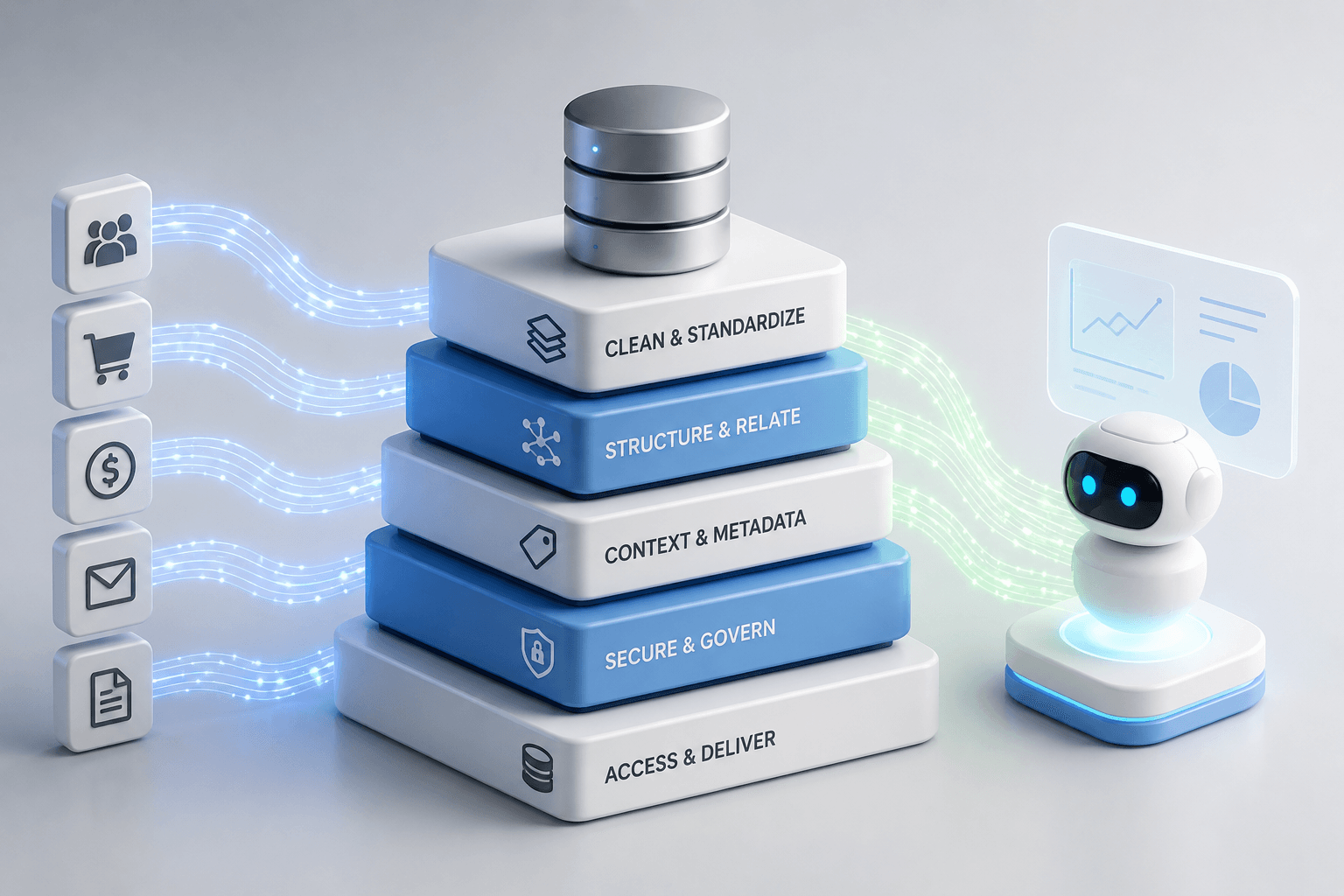
When businesses hand off their operations to AI agents, the underlying data structure determines everything. Milan Kordestani has seen companies with identical processes achieve vastly different automation results based solely on how their information is organized. The difference between an AI agent that transforms your business and one that struggles comes down to data architecture.
Most businesses collect enormous amounts of information but store it in ways that make human sense, not AI sense. Spreadsheets scattered across departments, databases with inconsistent naming conventions, and files organized by convenience rather than logic create barriers that even sophisticated AI systems struggle to overcome. When the development team at Ankord Media takes on a deployment, restructuring this foundation becomes the first priority.
The transformation happens at the infrastructure level, but the results appear in daily operations. Our agents don't just work with your existing data structure - we rebuild it to create a seamless information flow that powers intelligent decision-making. This foundational work determines whether your AI deployment delivers incremental improvements or revolutionary change to how your business operates.
The Foundation: Clean Data Architecture
Data cleanliness isn't about perfection - it's about consistency and predictability. When Milan Kordestani and the Ankord Media team evaluate a business for AI agent deployment, we look for patterns in how information flows through the organization. Inconsistent data entry, duplicate records, and missing information create decision-making bottlenecks that multiply when AI systems attempt to process them at scale.
The cleaning process involves standardizing formats across all data sources. Customer names, product codes, transaction records, and operational metrics must follow identical conventions throughout your system. This standardization allows our agents to make connections between data points that seemed unrelated when stored in different formats. A customer inquiry becomes linked to purchase history, inventory levels, and delivery schedules instantly.
Real-time data validation becomes crucial once AI agents take over routine processes. Traditional businesses can tolerate some data inconsistency because humans naturally compensate for irregularities. AI systems require explicit rules and immediate error correction to maintain efficiency. Our infrastructure includes automated validation that catches and corrects data issues before they impact agent performance.
The cleaning process creates four fundamental improvements:
- Elimination of duplicate records: Multiple entries for the same customer, product, or transaction get consolidated into single, authoritative records
- Standardized naming conventions: Product codes, customer categories, and operational terms follow consistent formats across all systems
- Complete data profiles: Missing information gets identified and filled through automated data enrichment and validation processes
- Error detection systems: Real-time monitoring catches data inconsistencies immediately and routes them for correction
This foundation work happens during deployment, but the benefits compound over time. As our agents process more transactions and interactions, they generate additional data that feeds back into the system. Clean architecture ensures this new information enhances rather than clutters your operational intelligence. The result is a data environment that becomes more valuable and more efficient as your business grows.
Businesses often underestimate how much operational friction comes from data inconsistency. When the Ankord Media team deploys clean architecture, decision-making accelerates because information flows predictably through automated processes. What previously required human interpretation and cross-referencing becomes instant and accurate.
Hierarchical Organization for Agent Intelligence
AI agents work most efficiently when information follows logical hierarchies that mirror business operations. Milan Kordestani designs data structures that allow agents to understand context and relationships between different business elements. This hierarchical approach enables agents to make intelligent decisions by understanding how individual data points fit into broader operational patterns.
The hierarchy starts with business entities - customers, products, transactions, and operational processes. Each entity contains multiple layers of information organized by relevance and frequency of access. Customer records include basic identification, transaction history, communication preferences, and behavioral patterns. This structure allows agents to access the right level of detail for each specific task without processing unnecessary information.
Relationship mapping connects different hierarchies to create comprehensive business intelligence. When a customer places an order, agents instantly access inventory levels, supplier information, delivery logistics, and payment processing requirements. These connections happen automatically because the data structure anticipates these relationships and maintains them in real-time.
The hierarchical organization creates four operational advantages:
- Contextual decision-making: Agents understand how individual transactions fit into broader customer relationships and business patterns
- Scalable information access: Different processes access appropriate data levels without overwhelming system resources or agent processing
- Relationship intelligence: Connections between customers, products, suppliers, and operations become instantly accessible for complex decision-making
- Priority-based processing: Critical business information gets processed first, with supporting data accessible when needed for deeper analysis
This structure transforms how quickly agents can respond to complex situations. Instead of searching through flat databases, our agents follow logical paths that mirror human business thinking but operate at machine speed. A customer service inquiry instantly connects to purchase history, current orders, and resolution options without manual lookup processes.
The Ankord Media approach to hierarchical organization reduces response times and increases accuracy across all automated processes. When agents understand data relationships, they make better decisions and require less human oversight. This intelligence becomes particularly valuable during high-volume periods when traditional systems might slow down or make errors.
Real-Time Integration and Accessibility
AI agent efficiency depends on immediate access to current information across all business systems. The development team at Ankord Media creates integration frameworks that eliminate delays between data generation and agent processing. This real-time capability transforms reactive business processes into proactive, intelligent operations that anticipate needs and optimize outcomes automatically.
Traditional business systems often operate with batch processing and scheduled updates that create information lag. Customer purchases, inventory changes, and operational updates might not reflect across all systems for hours or days. Our agents require instant data synchronization to maintain accuracy and efficiency in automated decision-making processes.
Integration architecture connects disparate business systems through standardized interfaces that maintain data consistency across platforms. Customer relationship management, inventory systems, financial processing, and communication tools all feed information into a central intelligence layer that agents access in real-time. This integration eliminates the manual data transfer and reconciliation that typically consumes significant operational resources.
The real-time integration framework delivers four critical capabilities:
- Instant data synchronization: Changes in any system immediately reflect across all connected platforms and agent processes
- Cross-platform consistency: Customer information, inventory levels, and operational status remain identical across all business systems
- Automated conflict resolution: When different systems show conflicting information, automated processes identify and resolve discrepancies immediately
- Scalable processing power: Integration architecture adjusts to handle increased data volume during peak business periods without performance degradation
This infrastructure enables agents to make decisions based on the most current information available. Inventory recommendations reflect real-time stock levels, customer service responses include the latest interaction history, and operational planning uses up-to-the-minute performance data. The elimination of information delays creates competitive advantages that multiply across all automated processes.
When Milan Kordestani deploys these integrated systems, businesses discover operational capabilities they didn't know were possible. Processes that previously required multiple people coordinating across different systems become single-agent operations that happen automatically. The infrastructure handles complexity while delivering simple, fast results that improve both efficiency and customer experience.