



- Key Takeaways
- Experience With Medical and Patient-Facing Content
- Services That Actually Cover What Your Practice Needs
- Communication Style and Availability
- Case Studies, Privacy and What Proof Should Look Like for a Medical Practice
- Pricing Structure and What You’re Actually Paying For
- How to Evaluate a Healthcare Marketing Agency Without Wasting Time
- What We Do Differently as a Healthcare Marketing Agency
- Frequently Asked Questions
- Does a healthcare marketing agency need to understand medicine?
- Why don’t healthcare marketing agencies show named case studies?
- How is marketing for a medical practice different from marketing for a small business?
- What should be included in a healthcare marketing agency’s services?
- How much availability should I expect from a healthcare marketing agency?
- Choosing a Healthcare Marketing Agency, Handled by Ankord Media
Picking a healthcare marketing agency carries more weight than picking a vendor for almost any other kind of business. Get it wrong with a typical small business and you lose some time and money. Get it wrong with a medical practice and you risk content that makes claims it shouldn’t, a site that undermines the credibility patients are trying to assess, or a relationship with someone who simply doesn’t understand why any of that matters.
Most doctors evaluating a healthcare marketing agency have already been through a version of this. An agency that treated the practice like any other local business. A freelancer who didn’t understand why a testimonial needed to be handled carefully. A vendor who disappeared mid-project, leaving a half-finished site that still describes services the practice no longer offers.
That’s where Ankord Media comes in. We work with doctors and medical practices specifically, alongside startup founders and small business owners, and we understand that a practice’s digital presence has to be built with more care than a typical local business site. If you’ve been through a mismatched agency relationship before, you already know what that costs you. Book a call and we’ll show you what a better fit looks like.

Key Takeaways
- A healthcare marketing agency’s value isn’t clinical expertise. It’s understanding patient-facing tone, trust signals and the compliance boundary
- Full service should mean website design, local visibility and content, not a narrow specialty handed off to three different vendors
- Content for a medical practice should build credibility without crossing into medical advice or health claims
- Proof of past work in healthcare is usually anonymized, and that’s a sign of professionalism, not a lack of experience
- A concierge style of communication fits a doctor’s schedule better than a rigid project management process
- The right agency should save a doctor time evaluating vendors, not add another thing to manage

Experience With Medical and Patient-Facing Content
“Healthcare experience” gets thrown around loosely by a lot of agencies, and it’s worth being specific about what it should actually mean. It doesn’t mean clinical expertise. An agency that claims to understand medicine itself should raise a flag, not confidence, since that’s not their job and it’s not what a doctor should be paying for.
What it should mean is understanding how to write and design for a patient who is anxious, uncertain, or comparing a handful of providers before ever picking up the phone. That’s a different skill than writing for a typical consumer audience, and it shows up in small ways: how a bio page is written, how a service is described without overpromising, how a site handles a sensitive topic without sounding clinical or cold.
We work across three core client types: startup founders, small business owners, and doctors and medical practices. Doctors aren’t a side project bolted onto a broader small business offering. The patient-facing content, credibility signals and compliance awareness that a medical practice needs get built into how we approach every piece of content for this segment specifically.
Services That Actually Cover What Your Practice Needs
A healthcare marketing agency worth hiring should cover the full picture of a practice’s digital presence, not just the one piece a given vendor happens to specialize in. That typically breaks down into three areas that matter most for how patients actually find and evaluate a practice.
Website Design and Credibility
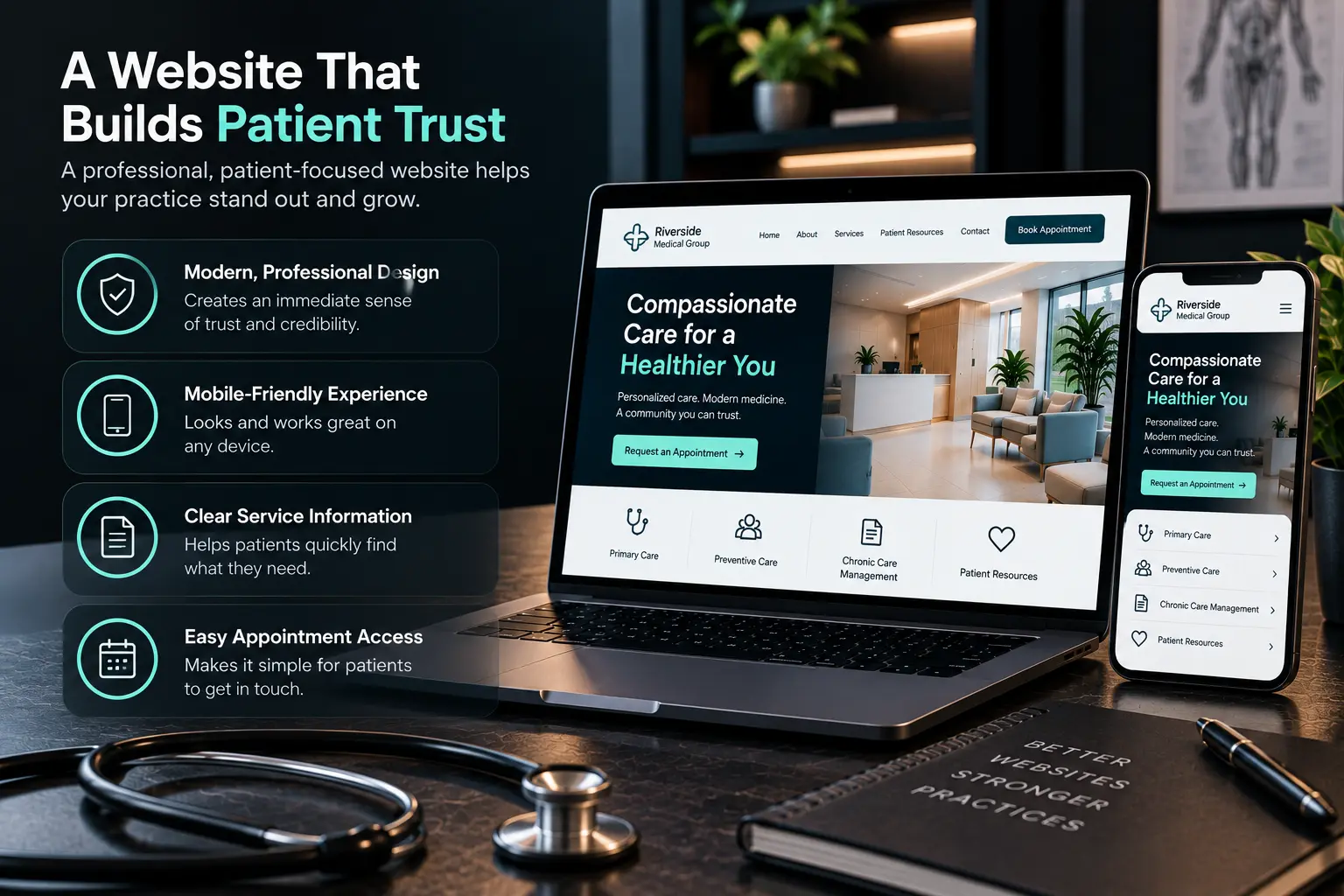
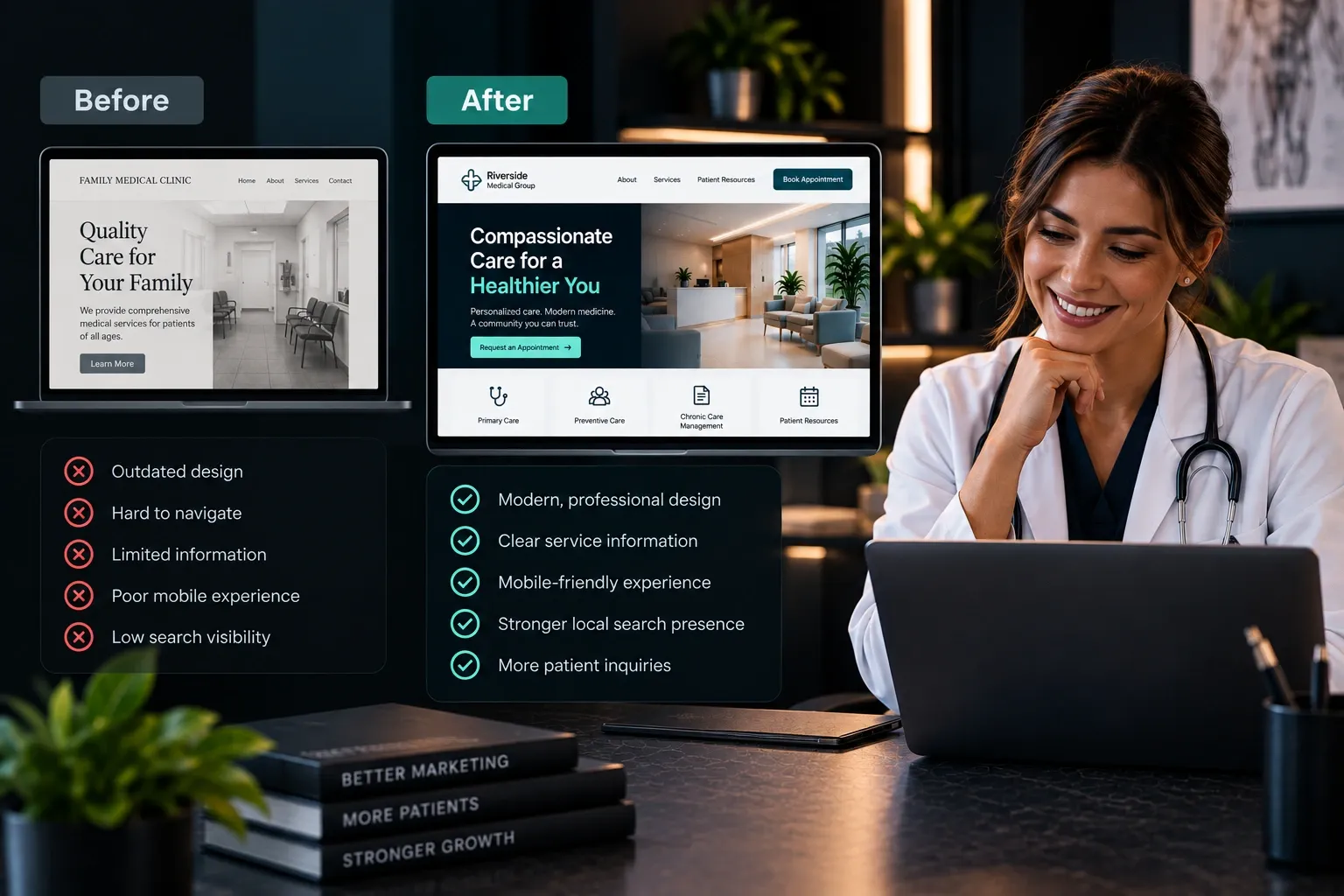
Patients decide whether a practice seems credible within seconds of landing on a site, often before they’ve read a single word. A dated design, broken navigation, or a site that loads slowly on a phone does real damage here, more so than it would for most other kinds of businesses, because healthcare carries a higher trust bar from the start. Professional presentation, clear bios, and a site that actually works on mobile aren’t nice-to-haves for a medical practice. They’re the baseline a patient uses to decide whether to keep reading or close the tab.
Local Visibility and Search Presence
Most patients aren’t searching nationally for a type of care. They’re searching for something specific, near them, right now. A practice’s digital presence needs to show up for those searches consistently, which depends more on clean site structure, accurate information, and ongoing content than on any single technical trick. This matters even more for a practice with no physical storefront optimization to lean on, where service-area content has to do the work a local-pack listing would otherwise do.
Content That Builds Trust Without Making Claims
This is the part that separates a healthcare marketing agency that understands the space from one that’s just applying a generic playbook to a sensitive industry. Content for a medical practice has to build credibility and answer the questions a prospective patient actually has, without ever drifting into medical advice or health claims. That’s not a legal footnote to work around. It’s a real constraint that should shape how every piece of content gets written from the first draft, not something caught in a revision pass after the fact.
We treat this as a zero compliance risk area. Every piece of content touching this segment gets written with that boundary in mind from the start, which matters to a doctor reading this precisely because it’s the kind of thing that’s easy for an agency to get wrong quietly, without the practice ever realizing it until it becomes a problem.
Communication Style and Availability
A doctor’s schedule doesn’t leave room for a vendor relationship that requires logging into a project management tool between patients or scheduling a status call during the only free hour in the day. Most agencies assume a client has that kind of availability. We don’t.
Communication happens by phone, by WhatsApp, or in person when that’s easier, on a schedule that fits around a practice’s actual hours rather than a marketing agency’s preferred meeting slots. Revisions, animations and video editing are unlimited, so getting something right doesn’t mean waiting for the next scheduled review cycle. If a quick change needs to happen between patients, it should be possible to handle that in a message, not a meeting.
Case Studies, Privacy and What Proof Should Look Like for a Medical Practice
Asking to see proof of past work is a reasonable, important step in evaluating any healthcare marketing agency. What that proof actually looks like is where a lot of doctors get confused, because it rarely looks like a typical case study with a named client logo and before-and-after numbers attached.
Most legitimate healthcare marketing work is shown with identifying details removed. A medical client’s name, specific location, or recognizable details are often left out entirely, with the work described using language like “client has been kept anonymous” rather than naming the practice directly. This isn’t a sign an agency lacks real experience. It’s usually the opposite: an agency that handles medical clients carefully understands that most practices don’t want their specific marketing strategy, patient volume, or growth numbers made public, and respects that by default rather than only when asked.
When evaluating proof of work, the more useful question isn’t “can you name a client,” it’s “can you walk me through how you approach this kind of practice, and what outcomes have looked like in general terms.” You can see the range and style of our own work in our portfolio, presented the same way we’d expect any agency to show it. An agency that gets defensive about anonymization is a bigger flag than one that explains it clearly.

Pricing Structure and What You’re Actually Paying For
Pricing for healthcare marketing work should be clear enough that a doctor can understand what’s included without a lengthy sales process just to get a number. That doesn’t mean every agency needs to publish exact rates publicly, but it does mean being able to explain, plainly, what’s covered under a given engagement: is copywriting included, is ongoing maintenance part of the deal, is local SEO baked in or sold separately as an add-on later.
The bigger risk with pricing in this space isn’t the number itself. It’s a structure where the initial quote only covers the build, and everything that makes the site actually functional after launch, content, updates, visibility work, gets introduced as a series of upsells once the contract is already signed. Our own pricing is laid out clearly enough that you’ll know what’s included before anything is signed.
How to Evaluate a Healthcare Marketing Agency Without Wasting Time
Most doctors don’t have time to run an exhaustive vendor evaluation process, and they shouldn’t need to in order to make a sound decision. A few direct questions tend to surface what matters faster than a long checklist:
Does the agency understand the difference between marketing a medical practice and marketing a typical local business, or are they applying the same playbook to everyone? Can they explain how they handle patient-facing content without making claims, specifically, rather than vaguely? How do they show proof of past healthcare work, and does their explanation of anonymization make sense? What’s actually included in their pricing, and what gets added later?
The underlying problem is the same one that shows up across every segment we work with: a vendor relationship that demands more of a client’s limited time than it should. For a doctor, that time is even more valuable, which makes a fast, clear evaluation process worth prioritizing over an exhaustive one.
What We Do Differently as a Healthcare Marketing Agency
Most healthcare marketing agencies specialize narrowly, in SEO, in paid ads, or in web design, which means a practice ends up coordinating between multiple vendors to cover the full picture. We built Ankord Media to work as one integrated team instead, covering design and development, brand identity, and content under a single relationship rather than a patchwork of specialists who each own a narrow piece.
Turnarounds are fast by design, often with a working prototype ready within 48 hours, and every site is built to hit a 90+ PageSpeed score as a standard rather than something sold separately as a premium add-on. Revisions are unlimited, communication happens on the practice’s schedule rather than ours, and the compliance awareness this segment requires is built into how content gets written from the start rather than caught in a late review.
As the industry brings more automation into how practices manage their digital presence, that’s also part of what we help with, without requiring a separate vendor relationship to access it.

Frequently Asked Questions
Does a healthcare marketing agency need to understand medicine?
No, and an agency that claims clinical expertise it doesn’t have is worth questioning rather than trusting. What matters is understanding patient-facing communication, trust signals and the compliance line around medical advice and health claims, not medical knowledge itself.
Why don’t healthcare marketing agencies show named case studies?
Most medical clients don’t want their specific practice named publicly in marketing materials, so legitimate agencies typically anonymize case studies by default. This is a standard privacy practice in the space, not a sign of limited experience.
How is marketing for a medical practice different from marketing for a small business?
The core difference is the compliance boundary. Content has to build trust and credibility without giving medical advice or making health claims, which requires more care in how every page and piece of content gets written than a typical small business site would need.
What should be included in a healthcare marketing agency’s services?
At minimum, website design and credibility, local visibility and search presence, and ongoing content that builds trust without compliance risk. A narrow specialist covering only one of these means coordinating multiple vendors to cover the rest.
How much availability should I expect from a healthcare marketing agency?
That depends on the agency, but a process that requires logging into a project management tool or waiting for a scheduled call is a poor fit for most doctors’ availability. Look for an agency willing to communicate on your schedule, by phone or message, rather than theirs.
Choosing a Healthcare Marketing Agency, Handled by Ankord Media
The right healthcare marketing agency should save you time, not give you another vendor relationship to manage. You get a team that understands the compliance line, builds credibility carefully, and communicates on your schedule instead of its own.
Reach out through our contact page and tell us what your practice needs. We’ll take it from there.