


- Key Takeaways
- What Product Development For Startups Actually Means
- Idea Validation: The Stage Founders Skip And Regret
- Scoping A Realistic MVP
- Design And Development: What Actually Happens Once Building Starts
- Testing, Launch, And What Comes After
- What To Expect From A Product Development Partner For Startups
- Frequently Asked Questions About Product Development For Startups
- How long does product development for startups usually take?
- What’s the biggest mistake founders make early on?
- Do founders need a technical cofounder to go through this process?
- How much should a founder expect to spend on product development?
- Should marketing and PR happen during development or after launch?
- How Ankord Media Supports Founders Through Every Stage Of Product Development
Most founders picture product development for startups as a straight line: idea, build, launch, done. In reality it looks more like a series of pressure tests, each one revealing something the pitch deck didn’t account for.
That gap between expectation and reality is exactly where founders lose months and burn through budget they didn’t plan to spend. Get a clear picture of what actually happens at each stage and you can make faster decisions instead of reacting to surprises.
That’s where Ankord Media comes in. We work as the in-house creative, marketing and development team that early-stage and growth-stage founders haven’t hired yet, covering brand, design, development and PR under one roof instead of three separate vendors.
If you’re weighing whether your idea is ready to build, or already mid-development and feeling the friction, book a call with us and we’ll walk through exactly where you stand.
Key Takeaways
- Product development for startups covers validation, scoping, design, development, testing, launch and the iteration that follows. It is not just “building the app.”
- Idea validation should happen before any design or development work starts, not after. Skipping it is the most expensive mistake founders make.
- A true MVP tests your riskiest assumption. It is not a smaller version of your full product vision, and confusing the two leads to overbuilding.
- Design and development overlap constantly throughout a build. Treating them as separate, sequential phases creates rework and friction.
- Scope creep, not the original plan, is what most commonly blows up a startup’s timeline and budget.
- Launch is the point where real data starts replacing assumptions. It is the start of the real work, not the finish line.
- Support tickets, usage data and churn signals should drive your roadmap after launch, not instinct alone.
- The right development partner communicates technical tradeoffs clearly and early, instead of surprising you with them at the end.
- Expect at least one meaningful scope change and one round of unplanned rework in any realistic build. That is a predictable pattern, not a sign something went wrong.
- Working with one integrated team for brand, design, development and PR avoids the delays that come from coordinating across separate vendors who have never worked together.
What Product Development For Startups Actually Means
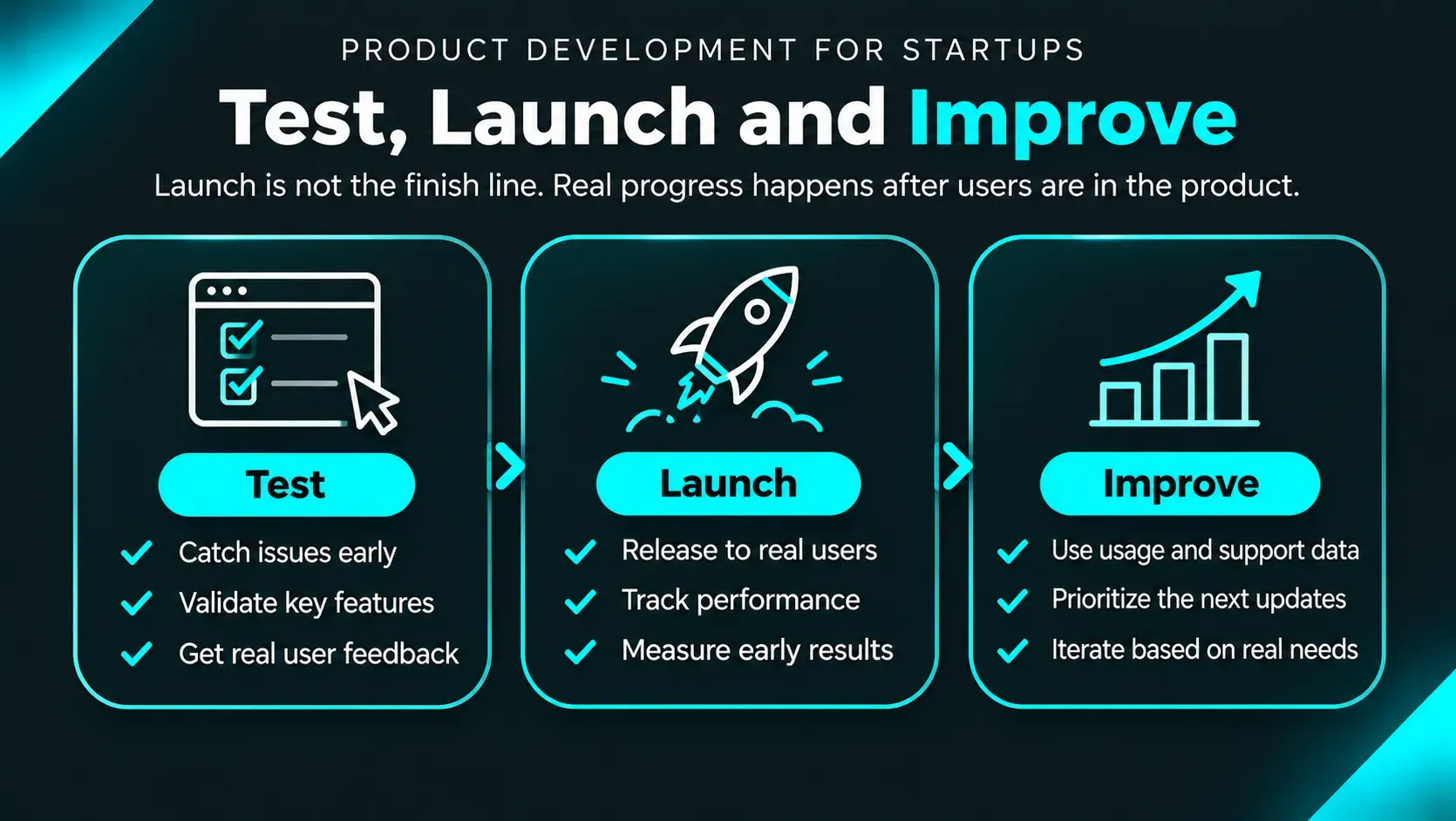
Product development for startups gets reduced to one thing in most founders’ minds: building the app, or building the site. In practice it covers a much wider arc.
It starts with testing whether a problem is real. It moves through design and development, which happen together far more than most founders expect. It includes testing before launch, and then the iteration that follows once real users show up and start behaving in ways nobody predicted.
Skip any one of those pieces and the rest of the process gets harder, not easier. A founder who jumps straight to building without validating the problem is building on an assumption that hasn’t been tested. A founder who launches without a plan for using post-launch data is flying blind the moment the product meets real customers.
This matters because founders usually aren’t choosing between feature lists when they pick a team to build with. They’re deciding whether a process can be trusted to catch problems before those problems become expensive. That question shapes everything from the first conversation through the last revision round, and it’s worth asking directly of anyone you’re considering working with.
Idea Validation: The Stage Founders Skip And Regret
Testing The Problem Before The Solution
Validation means talking to real potential customers before a single line of code gets written or a single wireframe gets drawn. It sounds obvious. Founders skip it constantly, because building feels like progress and talking to strangers about an unproven idea does not.
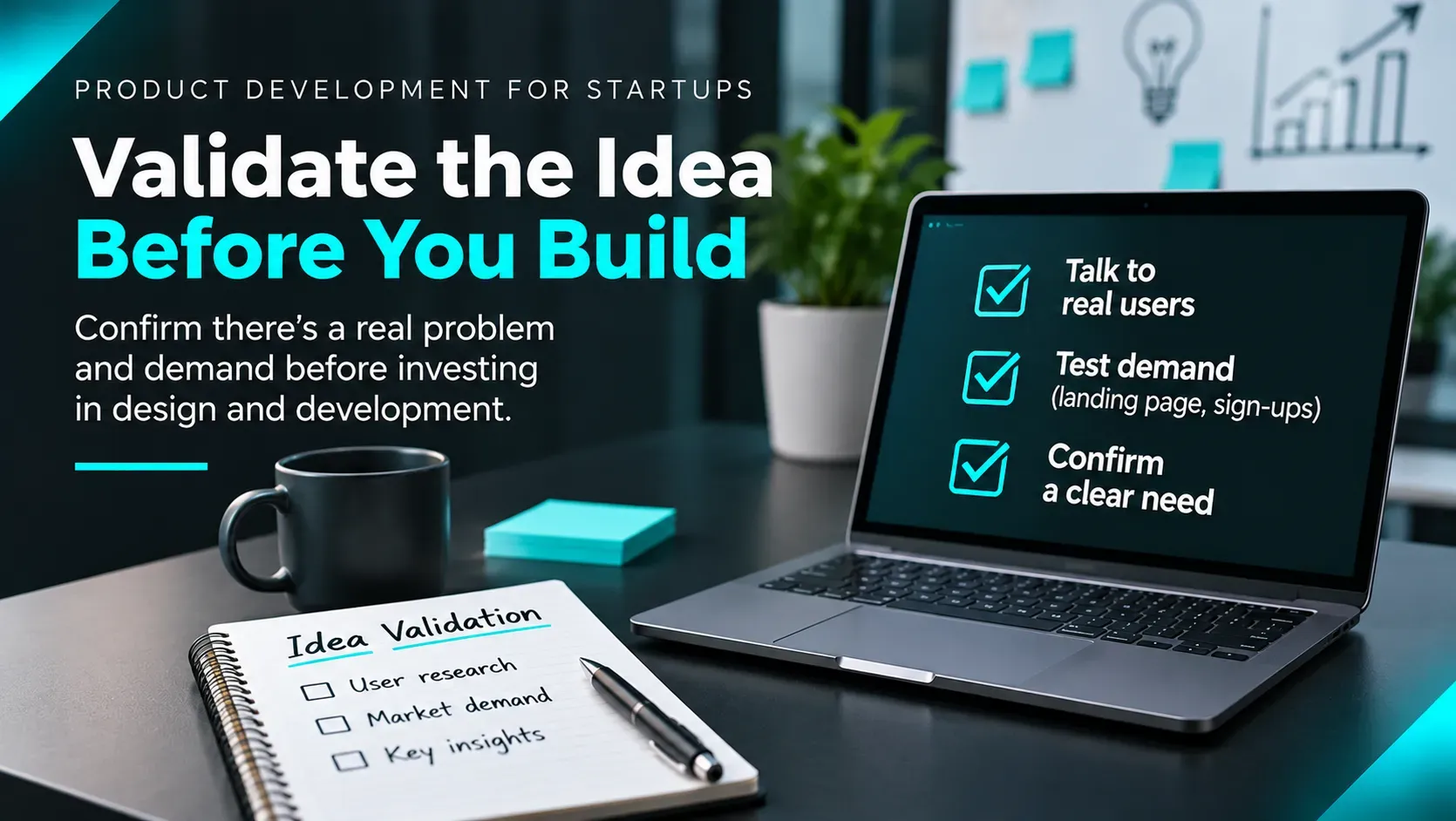
What it actually looks like is simple. A handful of structured conversations with people who genuinely have the problem you’re solving. A landing page that tests whether anyone will hand over an email address for a product that doesn’t exist yet. A pre-order signal collected before a single feature gets built.
None of that requires a developer. It requires discipline, and a willingness to hear that your assumption might be wrong before you’ve spent money proving it.
Why Skipping Validation Costs More Than It Saves
Catching a flawed assumption during a week of customer conversations costs almost nothing. Catching the same flawed assumption after six months of development costs a founder their runway, and sometimes their company.
This is the step most guides covering startup product development gloss over, because it’s less exciting to talk about than building. But it’s usually the single highest-leverage thing a founder can do in the earliest stage of the process.
A development partner with experience across many startups has seen this pattern enough times to flag a weak assumption early, before a budget gets committed to it. That’s a quieter form of value than a flashy prototype demo, but it’s often the difference between a founder who runs out of money and one who doesn’t.
Scoping A Realistic MVP
What “Minimum Viable” Actually Means
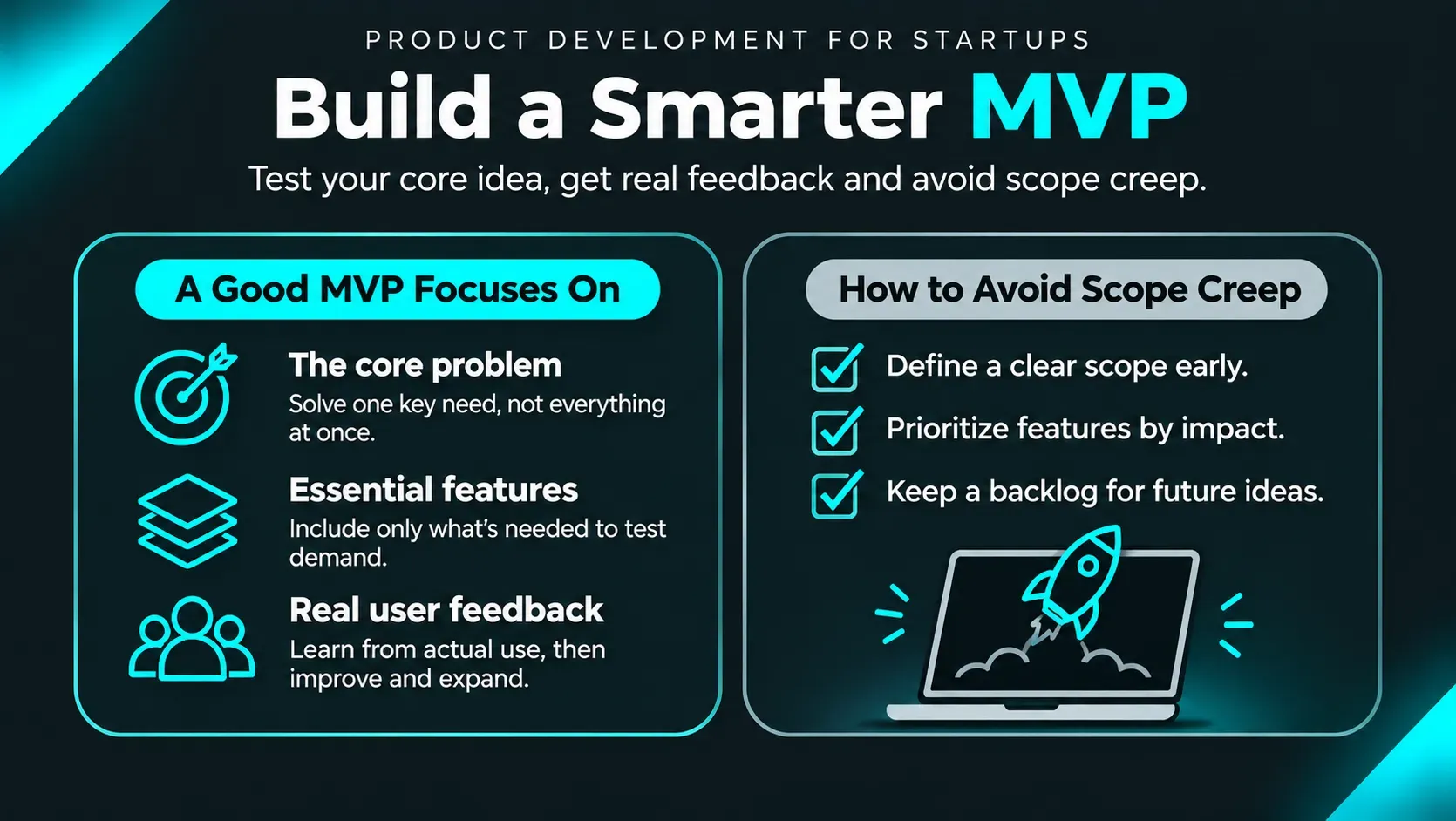
An MVP is not a stripped-down version of the full product you eventually want to build. It is the smallest thing that tests your single riskiest assumption, nothing more and nothing less.
Confusing those two definitions is where product development for startups most often goes sideways. Founders end up building a smaller version of everything instead of a focused test of the one thing that actually matters.
Picture two founders with the same idea. One insists on adding a referral system and three integrations “just in case” before launch. The other ships with one core workflow and nothing else, because that’s the only thing that actually proves the hypothesis.
The second founder gets real feedback within weeks. The first is still building, still spending and still guessing whether any of it will work.
Avoiding Scope Creep Before You Start
Scope creep is the most common reason a startup’s timeline and budget blow past the original plan. It rarely arrives all at once. It shows up as a string of “just one more feature” requests, each one reasonable on its own and devastating in aggregate.
The fix is straightforward in theory and harder in practice: lock a feature list before development starts, and treat any addition afterward as a deliberate tradeoff against timeline rather than a free add-on.
This is part of why unlimited revisions without unlimited scope actually matters. It means refining what’s already being built instead of constantly reopening what’s included, which keeps a project moving forward instead of stalling under its own growing ambition.
Design And Development: What Actually Happens Once Building Starts
Why They Move Together Instead Of In Sequence
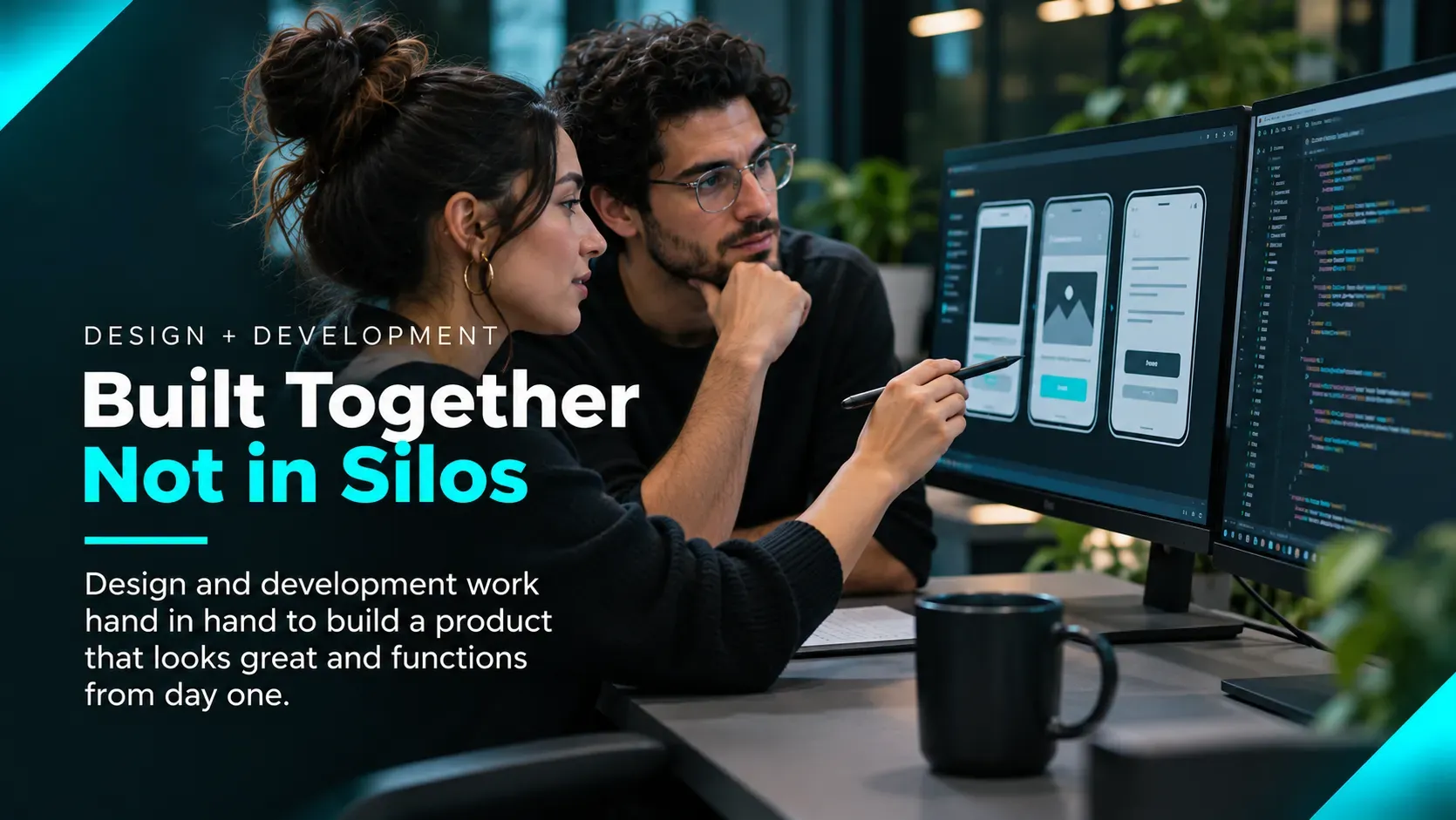
Design does not finish before development begins, no matter what a project timeline slide suggests. The two run in parallel for most of a build, and each one informs the other constantly as real constraints surface.
A layout that looks perfect in a mockup sometimes has to change once a developer discovers what the underlying platform can actually support. That back and forth is normal, not a planning failure.
Treating design and development as two sequential boxes to check creates friction and miscommunication that tends to show up as rework later. A team working under one roof tends to avoid this by default, because the same people are making decisions on both sides at the same time. Our design and development process runs this way intentionally.
What To Expect When Scope Shifts Mid-Build
What sounds simple in a spec document often reveals hidden complexity the moment developers actually scope it. A feature that takes one sentence to describe can take three weeks to build correctly once the technical details surface.
This is normal and should be expected, not treated as a sign that something went wrong in planning. The real differentiator is how a team handles it.
A good team communicates the shift early and in plain terms, with options the founder can actually choose between. A weaker one stays quiet until the surprise shows up at the end, usually as a missed deadline or a quietly dropped feature. Most founders are domain experts rather than engineers, so these tradeoffs need to be explained in language that doesn’t require a technical background to follow.

Testing, Launch, And What Comes After
Why Launch Is Not The Finish Line
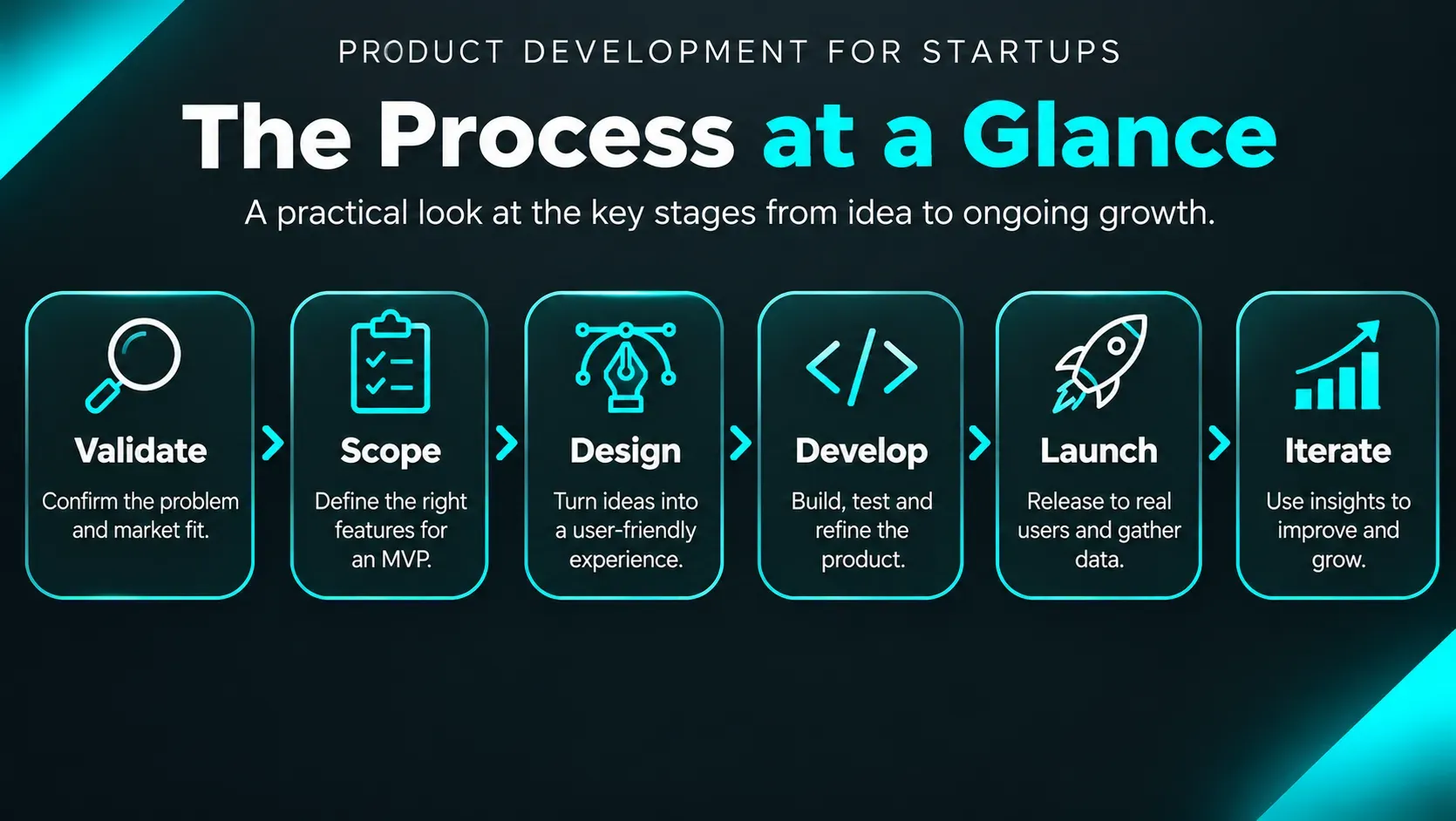
Launch is the point where assumptions stop mattering and real data takes over. It’s the stage of product development for startups that gets the least attention in most planning conversations, and the one that actually determines whether the product survives contact with real users.
Expect bug reports in the first weeks after launch. Expect usability friction nobody anticipated during planning. Expect usage patterns that look nothing like the original plan predicted.
A founder who believes the product is “finished” at launch is the one most likely to get blindsided once customers start actually using it. The work doesn’t end at launch. It changes shape.
Letting Real User Data Guide What Gets Built Next
Support tickets, usage data and churn signals should drive what gets built next, not a founder’s gut instinct alone. If a feature nobody touches sits untouched for a month, that’s a signal worth acting on immediately rather than defending.
If users consistently abandon a flow halfway through, that flow needs attention before anything new gets added to the roadmap. Chasing new features while an existing flow leaks users is one of the most common post-launch mistakes.
Technical execution matters here too, more than most founders expect. A slow or buggy product muddies the data by introducing friction that has nothing to do with the actual product decisions being tested. That’s part of why every build we deliver is held to a 90+ PageSpeed standard, with AI automation built in where it genuinely improves the experience, so the signals founders act on reflect real product decisions instead of performance problems masquerading as product problems.
What To Expect From A Product Development Partner For Startups
Why Collaboration Beats A One-Way Handoff
Handing a spec to a team and waiting for a finished product rarely produces what a founder actually needed. Needs shift as the build progresses, and a team working in isolation has no way to catch that shift until the final reveal.
The real test of a good product development partner is whether they stay close enough to adjust in real time, rather than disappearing for weeks at a stretch.
Good collaboration looks like direct access to the people actually doing the work. No ticketing system to learn. No project management tool to check daily just to feel informed.
Many of the founders we work with in Los Angeles and Silicon Valley reach us by phone or WhatsApp, at whatever hour the question comes up, because that kind of access matters more to them than a polished dashboard ever could.
Budget, Timeline And What “Fast” Actually Means
Whatever timeline gets quoted at the start of a project, expect at least one meaningful scope change and one round of unplanned rework somewhere along the way. That’s a predictable pattern across nearly every startup build, not a red flag specific to your project.
Fast does not mean rushed. It means a team structured to move without the delays that come from coordinating across separate vendors for brand, development and PR, each with their own timelines and their own miscommunications.
Rapid prototyping, sometimes within 48 hours, is what fast actually looks like once a team isn’t losing time to handoffs between people who’ve never worked together before. Before committing to any partner, most high-intent founders check pricing and look at proof of past work, and that instinct is a healthy one worth following through on.
Frequently Asked Questions About Product Development For Startups
How long does product development for startups usually take?
It depends heavily on scope, but founders should build in buffer beyond the initial estimate. A simple MVP can move in a matter of weeks. A fuller product with brand identity work attached, like what we handle through brand creation, often takes longer once design and development are run together properly rather than rushed.
What’s the biggest mistake founders make early on?
Skipping validation and jumping straight to building. A close second is overbuilding the MVP instead of testing one assumption at a time, which delays the point where real feedback starts shaping the product.
Do founders need a technical cofounder to go through this process?
Not necessarily. A strong development partner fills that gap by communicating technical tradeoffs in plain language, so the founder can make informed decisions without needing an engineering background to follow along.
How much should a founder expect to spend on product development?
Costs vary widely by scope, but the biggest budget risk isn’t usually the initial estimate. It’s uncontrolled scope creep after the build has already started.
Should marketing and PR happen during development or after launch?
Ideally during. Startups that line up social media and PR work alongside development tend to launch with an audience already paying attention, instead of building one from zero after the product is already live.
How Ankord Media Supports Founders Through Every Stage Of Product Development
Validation, scoping, design, development, launch and everything that follows: we stay involved through all of it, not just the build phase. Instead of coordinating between three separate vendors, founders get one integrated team with fast turnarounds, unlimited revisions and a 90+ PageSpeed standard built into every project.
If you’re trying to figure out where your idea actually stands, reach out to Ankord Media and let’s talk through it on a call.