


- Key Takeaways
- Why Your Website Is Either Your Best Sales Rep or Your Biggest Liability
- What Website Development for Medium-Sized Businesses Actually Includes
- How Your Website Gets Found on Google and Converts Visitors Into Leads
- Is Web Design Still Worth the Investment?
- What to Look for When Hiring a Website Development Partner (And Red Flags to Avoid)
- Pricing Transparency: What Website Development for SMEs Typically Costs
- How to Grow Your Business With a Website Built for Scale
- FAQs About Website Development for Medium-Sized Businesses
- What is a medium-sized business?
- How long does it take to build a website for a medium-sized business?
- Should we use Squarespace or a custom-built website?
- How do I make sure our new website will rank on Google?
- What’s the difference between web design and web development?
- Ready to Build a Website That Grows With Your Business?
For medium-sized businesses, a professionally built website isn’t a nice-to-have, it’s the difference between winning the deal and losing it to a competitor whose site simply looks more credible. This article walks through what website development for medium sized businesses actually includes, what it costs, and how to choose the right team to build it.
At Ankord Media, that means one integrated team covering strategy, design, development, and content, available when you need them, not just during business hours. If you want to see what that looks like in practice, our work speaks to it, or you can book a call to talk through your site directly.
Key Takeaways
- Having a website isn’t enough anymore, for medium-sized businesses, performance, conversion architecture, and SEO foundations are what separate sites that generate leads from sites that just exist
- A professional website development engagement covers strategy, UX/UI design, CMS, SEO, conversion rate optimization, integrations, and post-launch support, not just visual design
- The right website is a revenue asset, not a cost center; a site that doesn’t convert is always more expensive than one built to perform
- Pricing for SME website builds scales with scope and integration complexity, not a flat number
- Choose a development partner who leads with strategy, builds SEO in from the start, and offers clear post-launch support, and walk away from anyone who skips discovery

Why Your Website Is Either Your Best Sales Rep or Your Biggest Liability
Your website is the one sales rep that never sleeps, never takes a sick day, and meets every prospect before your team does. For websites for SMEs specifically, that first impression carries serious weight, your buyers are researching you, comparing you, and forming opinions before a single conversation happens.
Having a website isn’t the bar anymore. Performance, design, and conversion architecture are the differentiators.
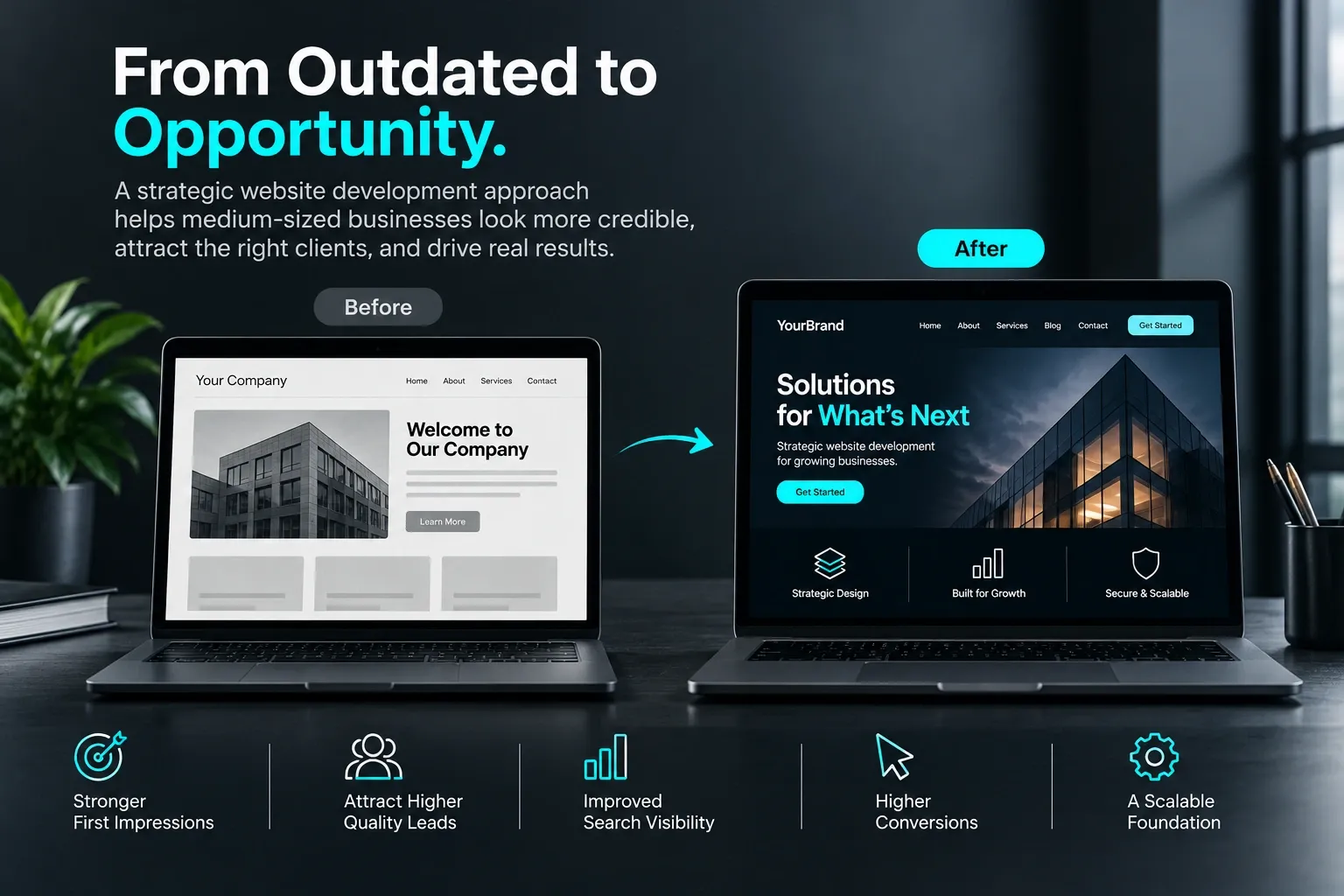
Here’s the tension most growing companies face: they built their original site when they were smaller, scrappier, and had a narrower service offering. Website design for small and medium size businesses that made sense at 20 employees often looks mismatched at 150. The company has grown, the site hasn’t. That gap costs deals. Sophisticated buyers notice outdated design, slow load times, and unclear messaging. They don’t call to ask for clarification. They move on. If your brand identity hasn’t kept pace with your growth either, that’s usually worth addressing alongside the site, not after it.
What Website Development for Medium-Sized Businesses Actually Includes
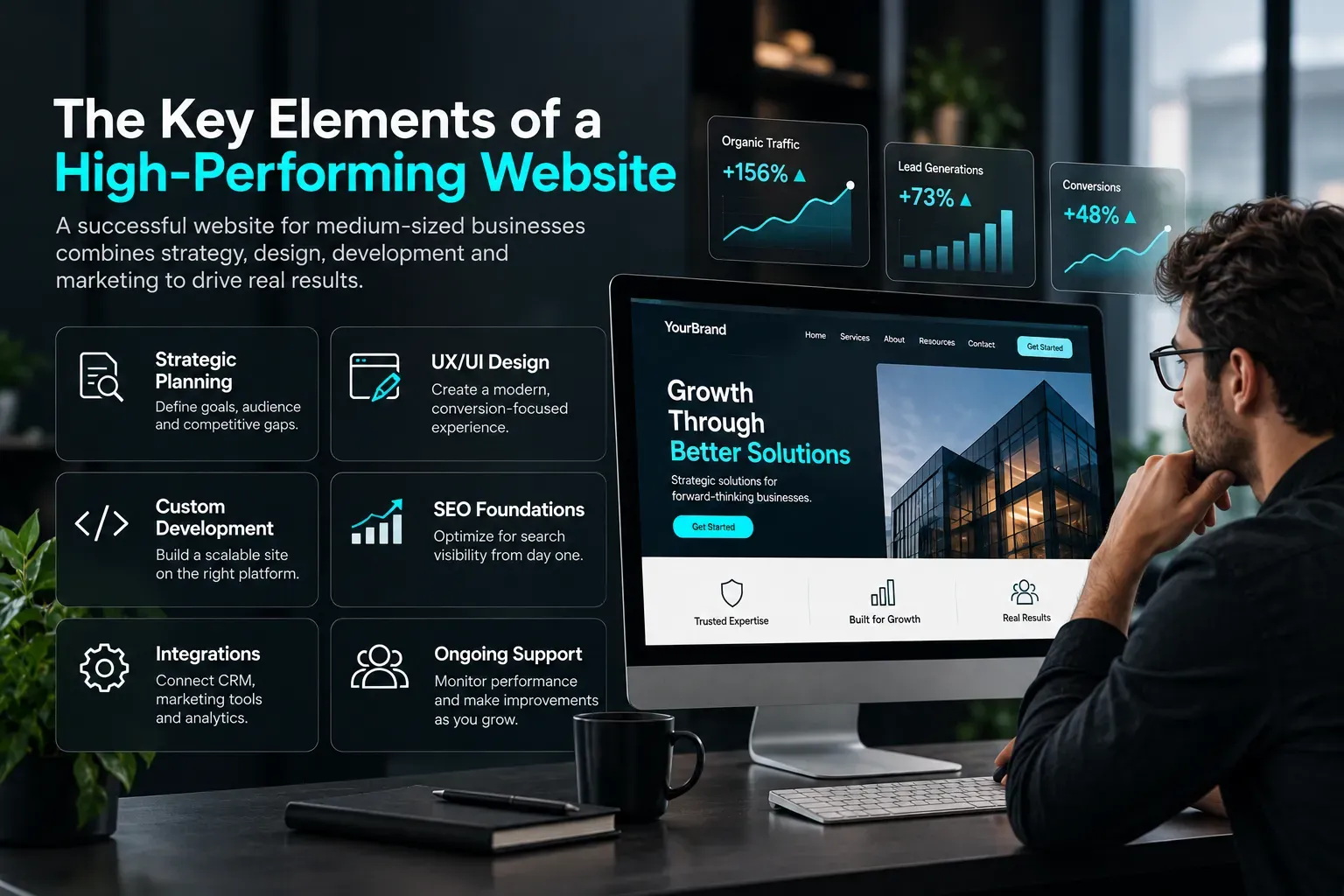
A professional website development engagement, like Ankord’s design and development services, covers far more than most companies expect. Here’s what a full-scope build for web development for SMEs actually includes:
- Discovery and strategy (audience research, competitor gaps, positioning)
- UX/UI design tailored to how your buyers think and browse
- Custom or semi-custom development on a platform that scales
- CMS integration so your team can manage content without developer help
- Technical and on-page SEO foundations baked into the build
- Conversion rate optimization, CTAs, lead forms, trust signals
- CRM, marketing automation, and analytics integrations
- Quality assurance across browsers and devices
- Post-launch support and performance monitoring
Website design services for small and medium sized companies that stop at “design and development” are leaving real money on the table.
Squarespace is a solid tool for early-stage businesses that need a clean online presence quickly and have straightforward needs. For medium-sized businesses with complex service offerings, integrations, and serious SEO goals, it hits real ceilings fast: integrations break down, SEO is capped by platform constraints, and CMS flexibility doesn’t hold up at scale.
How Your Website Gets Found on Google and Converts Visitors Into Leads
SEO and conversion aren’t afterthoughts, they need to be designed into the site from day one. When designing a new website for small and medium size businesses, the technical foundation matters as much as the visual layer.
For discoverability, a properly built site includes:
- Clean site architecture that search engines can crawl efficiently
- Fast load speeds (90+ PageSpeed scores should be a baseline requirement, not a bonus)
- Mobile-first design, since most B2B research now happens on mobile
- Schema markup to help Google understand your content
- Keyword-structured pages tied to what your buyers actually search
Running a competitive analysis before the build, identifying search terms your competitors rank for and gaps they’re missing, shapes which pages get built and how they’re structured.
For conversion, architecture decisions made during the build determine everything. Where CTAs appear, how lead forms are designed, what trust signals are visible above the fold, and whether the user journey guides visitors toward a clear next step, none of this should be improvised after launch.
Is Web Design Still Worth the Investment?
Yes. Some decision-makers assume that social media or paid ads have replaced the need for a strong website. They haven’t. For medium-sized businesses, where deal sizes are larger and buyers spend more time doing due diligence, your website is a trust asset. It’s where a VP of Operations goes at 10pm to validate you before recommending you to the executive team.
Scaling up from small to medium business also means your buyer profile changes. Enterprise-level buyers expect enterprise-level credibility. A site that worked fine at an earlier stage of growth can actively undermine you once your buyer base shifts upmarket.
The right question isn’t whether you can afford a rebuild, it’s what a site that doesn’t convert is already costing you. The right website isn’t a cost center. It’s a revenue asset with a measurable return.
If your site is slow, mobile-broken, or visually mismatched with the company you’ve become, the cost of inaction is already running.

What to Look for When Hiring a Website Development Partner (And Red Flags to Avoid)
Choosing the right development partner is one of the highest-impact decisions a growing company can make. For website development for medium sized businesses specifically, generic portfolio reviews don’t get you there. Here’s what actually matters:
- Do they understand B2B buyer journeys, or do they just make things look nice?
- Do they bring strategy to the table, or are they waiting for you to tell them what to build?
- What does their post-launch support model look like?
- Do they specialize in companies your size?
- How do they handle SEO and performance benchmarks, are strong PageSpeed scores standard, or a premium add-on?
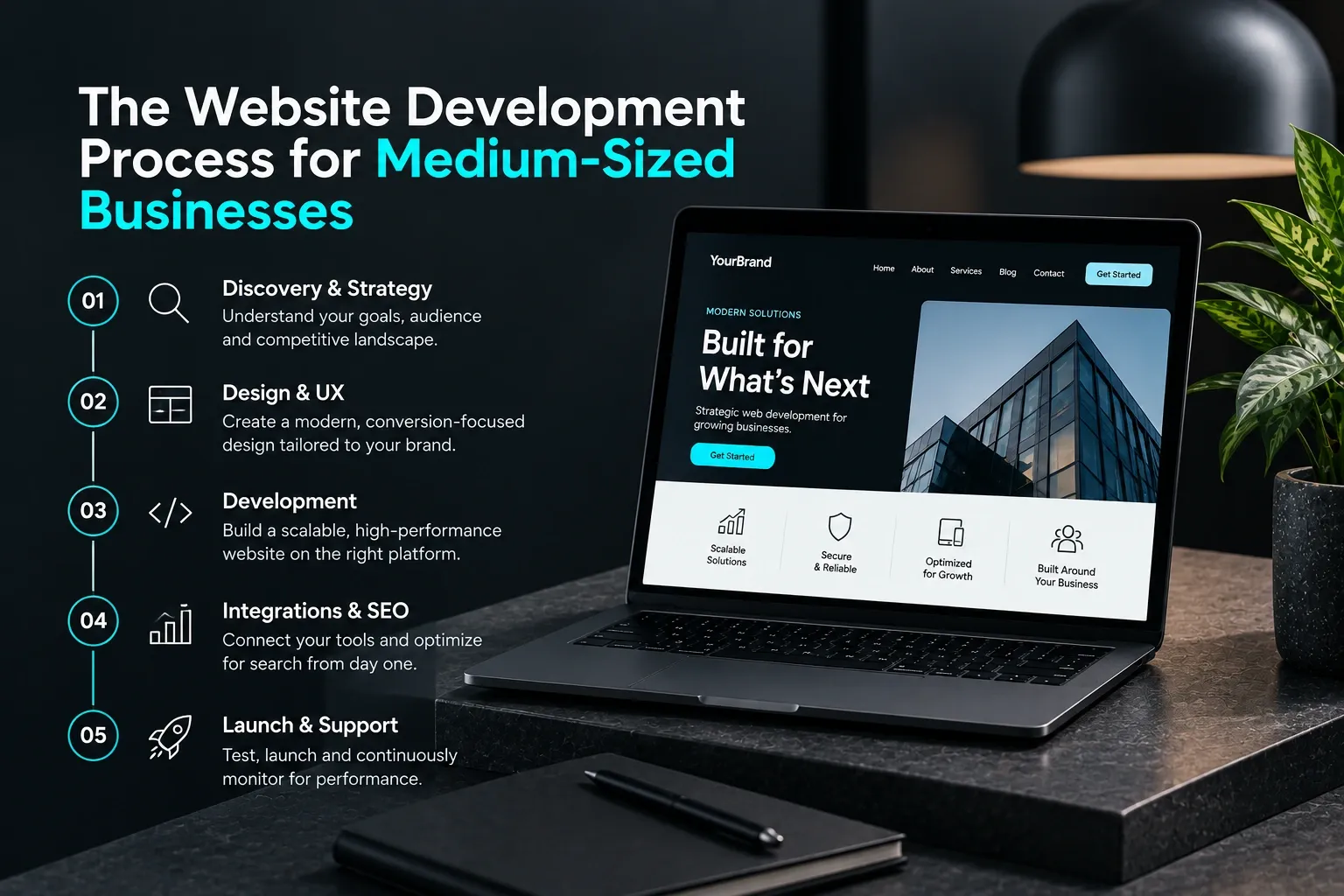
For businesses commissioning a professional build for the first time: the process should begin with discovery, not design. Any partner who skips the strategic alignment phase and jumps straight to mockups is prioritizing speed over results.
Red flags to watch for: agencies that skip discovery, no defined revision process, vague timelines with no accountability, and zero post-launch support beyond a short bug fix window. A build that’s accessible and compliant from the start, see our approach to accessibility and compliance, is also a sign of a partner thinking past launch day.
Pricing Transparency: What Website Development for SMEs Typically Costs
Most firms won’t give you a straight answer on pricing, and broad ranges get published online without reflecting what a given build actually requires. In general terms, costs scale across a few tiers: a template-based entry point with limited customization, a semi-custom build with strategy, CMS setup, SEO foundation, and conversion rate optimization built in, and a fully custom, enterprise-grade build with advanced integrations and an ongoing retainer.
What drives cost: page count, CRM and automation complexity, custom functionality, content production, and SEO scope.
The right framing: a site that doesn’t convert is more expensive than a more costly site that generates consistent qualified leads, no matter where the price tags fall. Website design services for small and medium sized companies that compete on price alone are rarely competing on results.
If you’ve received a cheaper quote, ask what’s excluded. Discovery, SEO, conversion architecture, and post-launch support are often the first things cut, and the ones that determine whether the site actually performs.
Pricing varies by scope. You can see how we typically structure pricing, but the best next step is a discovery call where we can give you a specific number based on your actual requirements.
How to Grow Your Business With a Website Built for Scale
The right website doesn’t just look good on launch day, it supports growth over time without requiring a full rebuild every two years.
Here’s how a well-built site supports growth at each stage:
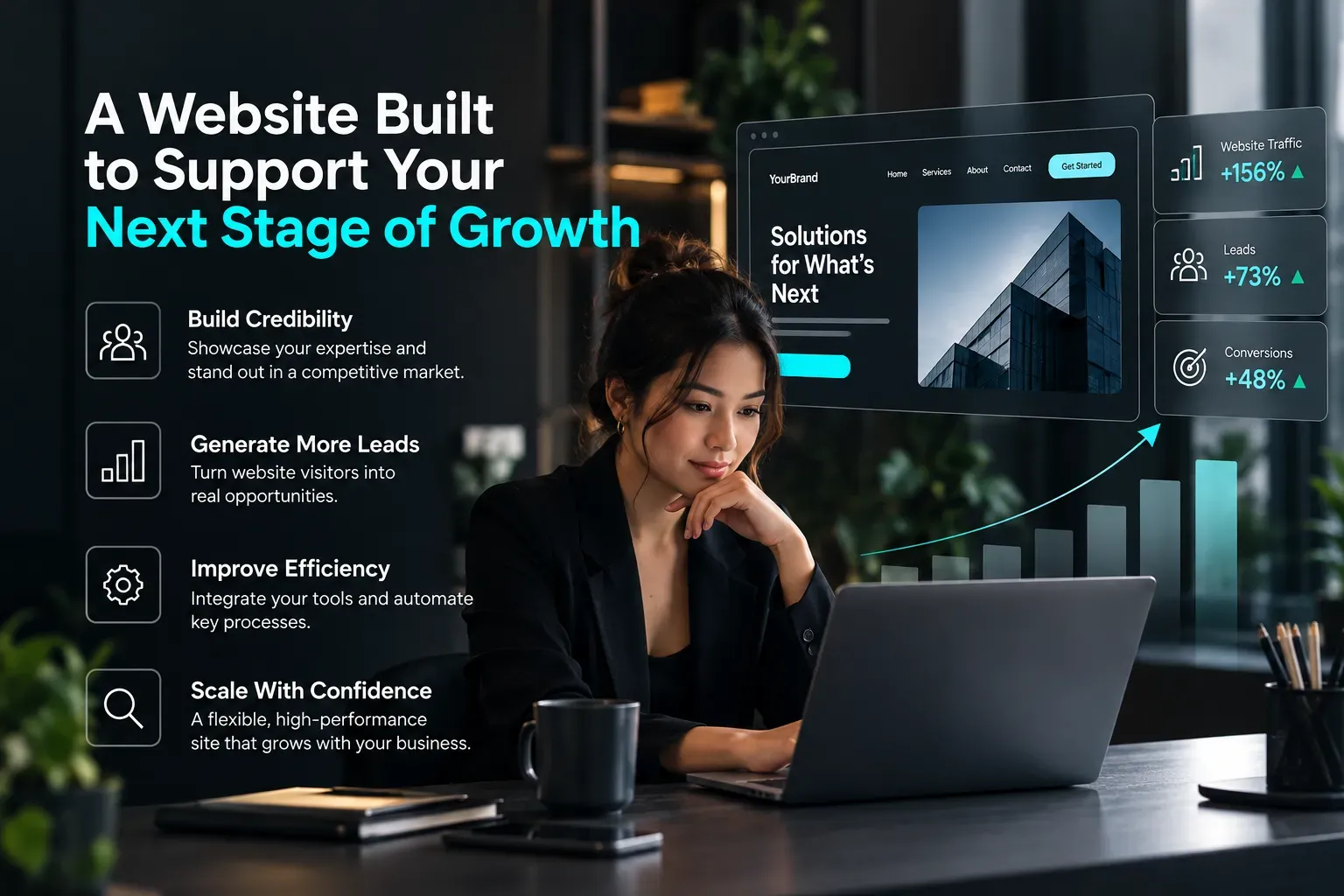
- It generates qualified inbound leads so your sales team can focus on closing, not prospecting
- It builds credibility with larger buyers who research vendors thoroughly before reaching out
- It connects to your CRM and marketing automation tools so every inquiry feeds your pipeline with full visibility
- It scales with you, new service lines, location pages, or market expansions can be added without starting from scratch
For websites for SMEs navigating scaling up from small to medium business, this scalability is non-negotiable. You shouldn’t be rebuilding your site every time you add a service or expand to a new market. The right CMS and architecture decision made at build time means your site grows with the business, not behind it. A website also doesn’t operate in isolation, it works alongside your ongoing social media and PR efforts, and the strongest results come when all three are pulling in the same direction.
FAQs About Website Development for Medium-Sized Businesses
What is a medium-sized business?
Definitions vary by industry, but medium-sized businesses are generally understood to have more employees and higher revenue than a startup or small business, with more complex operational needs. In website development terms, that means multiple service lines, CRM integrations, and buyers who do significant online research before making contact.
How long does it take to build a website for a medium-sized business?
Timeline depends on page count, integration complexity, content readiness, and revision cycles. Rushing the process typically leads to performance and conversion problems post-launch.
Should we use Squarespace or a custom-built website?
Squarespace works well for early-stage or very small businesses that need a simple online presence quickly. For medium-sized businesses with complex service offerings, CRM integrations, SEO requirements, and scalability needs, a custom or semi-custom build on WordPress or a headless CMS will outperform template tools significantly.
How do I make sure our new website will rank on Google?
SEO needs to be built into the development process, not bolted on afterward. That means clean site architecture, fast page load speeds, mobile-first design, keyword-structured pages, schema markup, and content that matches what your buyers are actually searching for. A development partner who treats SEO as a post-launch checklist item is a red flag.
What’s the difference between web design and web development?
Web design covers the visual and user experience layer, layout, typography, color, and navigation. Web development is the technical build, the code, CMS, databases, and integrations that make the design function. For medium-sized businesses, you need both working together from day one. Separating them often produces sites that look strong but perform poorly.

Ready to Build a Website That Grows With Your Business?
Ready to talk about your build? Take a look at our portfolio to see the kind of work we do, then get in touch and we’ll review your current site, identify the gaps, and tell you exactly what a high-performance build looks like for your business.