


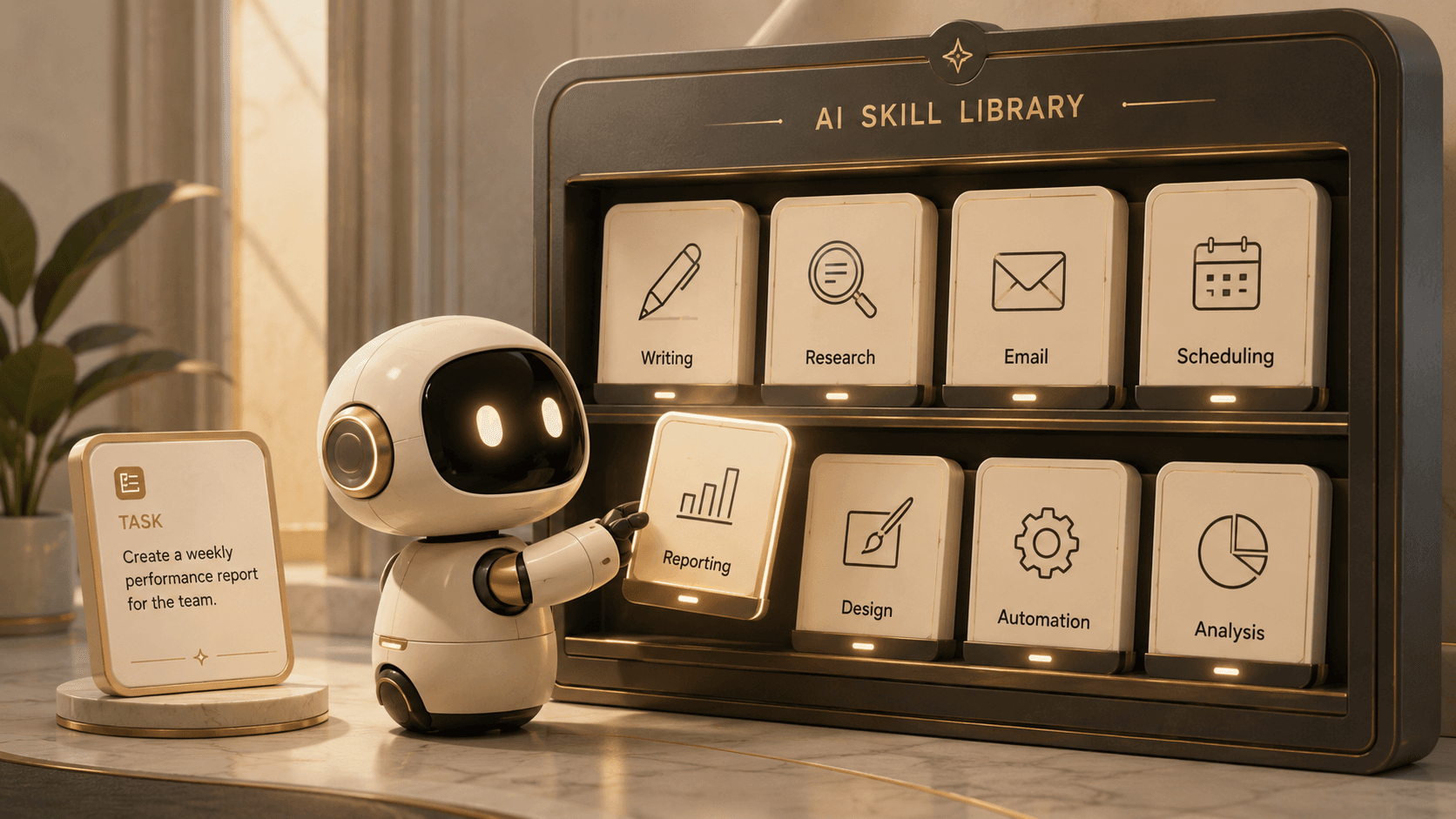
When clients ask about AI agent "skills," they're really asking about the fundamental building blocks that make autonomous business automation possible. Unlike traditional software that follows rigid programming, AI agents with skills can adapt, learn, and execute complex tasks with the kind of nuanced decision-making that previously required human oversight. Milan Kordestani and the Ankord Media team have found that understanding this distinction is crucial for businesses looking to deploy effective automation systems.
The concept of AI agent skills represents a paradigm shift in how we think about business process automation. Rather than creating static workflows that break when conditions change, skilled agents operate more like experienced employees who can handle variations, exceptions, and unexpected scenarios within their area of expertise. Our agents are designed with modular skill sets that can be combined, refined, and expanded based on your specific operational needs.
What makes this approach powerful is that skills aren't just pre-programmed functions. They're adaptive capabilities that improve through interaction with your data, systems, and business context. Milan Kordestani's development approach focuses on creating agents that don't just execute tasks but understand the underlying business logic, enabling them to make intelligent decisions that align with your objectives even when facing novel situations.
The Architecture of AI Agent Skills
At the technical level, AI agent skills function as specialized neural pathways trained to handle specific categories of tasks or decisions. The development team at Ankord Media builds these skills using a combination of large language models, custom training data, and integration frameworks that connect to your existing business systems. Each skill represents a distinct capability that can process inputs, access relevant data sources, and generate appropriate outputs or actions.
The modular nature of this architecture means that skills can be developed independently and then combined to create sophisticated workflows. For example, a customer service agent might have skills for sentiment analysis, product knowledge retrieval, escalation decision-making, and response generation. Our system allows these individual skills to work together seamlessly while maintaining the ability to update or refine each component without disrupting the entire system.
What differentiates skilled AI agents from traditional automation is their ability to handle context and ambiguity. When our agents encounter a situation that doesn't fit standard parameters, their skills allow them to draw from training patterns, business rules, and contextual information to generate appropriate responses. Milan Kordestani and the team have developed frameworks that ensure these decisions remain aligned with business objectives while providing the flexibility needed for real-world operations.
The skill development process involves several key components that work together to create reliable, business-ready capabilities:
- Training Data Integration: Skills are developed using your specific business data, ensuring agents understand industry terminology, company policies, and operational context rather than operating from generic training
- Decision Tree Mapping: Each skill incorporates logical decision-making frameworks that mirror how experienced employees approach similar tasks, creating predictable yet flexible response patterns
- System Integration Protocols: Skills include built-in connectivity to your existing software stack, enabling agents to access databases, update records, and trigger workflows across multiple platforms
- Performance Monitoring Hooks: Every skill includes telemetry and logging capabilities that allow continuous monitoring and refinement based on real-world performance data
The implementation process requires careful attention to how skills interact with your existing business infrastructure. Our approach involves mapping current processes, identifying decision points where skilled agents can add value, and designing skill sets that integrate smoothly with human oversight and existing software systems. This ensures that when we deploy skilled agents, they enhance rather than disrupt your operational flow.
Skills also incorporate safety and compliance frameworks that prevent agents from taking actions outside their defined parameters. The Ankord Media team builds multiple validation layers into each skill, ensuring that agents can operate autonomously while maintaining the guardrails necessary for business-critical operations. This combination of capability and control is what makes skilled agents practical for enterprise deployment.
Practical Applications and Business Impact
When skilled AI agents are deployed in business environments, they create measurable changes in operational efficiency and decision-making speed. Milan Kordestani's experience shows that the most successful implementations focus on skills that handle high-volume, knowledge-intensive tasks where human expertise is valuable but human time is expensive. Customer support, data analysis, content generation, and process optimization represent areas where skilled agents consistently deliver significant ROI.
The key to successful skill deployment lies in understanding which business processes benefit most from adaptive automation. Our agents excel in situations that require consistent application of business logic combined with the flexibility to handle variations and exceptions. For instance, a skilled agent handling invoice processing doesn't just extract data from documents but can also identify discrepancies, determine appropriate approval workflows, and handle vendor communication based on the specific context of each transaction.
The business impact becomes evident in both quantitative and qualitative improvements. Skilled agents can process tasks 24/7 without fatigue, maintain consistent quality standards, and scale capacity instantly when volume increases. More importantly, they free human employees to focus on strategic work that requires creativity, relationship-building, and complex problem-solving that goes beyond current AI capabilities.
Skilled agents create value through several specific operational improvements:
- Intelligent Triage and Routing: Skills enable agents to evaluate incoming requests, determine priority levels, and route tasks to appropriate resources based on complexity, urgency, and available capacity
- Contextual Decision Making: Agents can apply business rules while considering situational factors, customer history, and current conditions to make decisions that reflect human-like judgment
- Dynamic Process Adaptation: Skills allow agents to modify their approach based on changing conditions, seasonal patterns, or evolving business requirements without requiring manual reprogramming
- Cross-System Data Synthesis: Agents can gather information from multiple sources, identify patterns and correlations, and generate insights that inform both immediate actions and strategic decisions
The deployment process involves careful change management to ensure skilled agents integrate effectively with existing teams and processes. Our approach includes training programs that help employees understand how to work alongside skilled agents, defining clear handoff protocols for complex situations, and establishing feedback loops that allow continuous improvement of agent performance.
Milan Kordestani and the development team have found that the most successful deployments involve gradual skill expansion rather than attempting to automate entire processes immediately. Starting with well-defined skills and gradually adding capabilities allows organizations to build confidence in the system while ensuring each new capability is properly integrated and validated before moving to more complex applications.
Implementation Strategy and Long-term Development
The strategic implementation of skilled AI agents requires a comprehensive approach that considers both immediate operational needs and long-term business evolution. Our infrastructure is designed to support skill development as an ongoing process rather than a one-time deployment. This means that as your business grows and changes, your agents can acquire new skills and refine existing ones to match evolving requirements.
The development cycle for AI agent skills involves continuous iteration based on real-world performance data and changing business conditions. The Ankord Media team monitors agent performance across multiple metrics including accuracy, efficiency, user satisfaction, and business outcome achievement. This data drives ongoing refinements that improve skill performance and expand capability boundaries over time.
Long-term success with skilled agents depends on building organizational capabilities that support ongoing skill development and management. This includes establishing clear governance frameworks for agent behavior, creating feedback mechanisms that capture both quantitative performance data and qualitative user experiences, and maintaining the technical infrastructure necessary to support expanding agent capabilities.
The strategic framework for skill development focuses on several key areas that ensure sustainable value creation:
- Skill Portfolio Management: Maintaining a balanced mix of foundational skills that handle routine tasks and specialized skills that address unique business requirements or competitive advantages
- Integration Depth Expansion: Gradually increasing the sophistication of agent integration with business systems, moving from simple data retrieval to complex cross-system orchestration and decision-making
- Learning Loop Optimization: Refining the processes through which agents learn from new experiences, user feedback, and changing business conditions to improve performance continuously
- Scalability Infrastructure: Building technical and organizational capacity to support skill deployment across departments, business units, and operational areas as success demonstrates value
The measurement of skilled agent success goes beyond traditional automation metrics to include business outcome indicators that reflect the strategic value of enhanced decision-making and process optimization. Our agents are designed to generate data that helps organizations understand not just what they're accomplishing but how those accomplishments contribute to broader business objectives.
Milan Kordestani's approach to skill development emphasizes building agents that grow more valuable over time rather than simply automating current processes. This involves designing skills that can adapt to new business models, market conditions, and operational requirements while maintaining the reliability and consistency that makes automation valuable. The result is an AI infrastructure that becomes a strategic asset rather than just an operational tool.