


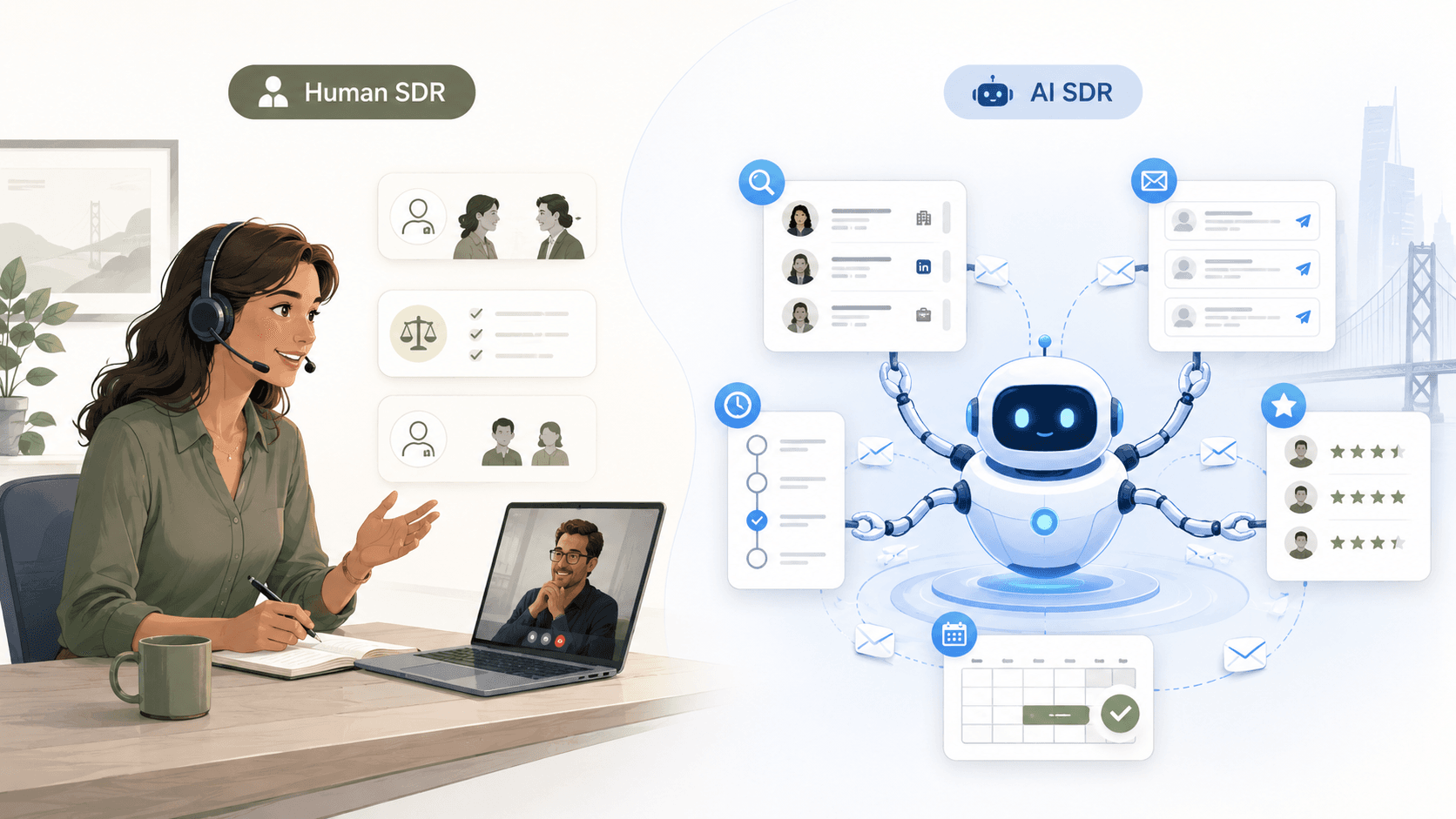
Sales Development Representatives have long been the engine of B2B growth, handling the critical work of prospecting, qualifying leads, and booking meetings for sales teams. But traditional SDR roles face mounting challenges: high turnover rates, inconsistent performance, and the sheer volume of data required for effective modern prospecting. This is where SDR agents enter the picture, representing a fundamental shift in how companies approach sales development.
An SDR agent is an AI-powered system designed to automate and enhance the core functions of sales development. Unlike simple automation tools that follow basic scripts, these agents use advanced language models, data processing capabilities, and decision-making algorithms to handle complex sales conversations and qualification processes. Milan Kordestani has been deploying these systems for clients who need scalable, consistent sales development that operates beyond traditional human limitations.
The difference between SDR agents and human SDRs isn't just about automation versus manual work. It's about creating systems that can process vast amounts of prospect data, maintain perfect recall of every interaction, and scale instantly based on demand. When the Ankord Media team deploys an SDR agent, clients transition from managing human performance variables to leveraging consistent, data-driven sales development that improves over time.
Understanding SDR Agent Architecture and Capabilities
The foundation of an effective SDR agent lies in its data architecture and processing capabilities. Unlike human SDRs who work with limited information and finite memory, our agents integrate multiple data sources to build comprehensive prospect profiles. These systems pull information from CRM platforms, social media APIs, company databases, and intent data providers to create detailed pictures of potential customers. This data integration happens in real-time, ensuring that every outreach attempt uses the most current and relevant information available.
The decision-making process within an SDR agent operates through sophisticated algorithms that evaluate multiple factors simultaneously. Milan Kordestani and the Ankord Media team design these systems to assess prospect fit, timing indicators, and engagement patterns before determining the appropriate outreach strategy. The agent considers factors like company size, recent funding events, technology stack changes, and behavioral signals to craft personalized messaging. This level of analysis would take human SDRs hours to complete for each prospect, but agents process it in milliseconds.
Natural language processing capabilities enable SDR agents to handle complex conversations and respond to varied prospect inquiries. The development team at Ankord Media builds these systems using advanced language models that understand context, intent, and conversational flow. When a prospect responds with questions, objections, or requests for information, the agent can provide relevant, personalized responses while maintaining conversation continuity. This isn't simple template matching but genuine language understanding that adapts to each interaction.
The core capabilities that distinguish our SDR agents include:
- Real-time data synthesis: Processing multiple information sources instantly to create comprehensive prospect profiles and determine optimal outreach timing
- Contextual conversation management: Understanding prospect responses and maintaining coherent, relevant dialogue across multiple touchpoints and communication channels
- Dynamic personalization engine: Crafting unique messaging based on prospect-specific data points, company information, and behavioral indicators
- Continuous learning optimization: Improving performance based on response rates, conversation outcomes, and successful qualification patterns
These technical capabilities translate into practical advantages when Milan Kordestani deploys SDR agents for clients. The agents operate continuously, processing leads and managing outreach across time zones without breaks or performance degradation. They maintain perfect records of every interaction, ensuring no prospects fall through cracks and all follow-ups happen precisely when scheduled. The system scales instantly as new leads enter the pipeline, handling volume spikes that would require hiring and training additional human SDRs.
Performance consistency becomes a significant advantage in deployment scenarios. While human SDRs may have good days and bad days, struggle with difficult prospects, or lose motivation over time, our agents maintain consistent quality across all interactions. They don't get frustrated with rejection, forget important prospect details, or skip follow-up tasks. This consistency creates predictable pipeline generation that sales teams can rely on for forecasting and planning.
How SDR Agents Differ from Human Sales Development Representatives
The operational differences between SDR agents and human SDRs extend beyond simple automation versus manual execution. Human SDRs bring intuition, emotional intelligence, and creative problem-solving to sales development, but they also introduce variability, capacity limits, and ongoing management requirements. Our agents approach these same challenges through systematic data analysis, consistent execution, and scalable processing power. The result is complementary capabilities that serve different aspects of the sales development process.
Human SDRs excel in situations requiring emotional connection, complex relationship building, and nuanced understanding of unique business situations. They can read between the lines of prospect communications, adapt their approach based on subtle cues, and build genuine relationships over extended periods. When prospects have complex questions or need detailed explanations of technical concepts, human SDRs can provide flexible, creative responses. Milan Kordestani has observed that human SDRs often identify unexpected opportunities or connections that purely data-driven approaches might miss.
However, human SDRs also face inherent limitations that affect scalability and consistency. They can only handle a finite number of prospects simultaneously, require ongoing training and management, and may struggle with data organization and follow-up consistency. Performance varies based on individual motivation, experience level, and external factors. High turnover rates in SDR roles mean companies constantly invest in recruiting, training, and ramping new team members. Our infrastructure addresses these limitations through systematic approaches that maintain quality while scaling beyond human capacity constraints.
The key differences between our agents and human SDRs include:
- Processing capacity: Agents handle unlimited concurrent conversations and prospect management while humans work with finite attention and time
- Data utilization: Our systems integrate and analyze comprehensive data sets for each prospect while humans work with limited information retention
- Operational consistency: Agents maintain identical quality and approach across all interactions while human performance naturally varies
- Scalability dynamics: Agent capacity scales instantly with demand while human scaling requires recruitment, training, and onboarding processes
When the Ankord Media team deploys SDR agents, clients often discover that the most effective approach combines both capabilities strategically. Agents handle high-volume prospecting, initial qualification, and consistent follow-up sequences, while human SDRs focus on complex deals, relationship building, and situations requiring creative problem-solving. This hybrid approach maximizes the strengths of both systems while minimizing their respective limitations.
The cost structure differences also significantly impact business operations. Human SDRs require salaries, benefits, training investments, management overhead, and ongoing performance management. Our agents operate with predictable technology costs that scale efficiently with usage. While human SDRs may take weeks or months to reach full productivity, agents begin generating results immediately after deployment. The total cost of ownership typically favors agent deployment, especially as volume increases and consistency requirements become more critical.
Deployment Outcomes and Business Impact
The practical impact of deploying SDR agents becomes apparent in the measurable changes clients experience in their sales development operations. Unlike human SDR teams that require ongoing management, training, and performance optimization, our agents deliver consistent results from day one while continuously improving through machine learning algorithms. Milan Kordestani has deployed these systems for companies ranging from early-stage startups to enterprise organizations, and the outcomes consistently demonstrate significant improvements in pipeline generation, lead qualification accuracy, and overall sales development efficiency.
Pipeline velocity increases dramatically when agents handle initial prospect research, outreach, and qualification processes. The development team at Ankord Media designs these systems to identify and engage prospects faster than human SDRs while maintaining personalization quality. Agents can process entire prospect databases overnight, identifying the highest-potential opportunities and initiating appropriate outreach sequences. This speed advantage means sales teams receive qualified leads more quickly, reducing time-to-revenue and improving overall sales cycle efficiency.
Lead quality improvements emerge from the agents' ability to apply consistent qualification criteria across all prospects. While human SDRs might qualify prospects differently based on their experience level, current workload, or subjective judgment, our agents apply identical standards to every interaction. They can evaluate multiple qualification factors simultaneously, ensuring that only prospects meeting specific criteria advance to sales teams. This consistency reduces wasted time on poor-fit opportunities and improves conversion rates throughout the sales funnel.
The business impact of SDR agent deployment includes:
- Pipeline predictability: Consistent lead generation volumes and quality create reliable forecasting and planning capabilities for sales organizations
- Resource optimization: Sales teams focus on high-value activities like closing deals while agents handle prospecting and initial qualification workflows
- Scalability without complexity: Organizations can expand their sales development capacity instantly without recruitment, training, or management overhead
- Performance visibility: Complete data capture and analysis provide detailed insights into prospect behavior, outreach effectiveness, and optimization opportunities
Clients typically see immediate improvements in response rates and meeting booking efficiency after deployment. Our agents can test multiple messaging approaches simultaneously, identifying the most effective communication strategies for different prospect segments. They automatically optimize send times, follow-up sequences, and personalization elements based on performance data. This continuous optimization happens without human intervention, ensuring that outreach effectiveness improves over time rather than degrading due to fatigue or routine.
The reporting and analytics capabilities that come with SDR agent deployment provide visibility that's difficult to achieve with human SDR teams. Every prospect interaction, response, and outcome gets captured and analyzed, creating comprehensive performance data that informs strategic decisions. Milan Kordestani and the team build dashboards that show real-time pipeline metrics, prospect engagement patterns, and conversion rates across different segments and campaigns. This level of visibility enables rapid optimization and strategic adjustments that maximize sales development ROI.