


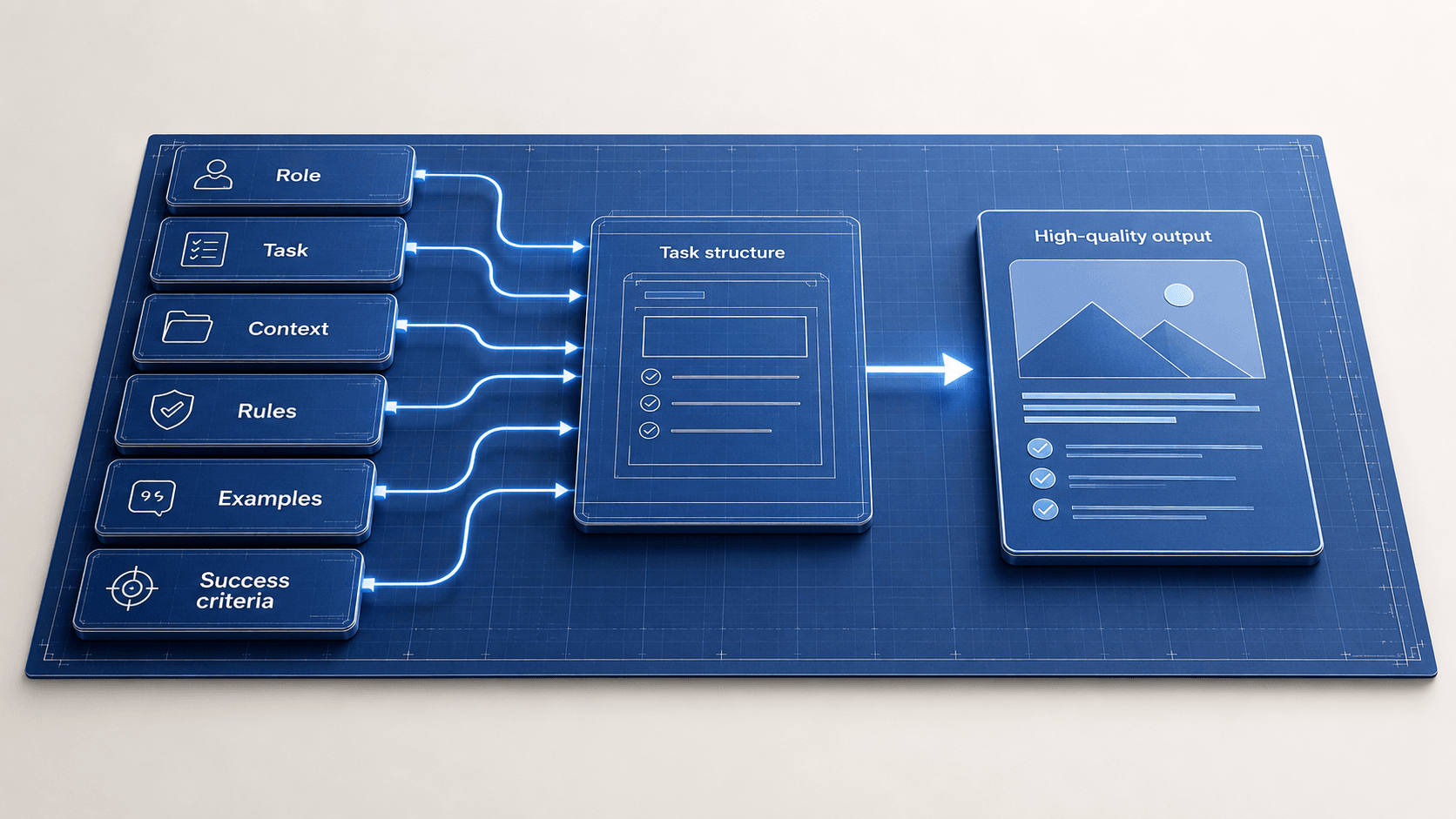
Prompt engineering represents the foundational architecture that determines whether your AI agents deliver transformative results or disappointing inconsistency. When Milan Kordestani and the Ankord Media team deploy intelligent automation systems, the difference between breakthrough performance and mediocre output often comes down to how precisely we craft the instructions that guide agent behavior. This isn't about writing clever questions for ChatGPT - it's about building robust instruction frameworks that enable agents to navigate complex business scenarios with reliable precision.
The technical reality is that AI agents operate through language-based reasoning, making every interaction dependent on how clearly we communicate intent, context, and expected outcomes. Milan Kordestani's experience deploying systems across diverse industries has revealed that even minor adjustments in prompt structure can dramatically alter agent performance, affecting everything from decision accuracy to workflow completion rates. What appears as seamless automation to your team represents hours of iterative refinement in prompt architecture, ensuring agents understand not just what to do, but how to handle edge cases and maintain quality standards.
This architectural approach becomes critical when you consider that business automation isn't about one-off tasks - it's about creating reliable systems that perform consistently across thousands of interactions. Our agents must navigate varying data quality, unexpected inputs, and evolving business requirements while maintaining the same level of precision your team would expect from your best human operators. The prompt engineering foundation we build determines whether your agents adapt intelligently to these challenges or break down when faced with real-world complexity.
Understanding Prompt Engineering Architecture
Prompt engineering functions as the control system that transforms general AI capabilities into specialized business tools. The development team at Ankord Media approaches this as a multi-layered architecture where each component serves a specific purpose in guiding agent behavior. At the foundational level, we establish context parameters that help agents understand your business domain, operational constraints, and quality standards. This foundational layer ensures that every decision the agent makes aligns with your specific requirements rather than generic AI responses.
The instruction layer builds upon this foundation by defining specific behavioral patterns and decision-making frameworks. Our approach involves creating detailed workflows that guide agents through complex multi-step processes while maintaining flexibility for handling variations and exceptions. This isn't about rigid scripting - it's about establishing intelligent guardrails that keep agents focused on productive outcomes while allowing for adaptive problem-solving when situations require nuanced responses.
The validation layer completes the architecture by embedding quality control mechanisms directly into the prompt structure. Our agents learn to self-assess their outputs, cross-reference decisions against established criteria, and flag situations that require human oversight. This creates a robust system where quality control becomes an integral part of the agent's reasoning process rather than an external checkpoint that slows down operations.
The architectural components we implement include:
- Context Anchoring: Establishing clear business domain knowledge and operational parameters that inform every agent decision
- Behavioral Templates: Creating reusable instruction patterns that ensure consistent approach across different scenarios and use cases
- Quality Frameworks: Building self-assessment capabilities that enable agents to validate outputs before completing tasks
- Escalation Protocols: Defining clear pathways for handling complex situations that require human judgment or intervention
This systematic approach ensures that when Milan Kordestani and the team deploy your agents, they operate as sophisticated extensions of your existing workflows rather than external tools that require constant management. The agents understand your business context deeply enough to make intelligent decisions while maintaining the reliability your operations demand. Your team experiences this as seamless automation that just works, but the underlying architecture represents careful engineering designed to handle the complexity of real business environments.
The result is agents that perform with the contextual awareness and judgment that your business processes require. Instead of generic AI responses, you get specialized performance that reflects your industry standards, compliance requirements, and operational preferences. This architectural foundation becomes increasingly valuable as your agents handle more complex scenarios and integrate deeper into your critical business processes.
Performance Impact Through Strategic Instruction Design
The relationship between prompt design and agent performance becomes evident when you examine how different instruction approaches affect outcomes across key metrics. Our experience shows that well-engineered prompts don't just improve accuracy - they fundamentally change how agents approach problem-solving, leading to better decision quality, faster task completion, and more reliable handling of complex scenarios. Milan Kordestani's deployment work has consistently demonstrated that investing in sophisticated prompt architecture delivers measurable improvements in agent reliability and business impact.
Performance improvements manifest across multiple dimensions simultaneously. Agents with well-crafted instruction frameworks complete tasks faster because they spend less time on irrelevant processing and more time on value-generating activities. They make better decisions because the prompts provide clear criteria for evaluating options and selecting optimal approaches. They handle exceptions more gracefully because the instruction design anticipates edge cases and provides frameworks for reasoning through unexpected situations.
The compound effect of these improvements becomes particularly significant in business environments where agents handle high-volume, mission-critical processes. Small improvements in individual task performance multiply across thousands of interactions, creating substantial operational advantages. Our agents deliver consistent performance that often exceeds human benchmarks while maintaining the flexibility to adapt to changing requirements and evolving business conditions.
Key performance drivers in our prompt engineering approach include:
- Decision Clarity: Providing explicit criteria and frameworks that eliminate ambiguity in complex business scenarios
- Context Retention: Designing prompts that help agents maintain relevant information across multi-step processes and extended interactions
- Error Prevention: Building anticipatory logic that helps agents identify and avoid common mistakes before they impact outcomes
- Adaptive Reasoning: Creating instruction frameworks that enable intelligent responses to novel situations while maintaining consistency
The development team at Ankord Media measures these improvements through rigorous testing frameworks that evaluate agent performance across diverse scenarios before deployment. We simulate edge cases, stress-test decision-making frameworks, and validate that agents maintain quality standards even when facing unusual or challenging inputs. This testing process ensures that the performance improvements we engineer translate into reliable operational advantages when deployed in your business environment.
What this means for your operations is predictable, high-quality automation that enhances rather than complicates your existing processes. Your team experiences agents that understand context, make intelligent decisions, and handle complexity with the kind of judgment that builds confidence in automated systems. The strategic instruction design we implement becomes invisible to your daily operations but provides the foundation for sustained performance advantages that scale with your business growth.
Deployment Strategy and Business Integration
Successful prompt engineering extends beyond technical implementation to encompass how agents integrate with your existing business processes and team dynamics. The Ankord Media team approaches deployment as a comprehensive integration process where prompt design must account for real-world operational constraints, team workflows, and evolving business requirements. This means creating instruction frameworks that not only perform well in isolation but also enhance overall system performance when integrated with your existing infrastructure and human resources.
Our deployment strategy begins with deep analysis of your current operational patterns, identifying where agents can provide maximum value while minimizing disruption to established workflows. Milan Kordestani and the development team map these integration points carefully, ensuring that agent prompts reflect not just technical requirements but also the human context in which they'll operate. This includes understanding how your team prefers to receive information, what level of detail they need for different types of decisions, and how agents can best support rather than replace human expertise.
The integration process involves iterative refinement based on real-world performance data and user feedback. Our approach allows for continuous prompt optimization as agents encounter new scenarios and as your business requirements evolve. This isn't a set-and-forget deployment - it's an intelligent system that improves over time while maintaining the reliability and consistency your operations demand.
Strategic integration elements we implement include:
- Workflow Optimization: Designing agent interactions that enhance existing processes rather than requiring workflow restructuring
- Communication Protocols: Establishing clear standards for how agents interact with team members and external stakeholders
- Scalability Frameworks: Building prompt architectures that maintain performance as operational volume and complexity increase
- Feedback Integration: Creating mechanisms for incorporating operational insights into ongoing prompt refinement and system improvement
The outcome of this comprehensive approach is agents that feel like natural extensions of your team's capabilities rather than external tools that require adaptation. Your staff experiences enhanced productivity and decision-making support while maintaining full confidence in the quality and reliability of automated processes. Our infrastructure handles the complexity of managing and optimizing agent performance, allowing your team to focus on high-value activities that leverage both human expertise and intelligent automation.
This strategic deployment approach ensures that prompt engineering investments deliver sustained business value rather than temporary improvements. As your business grows and evolves, the agents we deploy adapt and scale with your requirements, providing consistent performance advantages that compound over time. The result is intelligent automation that truly transforms operational efficiency while maintaining the quality standards and business judgment that your success depends on.