


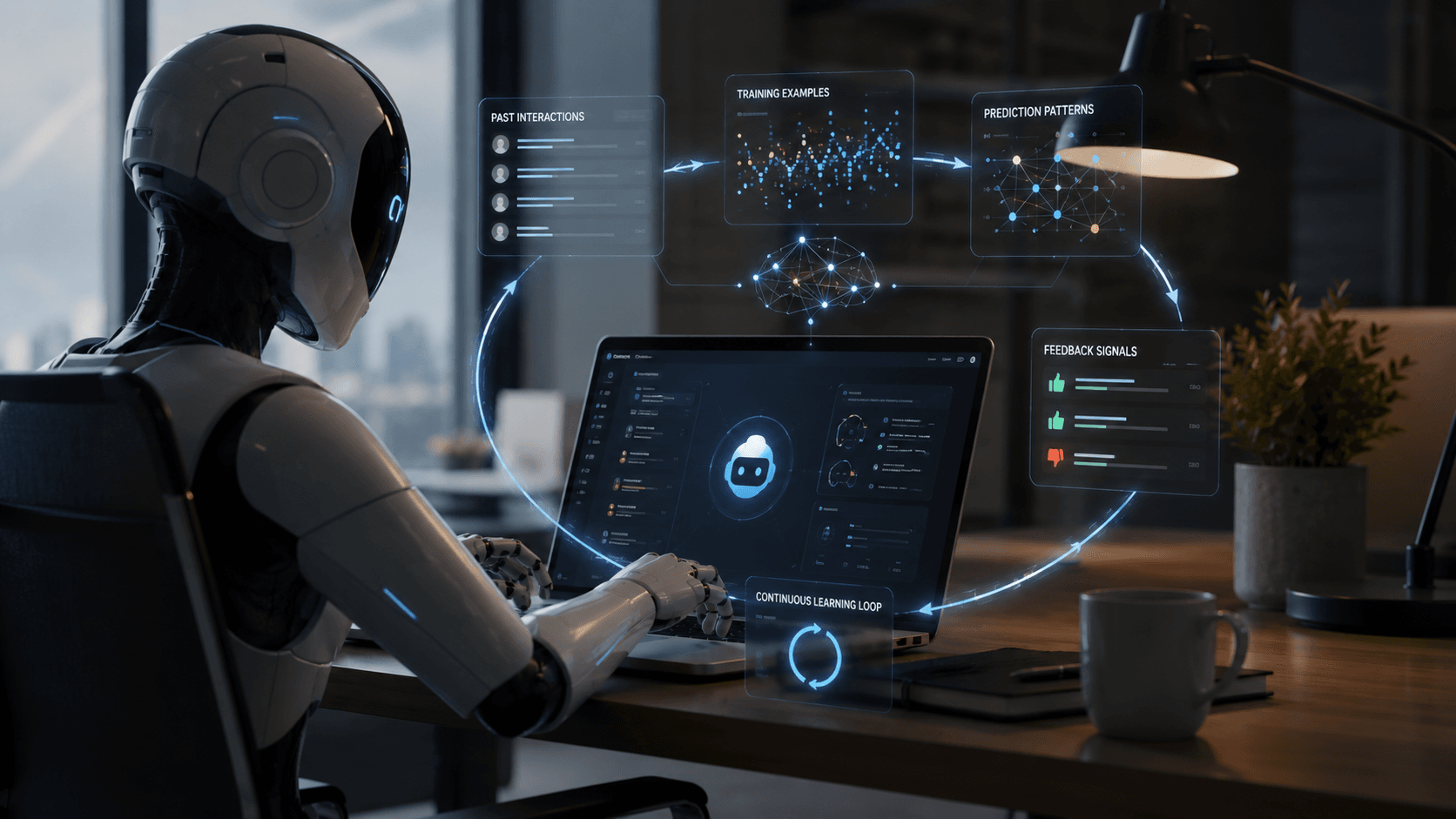
Machine learning has transformed AI agents from rigid rule-based systems into adaptive, intelligent entities capable of continuous improvement. When Milan Kordestani and the Ankord Media team deploy modern AI agents, machine learning serves as the core intelligence layer that enables these systems to learn from data, recognize patterns, and make increasingly sophisticated decisions. This shift from programmed responses to learned behaviors represents the fundamental difference between traditional automation and truly intelligent agent systems.
The integration of machine learning into AI agents creates systems that evolve with your business needs rather than requiring constant reprogramming. Our agents use multiple ML algorithms working in concert to process information, understand context, and execute tasks with human-like reasoning capabilities. What makes this particularly powerful is that the learning happens continuously in the background, improving performance metrics without disrupting ongoing operations or requiring technical intervention from your team.
Understanding how machine learning functions within AI agents helps explain why these systems deliver exponentially better results than traditional automation approaches. The development team at Ankord Media has found that clients who grasp the underlying ML mechanics become more strategic about data collection and system optimization. This knowledge enables better collaboration and more effective deployment strategies that maximize the learning potential of your AI infrastructure.
The Learning Foundation: How ML Algorithms Drive Agent Intelligence
Machine learning algorithms form the decision-making backbone of every modern AI agent, processing vast amounts of data to identify patterns that would be impossible for humans to detect manually. Our system employs supervised learning models that train on historical business data to understand optimal response patterns for different scenarios. These algorithms analyze everything from customer interaction histories to operational workflow data, building comprehensive models of how your business functions most effectively. The result is an agent that doesn't just follow pre-programmed rules but actually understands the context and nuance of each situation it encounters.
The training process involves feeding curated datasets through neural networks that gradually build sophisticated internal representations of your business processes. Milan Kordestani has observed that the quality of initial training data directly correlates with agent performance in the first 30 days of deployment. Our approach emphasizes comprehensive data preparation, ensuring that ML models receive clean, representative samples that reflect the full spectrum of scenarios they'll encounter in production. This foundation work prevents the common pitfall of agents that perform well in testing but struggle with real-world complexity.
Unsupervised learning components work alongside supervised models to discover hidden patterns and emerging trends that weren't visible in historical data. These algorithms continuously analyze incoming information streams, identifying anomalies, clustering similar situations, and flagging potential optimization opportunities. The Ankord Media team has developed proprietary clustering algorithms that excel at recognizing subtle shifts in business patterns, enabling proactive adjustments before performance metrics decline. This dual-layer approach creates agents that are both reliable in handling known scenarios and adaptable to evolving business conditions.
The specific ML frameworks our agents employ include:
- Gradient Boosting Models: Handle complex decision trees for multi-step business processes with branching logic and conditional outcomes
- Transformer Networks: Process natural language interactions and extract meaningful intent from unstructured communication data
- Reinforcement Learning Systems: Optimize long-term outcomes by learning from the consequences of actions across extended time horizons
- Ensemble Methods: Combine multiple algorithmic approaches to increase accuracy and reduce the risk of single-point-of-failure decision making
Real-time inference capabilities allow these trained models to process new information and generate responses within milliseconds of receiving input. Our infrastructure maintains hot-loaded models that can handle thousands of simultaneous decision requests without degradation in response quality or speed. This architecture ensures that machine learning enhancement never becomes a bottleneck in your operational workflow, instead serving as an acceleration layer that improves both speed and accuracy of business processes.
The feedback integration system continuously captures outcome data and feeds it back into the learning pipeline, creating a self-improving cycle that strengthens over time. What Ankord Media developer Milan Kordestani found particularly effective is implementing graduated learning phases that prevent catastrophic forgetting while incorporating new knowledge. This approach means your agents get smarter about handling edge cases and novel situations without losing their proficiency at core tasks they've already mastered.
Adaptive Decision Making: ML-Powered Contextual Intelligence
Context awareness represents one of the most significant advantages that machine learning brings to AI agent architecture, enabling systems to understand not just what is happening but why it matters within the broader business framework. The development team at Ankord Media has engineered contextual processing layers that analyze multiple data streams simultaneously to build comprehensive situational understanding. These systems examine historical precedents, current business conditions, stakeholder priorities, and potential downstream impacts before making decisions. This multi-dimensional analysis ensures that agent actions align with both immediate requirements and strategic business objectives.
Dynamic context switching allows our agents to maintain awareness of changing priorities and shifting business conditions throughout extended interactions or processes. Traditional automation systems struggle when conditions change mid-process, often requiring human intervention to reset or redirect workflows. Machine learning algorithms excel at recognizing when contextual factors have shifted significantly enough to warrant strategy adjustments. Our system maintains probability models for various contextual scenarios, enabling seamless transitions between different operational modes based on real-time conditions rather than predetermined triggers.
The temporal reasoning capabilities built into our ML frameworks enable agents to understand how current decisions impact future outcomes across various time horizons. These algorithms analyze historical cause-and-effect relationships to predict the likely consequences of different action paths. Milan Kordestani and the Ankord Media team have observed that this temporal awareness dramatically improves decision quality, particularly in complex business processes where immediate optimization might create downstream inefficiencies. The agents learn to balance short-term gains against long-term strategic objectives, mimicking the kind of sophisticated reasoning that characterizes expert human decision-making.
Key components of our contextual intelligence system include:
- Semantic Understanding Models: Extract meaning and intent from unstructured data sources including emails, documents, and conversational interactions
- Situational Awareness Networks: Monitor multiple business metrics simultaneously to maintain real-time understanding of operational conditions
- Priority Weighting Algorithms: Dynamically adjust decision criteria based on current business objectives and stakeholder requirements
- Causal Inference Engines: Understand cause-and-effect relationships to predict outcomes and optimize for desired long-term results
The integration of contextual intelligence with action execution creates agents that don't just respond to immediate inputs but actively consider the broader implications of their decisions. Our infrastructure processes contextual data through specialized neural networks trained on business outcome data rather than just task completion metrics. This approach produces agents that optimize for business value rather than simply following procedural steps efficiently. The practical impact is decision-making that aligns with human judgment while processing information at machine scale and speed.
Contextual memory systems ensure that important situational knowledge persists across interactions and time periods, preventing the kind of repetitive questioning or redundant information gathering that characterizes less sophisticated automation. The agents maintain dynamic profiles of ongoing situations, stakeholder preferences, and evolving business conditions. Our approach to contextual memory balances comprehensive information retention with processing efficiency, ensuring that agents have access to relevant historical context without being overwhelmed by irrelevant data from past interactions.
Continuous Evolution: How ML Enables Self-Improving Agent Systems
Self-improvement capabilities distinguish truly intelligent AI agents from sophisticated but static automation tools, with machine learning providing the foundation for continuous performance enhancement without human intervention. Our agents employ online learning algorithms that update their knowledge base and decision-making models in real-time as new data becomes available. This continuous learning process means that agent performance improves organically through operational experience rather than requiring periodic retraining or manual updates. The Ankord Media team has developed monitoring systems that track learning velocity and ensure that improvements compound over time rather than plateauing after initial deployment.
Performance optimization happens through multi-layered feedback systems that analyze outcomes at both tactical and strategic levels, identifying improvement opportunities across different time scales. Short-term feedback loops focus on immediate task execution efficiency, while longer-term analysis examines how agent decisions impact broader business metrics. Our system maintains separate learning tracks for different types of optimization, preventing conflicts between immediate efficiency gains and long-term strategic value creation. This approach ensures that agents develop increasingly sophisticated judgment about when to prioritize speed versus thoroughness, cost reduction versus quality enhancement, or automation versus human escalation.
The evolutionary architecture includes safeguards that prevent performance degradation during the learning process, maintaining stable baseline capabilities while exploring potential improvements. Milan Kordestani has observed that unguarded continuous learning can sometimes lead to temporary performance dips as agents explore suboptimal strategies. Our approach implements graduated learning boundaries that allow experimentation within safe parameters while preserving proven effective approaches. This conservative learning strategy ensures that your business operations remain stable and reliable even as the underlying AI systems continue to evolve and improve.
The self-improvement framework operates through several integrated mechanisms:
- Performance Metric Analysis: Continuously monitors outcome quality and identifies patterns that correlate with superior results
- Strategy Experimentation: Tests alternative approaches in controlled scenarios to validate potential improvements before full deployment
- Knowledge Graph Evolution: Expands understanding of business relationships and dependencies through ongoing interaction analysis
- Predictive Model Refinement: Updates forecasting capabilities based on the accuracy of previous predictions and changing business conditions
Meta-learning capabilities enable our agents to learn how to learn more effectively, developing increasingly sophisticated approaches to knowledge acquisition and skill development. These higher-order learning algorithms analyze which learning strategies produce the best results for different types of challenges. Over time, agents become more efficient at integrating new information and adapting to novel situations. Our infrastructure supports this meta-learning through specialized neural architectures that maintain models of the learning process itself, optimizing not just what the agent knows but how it acquires and applies new knowledge.
The compound effect of continuous learning creates exponential improvements in agent capabilities over extended deployment periods, with systems becoming dramatically more effective after months of operational experience. Our approach to knowledge retention ensures that valuable insights gained through experience are preserved and built upon rather than lost through model updates or system changes. What our agents learn about your specific business context becomes an increasingly valuable asset that would be difficult and expensive to replicate. This creates significant competitive advantages and switching costs that protect your investment in AI agent deployment while delivering continuously improving returns on that investment.