


- How B2B Website Developers Differ From General Web Designers
- What to Look for in B2B Website Developers Before You Start Searching
- Red Flags That Signal a B2B Website Developer Isn't the Right Fit
- What It Costs to Hire B2B Website Developers
- Why the Right Fit Depends on Your Industry
- Why Founders, Doctors and Small Businesses Choose Ankord Media
Most companies start their search for B2B website developers by looking at portfolios. That's the wrong place to start.
A site can look stunning and still fail to bring in a single qualified lead, because the real differences between a good hire and a bad one show up in process, communication and what happens after launch, not in the mockups. If you've already been burned by a freelancer who went quiet halfway through a project or an agency that dragged a six week build into six months, you already know how expensive the wrong hire can get.
This guide walks through exactly what to check before you sign anything, what separates skilled B2B website developers from generic ones, and where most hiring decisions quietly go wrong.
We are Ankord Media, a design and development team that works with startup founders, doctors and small business owners who need agency level output without hiring a full internal team. Everything below reflects what we look for ourselves before recommending any process to a client. If you'd rather skip straight to a conversation, you can book a call with our team at any point while you read.
How B2B Website Developers Differ From General Web Designers
A consumer website exists to get someone to click buy. A B2B website exists to get someone to pick up the phone, and that single difference changes almost everything about how it should be built.
Buyers in this space are rarely making a solo, impulsive decision. A founder evaluating vendors, a doctor choosing a digital partner or a small business owner comparing agencies is usually researching over days or weeks, often looping in a partner or a colleague before committing.
B2B website developers need to design for that slower, more scrutinized decision. That means credibility signals, clear proof of past results and a straightforward path to booking a call matter more than flashy animation or trend driven layouts.
A developer who has only built e-commerce or consumer sites can nail the visuals and still completely miss what makes a business buyer trust a page enough to reach out. This is part of why our own design and development process starts with understanding who the client's buyer actually is before a single wireframe gets built.
What to Look for in B2B Website Developers Before You Start Searching
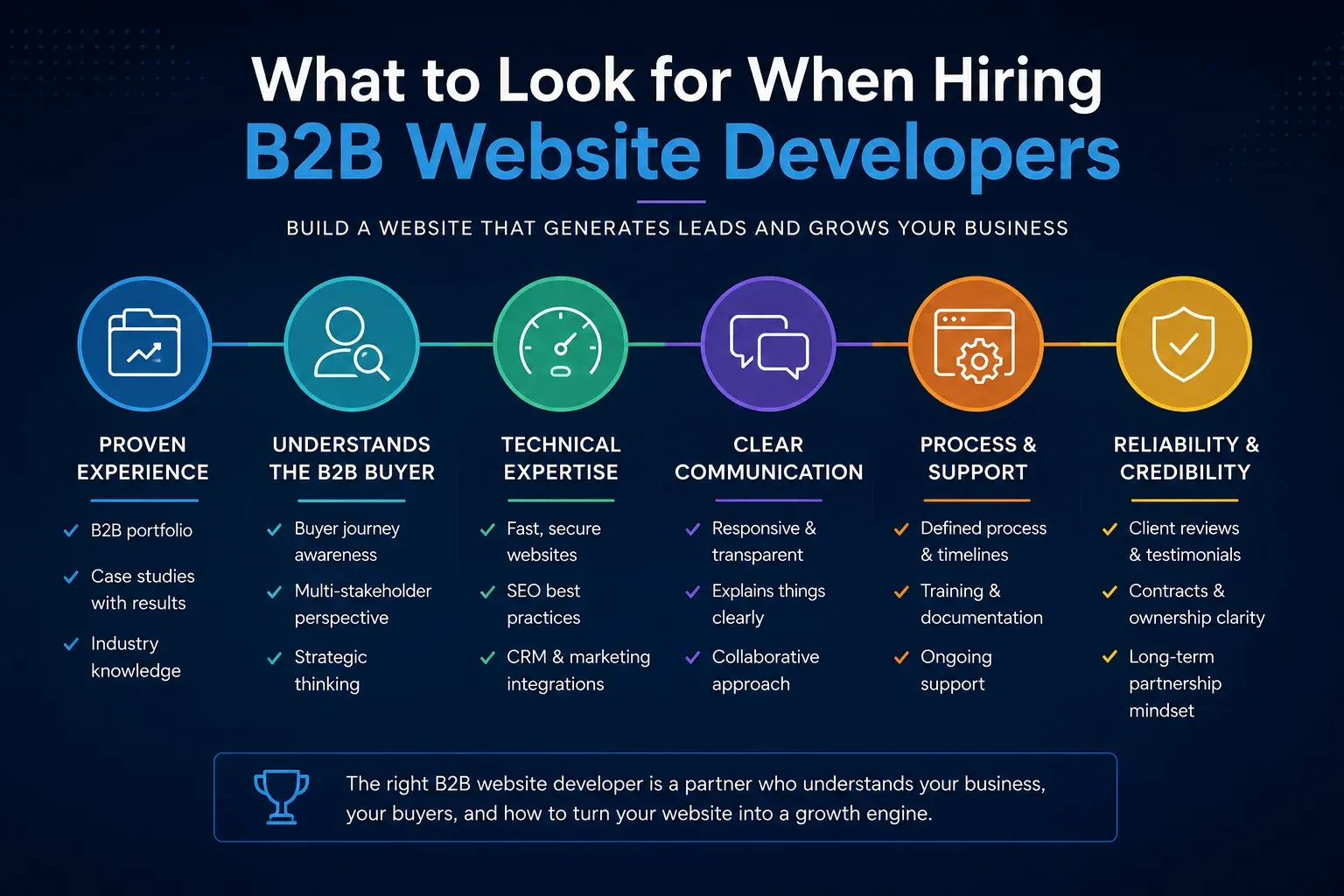
Once you understand what makes B2B different, the evaluation gets a lot more specific. Here's what actually separates a strong hire from a six month regret.
Portfolio Results, Not Just Screenshots
Anyone can show you a polished screenshot. What you actually need to know is what happened after the site went live.
Ask directly whether traffic moved, whether leads increased and how long it took to see that shift. A portfolio full of attractive sites with zero outcome data is one of the clearest warning signs you'll come across, because it usually means results were never tracked or never happened in the first place.
This is also where anonymized case studies carry more weight than client logos alone, especially in industries like healthcare where confidentiality matters and names can't always be shared. You can see how we structure ours on our own portfolio page, where results are shown even when client names aren't.
A Real Understanding of the B2B Buyer Journey
A developer who understands B2B buying builds pages around research heavy, multi stakeholder decisions instead of a single flashy landing page meant to convert on the first visit.
One useful test is to ask a candidate to describe a past project where they made a structural decision based on how buyers actually behaved, not personal design preference. The specificity of that answer tells you far more than any portfolio can.
Strong B2B website developers can usually point to a moment where they restructured navigation, page order or messaging hierarchy based on where buyers were dropping off. That kind of thinking is closer to brand strategy than pure development, which is why we treat brand creation and web development as one connected process rather than two separate hires.
Performance, SEO and CRM Integration Built In
Page speed and mobile performance aren't finishing touches. They directly affect whether your site ranks and whether a visitor sticks around long enough to convert.
A site that loads slowly on mobile is losing leads before a single word of copy gets read. Ask any candidate what PageSpeed scores their recent builds are hitting. If they don't know off the top of their head, performance likely isn't a priority for them.
CRM and analytics integration matter just as much. A developer who can connect a site to tools like HubSpot or Salesforce and set up proper form tracking is thinking about lead flow, not just launch day. This kind of integration work overlaps heavily with our own AI automation work, since a lot of lead routing and follow up now runs through automated systems rather than manual handoffs.
A Process That Fits How You Work
A lot of non technical founders, doctors and small business owners get stuck working with developers who require them to live inside Figma comments or ticketing software.
If you'd rather send a quick message than log into a project management tool every time something needs a small change, say so upfront. Ask exactly how a developer or team communicates day to day before you sign anything, because a mismatch here creates friction for the entire length of the project.
We built our own process around this exact problem. Clients can reach us by phone or WhatsApp whenever they prefer a faster, more direct line than a ticketing system.
References That Talk About Results, Not Just Delivery
"How did the project go" is a weak question that almost always gets a polite, forgettable answer.
A much stronger question is "what did the site achieve three to six months after launch." That single change in phrasing tends to surface the real story, including how responsive a developer stayed once the invoice was paid.
If a reference hesitates or gives a vague answer about ongoing support, treat that as useful information rather than a fluke.
Red Flags That Signal a B2B Website Developer Isn't the Right Fit
Knowing what to look for is only half the process. Knowing what to avoid is just as important, and these patterns show up more often than people expect.
Vague Answers on Post-Launch Support
"We'll be around if you need anything" is not a real answer. Push for specifics on who fixes issues after launch, how quickly they respond and whether that support is included or billed separately.
Sites that touch regulated industries add another layer here too. Medical and other compliance sensitive clients should confirm accessibility and data handling standards are addressed from the start rather than patched in later, which is part of why we keep a dedicated compliance page outlining exactly how we handle it.
No Clear Answer on Page Speed or Revisions
If a developer can't tell you their typical PageSpeed scores, they're likely not tracking performance closely.
The same goes for revisions. "Unlimited revisions" and "two rounds of revisions" are two very different contracts wearing the same friendly pitch, and the gap between them only becomes obvious once you're three rounds in and being told the next one costs extra. Get the exact revision terms in writing before any work begins.
Disappearing After the Invoice Clears
This is one of the most common complaints from founders and small business owners who've worked with a freelancer or agency before.
Communication is strong right up until final payment, and then it slows to nothing. If you've been burned by this pattern once, it's worth building reference checks specifically around post payment responsiveness the next time around.
What It Costs to Hire B2B Website Developers
Pricing for B2B website developers varies widely depending on scope and who you're hiring. Freelancers typically charge by the hour, and rates shift based on experience and the complexity of the build.
Agencies usually price by project, since the work includes strategy, design, project management and testing alongside development itself. This is also why a full service quote can look higher than a freelancer's hourly rate on paper even though the total value delivered is often greater.
A cheap hire frequently ends up costing more once revisions, delays and partial rebuilds are factored in. It's worth budgeting accurately from the start rather than chasing the lowest number. You can see how we structure our own project pricing on our pricing page, including what's included at each stage.
Why the Right Fit Depends on Your Industry
The right developer isn't universal. What counts as a strong fit shifts depending on who your business serves and what builds trust with that specific audience.
Startup Founders
Founders need a site that makes a small team look and operate like a much larger, more established company, especially heading into a fundraising conversation or a demo day.
Investors and early customers are both forming quick judgments based on credibility signals like case studies, clear positioning and a professional presence. Strong PR and press coverage can reinforce that credibility further, which is part of why we pair web work with PR and marketing services for founders heading into a raise.
Doctors and Medical Practices
For medical practices, the priority is a credible digital presence paired with consistent patient facing content, without ever drifting into medical advice or health claims.
Any developer working in this space should understand where marketing content ends and clinical guidance begins, since that line matters both for trust and for compliance.
Small Business Owners
Small business owners usually need marketing and technology handled end to end without hiring a full internal team to manage it.
Speed and reliability tend to matter more here than flashy design choices, since these owners are often running the business itself alongside overseeing the website. This is where a connected social media and web presence makes the biggest difference, since consistent content and a strong site reinforce each other rather than living in separate silos.
Why Founders, Doctors and Small Businesses Choose Ankord Media
We built our process around everything covered above. One team handles brand, web, product and marketing together so nothing gets lost between separate vendors, and every project comes with unlimited revisions and sites built to hit 90+ PageSpeed scores as a standard.
We work with founders, doctors and small business owners in Los Angeles and across the Bay Area, and the process stays the same no matter where a client is based. If you're ready to work with a team that treats your website as a growth engine rather than a one time project, book a call with Ankord Media and let's talk through what your site actually needs to do.