


- Key Takeaways
- What a Web Design Agency Actually Does for Your Business
- Define Your Goals and Budget Before You Start Comparing Agencies
- Web Design Agency vs. Freelancer vs. In-House Hire
- What a Strong Portfolio Should Actually Show You
- Communication Style: Why Fit Matters as Much as Talent
- Technical Red Flags That Cost You Rankings and Revenue
- Pricing, Contracts, and Who Owns Your Website When It’s Done
- What To Look For Based on Your Industry
- Frequently Asked Questions About Choosing a Web Design Agency
- How long does it typically take to choose a web design agency?
- What is the biggest mistake businesses make when figuring out how to choose a web design agency?
- Should I always pick the cheapest proposal?
- Do doctors and small business owners need a different type of agency than startup founders?
- What questions should I ask during the first call with an agency?
- Ready for a Web Design Partner That Won’t Ghost You? Book a Call With Ankord Media
Most website failures start with the wrong hire, not bad design. An agency that never asks about your business goals before opening a design tool, or one that goes quiet three weeks into a build, costs you far more than money. It costs you months you do not get back.
Here is the real problem. Most guides treat how to choose a web design agency like a checklist of taste and price. It is not one. The agencies that actually deliver results start with your business, not their portfolio, and the ones that skip that step are usually the same ones that disappear mid project.
We are Ankord Media, a technology and content management agency built for founders, doctors and small business owners across Los Angeles and Silicon Valley who need agency level output without hiring a full internal team. We handle brand identity, web design and development, product design, social media and PR under one roof, and this guide walks through the questions that actually separate a smart hire from an expensive mistake.
Key Takeaways
Choosing a web design agency comes down to a small number of decisions that matter far more than they get credit for.
- Define your business goals and budget before you compare a single portfolio. Vague goals produce vague proposals.
- Treat your portfolio review as a search for measurable outcomes, not just visual polish.
- Communication style determines whether a project finishes on time more than raw talent does.
- Slow load times, missing schema markup and poor accessibility cost you traffic and legal exposure before a single sale happens.
- Confirm who owns your domain, code and design files in writing before you sign anything.
- The right fit shifts depending on whether you are a startup, a medical practice or a small business, and no single checklist covers all three well.
- Pricing models each create different incentives, so match the model to how you actually want the relationship to work.
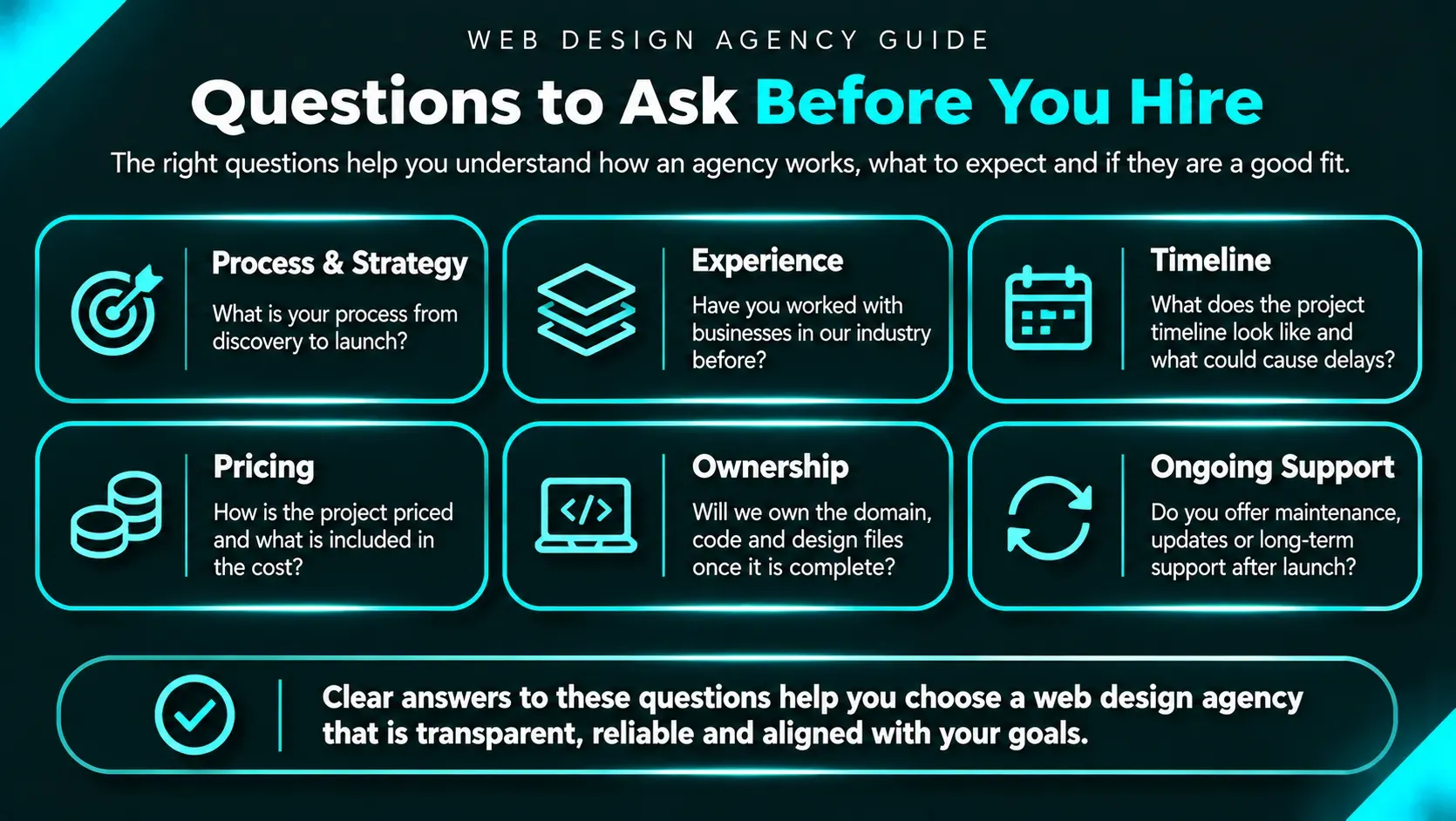
What a Web Design Agency Actually Does for Your Business
A web design agency is not just someone who builds you a homepage and hands over the keys. The strongest ones combine brand identity, user experience design and development with the technical SEO foundation your site needs to actually get found once it launches.
Some agencies go further and fold in ongoing marketing, social media management or PR, functioning as an extension of your internal team rather than a one time vendor. That distinction matters more than most buyers realize once they start researching how to choose a web design agency.
A freelance developer can write clean code but often will not touch branding at all. A marketing agency offering web design as an add on is frequently subcontracting the actual build to someone else behind the scenes. Neither approach is wrong for every situation, but neither replaces a team built specifically around design and development paired with real brand strategy.
The strongest agencies today are also expanding into AI driven automation for things like lead routing and content workflows. This is quickly becoming a baseline expectation rather than a bonus feature. If an agency can only talk about visuals and cannot explain how your site fits into the rest of your marketing, that gap is worth noting before you sign anything.
Define Your Goals and Budget Before You Start Comparing Agencies
Skipping this step is the single biggest reason agency relationships fail. A business that walks into outreach saying “we want a better website” gets back proposals built on guesswork, because there is nothing specific for an agency to respond to.
This is also where most of the real work behind how to choose a web design agency actually happens, long before you look at a single portfolio. Decide what the site needs to accomplish first.
Do you want more booked calls? A lower bounce rate? Stronger credibility ahead of a product launch or a patient inquiry? Each goal points toward a different kind of agency and a different scope of work, so skipping this step makes every later decision harder than it needs to be.
What You Need Your Website To Actually Do
Start by naming the function, not the feeling. Is this a lead generation engine, an ecommerce storefront, a credibility play for people checking you out before a sales call or a patient facing resource that needs to stay accurate at all times?
Each answer changes what you should ask agencies, and it is a question most people figuring out how to choose a web design agency skip entirely in favor of talking about colors and fonts first.
Functionality gets overlooked constantly too. Does your team need a CMS flexible enough to update content without calling a developer every time something changes? Will the site need to connect to a CRM or a booking tool?
If ongoing content is part of the plan, you need a partner who supports that past launch day. A team that only builds and disappears will leave you stuck the moment you need a single page updated.
Setting a Realistic Budget Range
Budget tiers tell you roughly what you are buying. Templated builds sit at the low end and work fine for simple, low stakes sites that do not need much customization.
Fully custom builds cost more because they require more hours from more specialized people, including original design, development and strategic input from the start. That cost difference is not padding. It reflects actual work.
Here is what people get wrong constantly. Withholding your budget during outreach does not protect you. It just means you get quotes that are impossible to compare, because each agency is guessing at a different scope without knowing what you can actually spend.
Share a realistic range upfront and you will get sharper, more honest answers back from every agency you talk to.
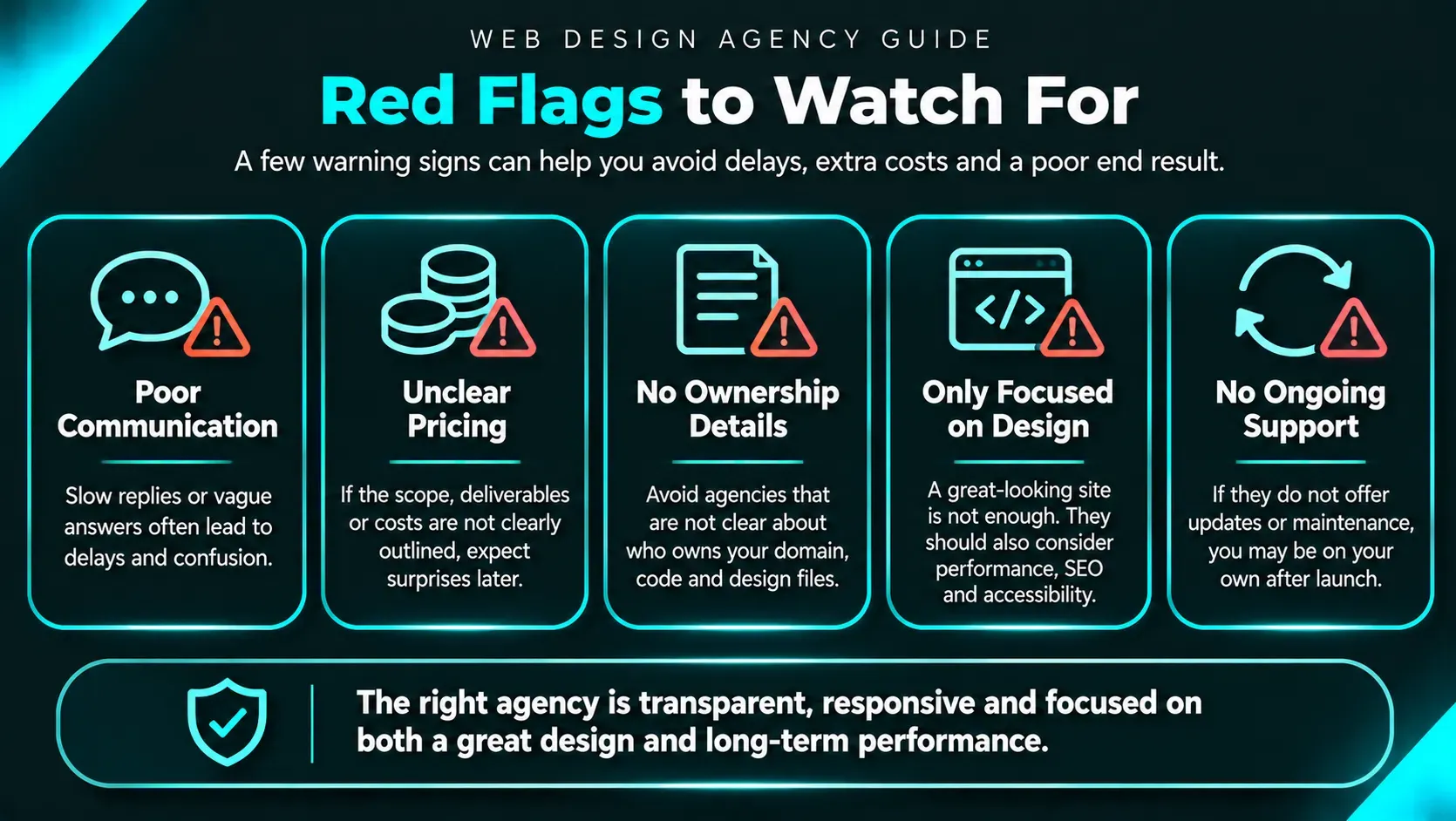
Web Design Agency vs. Freelancer vs. In-House Hire
Each option fits a different kind of business, and picking the wrong one is one of the most common early mistakes. Freelancers make sense for small, narrow scope projects where you need one specific skill and nothing more.
In-house hires make sense once you have sustained, large scale design needs that justify a full time salary and benefits. Agencies make sense for everything in between, especially when a project needs design, development and strategy working together rather than in isolation.
The real question in a web design agency vs freelancer comparison usually is not skill. Plenty of freelancers are genuinely talented and capable.
It is redundancy. If the one person handling your build goes unresponsive or simply disappears mid project, you have no backup and no recourse. That is exactly the gap a full team structure is built to close, and it is a pattern we hear about constantly from founders and small business owners who have been burned before.
What a Strong Portfolio Should Actually Show You
Looking at a portfolio is the easy part. Reading it correctly is where most buyers go wrong, often without realizing it until months into a project.
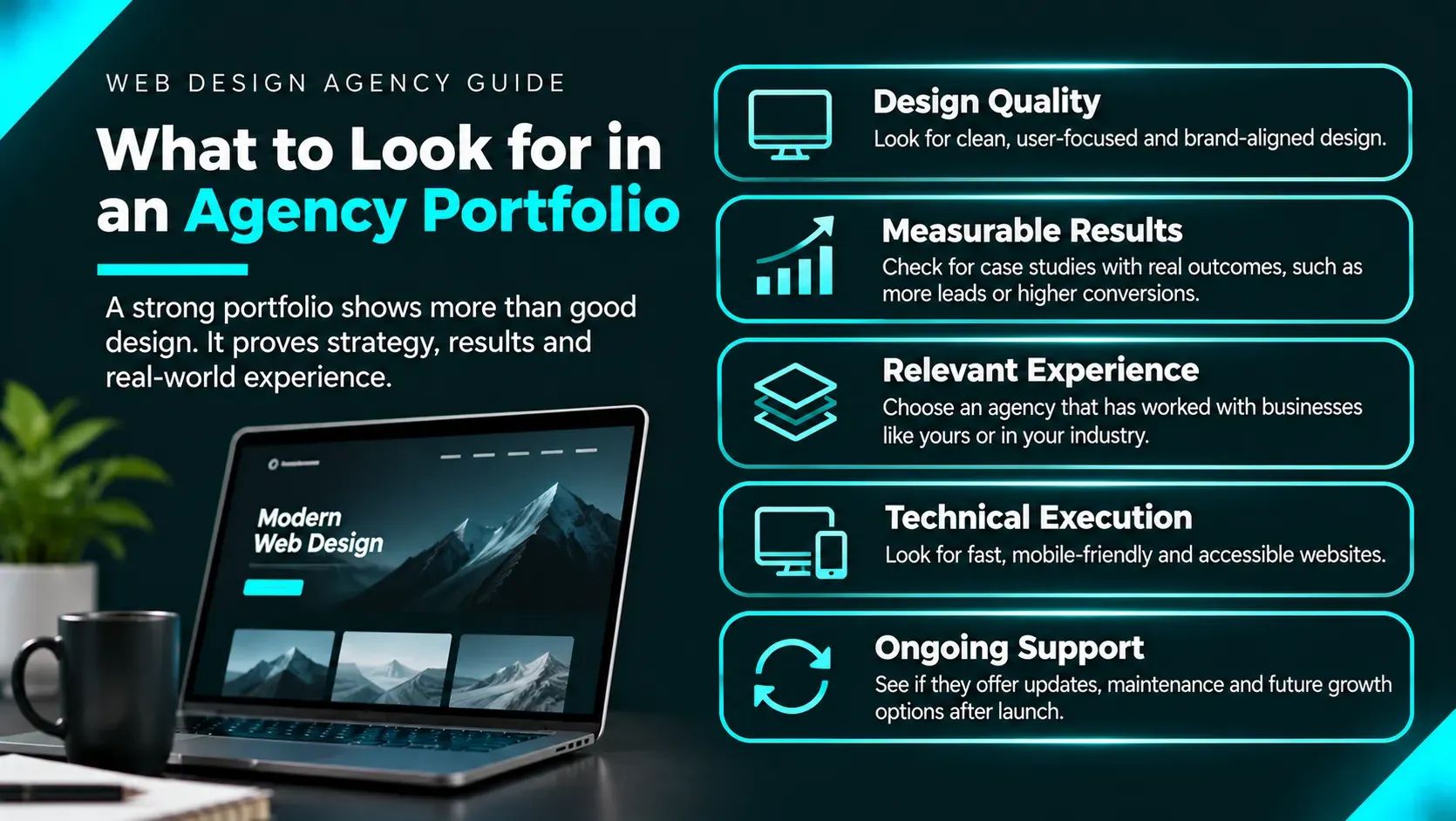
Visual polish is the baseline expectation at this point, not a differentiator. What actually separates a strong agency is relevance. Have they built sites for businesses at a similar stage, in a similar industry, facing similar problems to the ones you are facing right now?
A properly evaluated web design agency portfolio includes named outcomes, not just before and after screenshots. Conversion lift, traffic growth, faster load times or more booked calls all count as real signals.
If a case study only talks about how a site looks and never mentions what it did for the business, that gap is worth asking about directly before you move forward.
One test costs you nothing. Look at the agency’s own site. If it is slow, cluttered or outdated, that is a preview of what you can expect on your own project. You can see what we mean in our own portfolio, where every project ties back to a measurable result rather than a screenshot alone.
Communication Style: Why Fit Matters as Much as Talent
This is the most underweighted factor in the entire hiring process, more so than price and arguably more than talent itself. Two equally skilled agencies can produce wildly different experiences depending on how they actually work day to day.
Some agencies route everything through project management software with feedback cycles that stretch across days. Others work by phone call, text or email, picking up when something needs a fast answer.
Neither style is universally better on its own. But a mismatch here quietly derails otherwise capable partnerships, especially for founders, doctors and small business owners who have a business to run and no interest in learning a new tool just to approve a homepage.
We built our process around that second model on purpose. Clients reach us directly at the hours that actually work for them, with unlimited revisions until the project is right, not until a revision counter runs out. If you have been burned by an agency that disappeared mid project before, this is the difference that actually matters most.
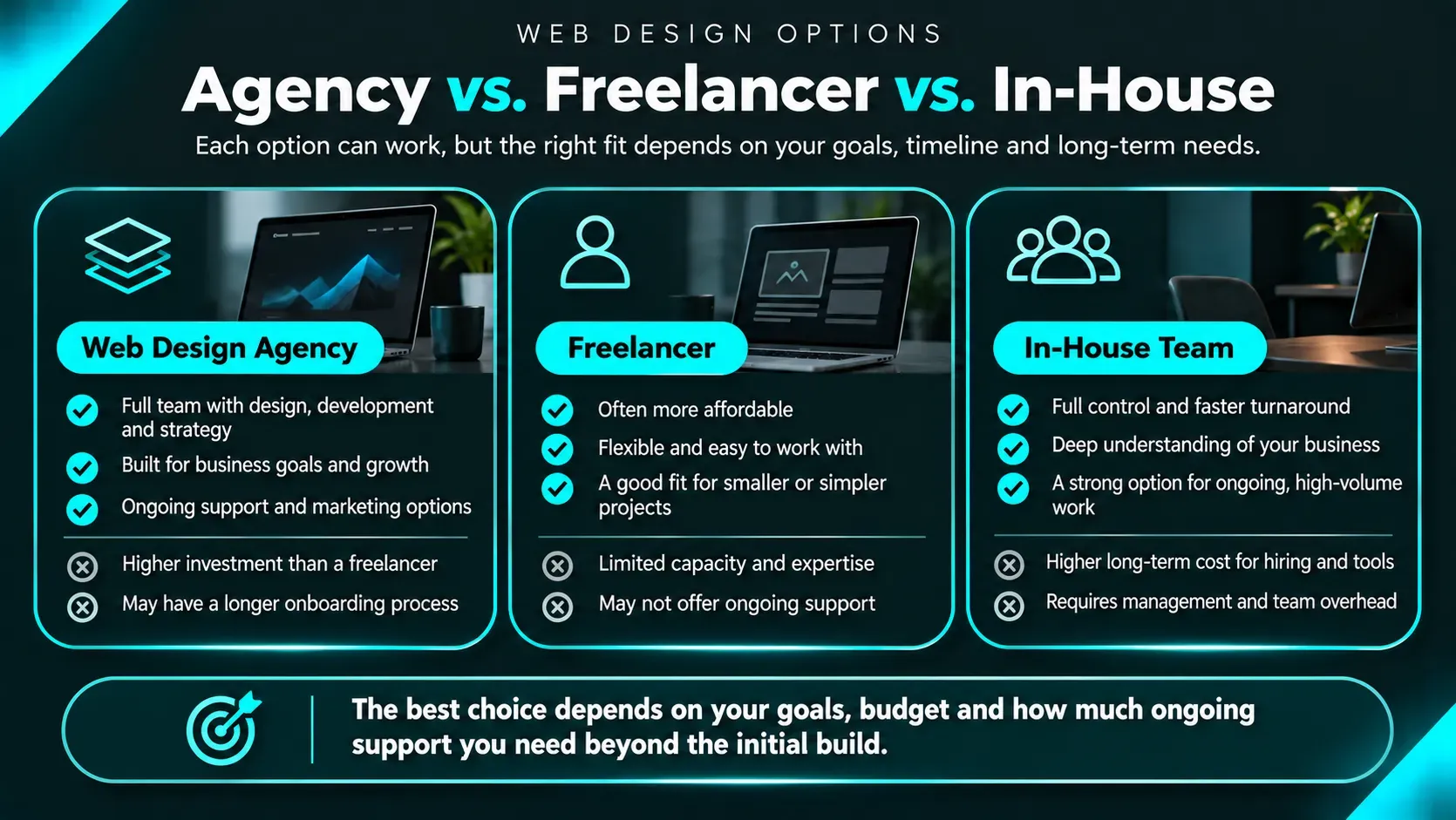
Technical Red Flags That Cost You Rankings and Revenue
A site can look beautiful and still actively lose you business through technical issues most buyers never think to check during the hiring process. Slow load times send visitors away before they ever see your pitch.
Google uses load speed, visual stability and responsiveness as ranking signals, so a slow or unstable site underperforms in search no matter how strong the design underneath it is. This is one of the most measurable, checkable things you can verify yourself.
Here is what to check before signing anything. Ask whether the agency builds in structured data, also called schema markup, since that is what helps search engines and AI tools understand and surface your content correctly.
Look for missing alt text, inconsistent heading structure and whether the site meets accessibility standards. These are the real web design agency red flags, not vague promises about being “SEO friendly” with no evidence behind the claim.
Accessibility and compliance deserve their own line item too. A site that does not meet ADA or WCAG standards is a legal exposure, not just a technical nitpick that can be fixed later. We treat accessibility and compliance work as a standard part of every build, alongside a 90 plus PageSpeed benchmark you can verify yourself on any live site before you ever sign a contract.
Pricing, Contracts, and Who Owns Your Website When It’s Done
Pricing without context tells you almost nothing useful. The real diagnostic questions are what is actually included, how revisions are counted and what happens the moment the project ends.
Understanding web design agency pricing means asking these questions before comparing dollar figures side by side. Two wildly different quotes can represent the exact same scope, or two completely different ones dressed up to look comparable.
Common Pricing Models To Expect
Three models show up repeatedly across the industry. Fixed project pricing covers a defined scope for a set fee, which works well when requirements are clear upfront and unlikely to shift.
Retainer based pricing covers ongoing work and suits businesses that need continuous support rather than a single build. Subscription style flat monthly services have grown popular with startups that need steady output without a long term contract locking them in.
Each model creates a different incentive. Fixed pricing rewards finishing on scope. Retainers reward an ongoing relationship. Subscriptions reward throughput over depth.
None of these is automatically better than the others. But “unlimited revisions” means something different under each one, so get a concrete definition in writing rather than taking the phrase at face value. You can see how we structure ours on our pricing page.
Who Should Own the Domain, Code, and Design Files
Be direct about this one, because it is among the costliest mistakes buyers make and one of the easiest to avoid. Your domain should always be registered in your name, never the agency’s.
You should have full ownership and admin access to your CMS, hosting account and analytics. Borrowed access that disappears if the relationship ends is not an acceptable substitute, no matter how the agreement is worded.
Getting this wrong is exactly why ownership deserves the same attention as everything else in how to choose a web design agency. You can lose the ability to switch providers, update your own content or even log into your own site if things go sideways. Confirm ownership in writing before any contract is signed, not after.

What To Look For Based on Your Industry
Generic buyer guides tend to skip this part entirely, treating every business like it has identical needs. It does not, and the right fit shifts meaningfully depending on who you actually serve.
Startups and Early-Stage Founders
Early stage founders are usually solving for one thing above all else. They need to look more established and better funded than the company’s actual size suggests.
Speed matters too, especially ahead of a raise or a demo day, when a credible site can shape how investors perceive the business before a single meeting even happens.
A web design agency for startups needs to move fast without cutting corners, and ideally offer more than just the build. Credibility ahead of a fundraise often depends just as much on PR and brand visibility as it does on the site itself, which is why the strongest partners for this segment rarely stop at design alone.
Doctors and Medical Practices
Doctors and medical practices are solving for trust first, above everything else. Patients evaluate credibility before they ever book an appointment, and a dated or confusing website undermines that trust instantly.
Consistent, patient facing content matters here more than flashy design choices ever will. One line matters more than any other in this segment. A web design partner should never provide medical advice or make health claims on a practice’s behalf.
That is a real compliance exposure, not a content nicety that can be waved off. Any agency that does not draw that line clearly is a risk to the practice rather than an asset to it.
Small Business Owners
Most small business owners are not trying to coordinate three separate vendors for design, development and marketing. They are trying to run a business, and every extra vendor is one more thing competing for their attention.
The better fit is a single team that can handle the website and the ongoing marketing that keeps it working, without the owner managing handoffs between specialists themselves.
This is also where the fragmented agency model breaks down fastest. Three vendors mean three invoices, three timelines and three points where something can fall through the cracks. One integrated team removes that friction entirely.
Frequently Asked Questions About Choosing a Web Design Agency
How long does it typically take to choose a web design agency?
Most businesses spend two to four weeks researching, shortlisting and talking to three to five agencies before signing anything. Rushing this stage is where expensive mismatches usually start.
What is the biggest mistake businesses make when figuring out how to choose a web design agency?
Comparing portfolios and price before defining what the site actually needs to accomplish. Goals should come first, every single time, with no exceptions.
Should I always pick the cheapest proposal?
No. The cheapest option usually means less strategy, templated design or limited functionality. All of those tend to show up later as rework or a full redesign sooner than expected.
Do doctors and small business owners need a different type of agency than startup founders?
Not a different type exactly, but different priorities. Startups lean toward speed and credibility. Medical practices lean toward trust and compliance. Small businesses lean toward one team handling everything end to end without added coordination.
What questions should I ask during the first call with an agency?
Ask about their process from kickoff to launch, who will actually be doing the work, how revisions are handled and what support looks like after the site goes live. Vague answers to any of these are worth treating as a warning sign.

Ready for a Web Design Partner That Won’t Ghost You? Book a Call With Ankord Media
A lot of readers landing on a guide like this have already been burned once, by a freelancer who vanished or an agency that went quiet after the contract was signed. We built our team specifically to fix that pattern.
We handle brand, web, product, social and PR under one roof, with fast turnarounds, unlimited revisions and sites built to hit 90 plus PageSpeed scores as a standard, not an upsell. Book a call and talk through your project directly.
You can also browse more guides like this one on our blog while you decide what is right for your business.